
Who Is the Antichrist? Every Major Bible Passage Explained
Every Major Bible Passage Explained Concerning the Antichrist to Come
By Bryan Smith
Who is the Antichrist according to the Bible? Discover every major biblical passage about the Antichrist, his rise to power, his role in end-time prophecy, and how Scripture reveals his ultimate defeat.
Who Is the Antichrist?
Few figures in Bible prophecy generate more curiosity than the Antichrist. Movies portray him as a supernatural villain. Popular novels imagine him as a charismatic dictator. News headlines often spark speculation that a current world leader might secretly be the man described in Scripture.
Yet the Bible provides far more clarity than confusion.
The Antichrist is not merely a symbol of evil, nor is he simply every wicked ruler throughout history. Scripture presents him as a real individual who will emerge during the last days, deceive much of the world, oppose Jesus Christ, persecute God’s people, and ultimately be destroyed at the Second Coming.
At the same time, the Bible teaches that the spirit of antichrist has already been at work throughout history. Long before the final Antichrist appears, the world has experienced countless leaders, governments, philosophies, and religious movements that oppose Christ and seek to replace God’s authority with man’s.
Understanding the difference between the spirit of antichrist and the coming Antichrist is essential if we are to interpret prophecy correctly.
This article examines every major biblical passage connected to the Antichrist. We’ll begin where Scripture does, not in Revelation, but in the letters of the Apostle John.
What Does “Antichrist” Mean?
One of the biggest surprises for many Bible students is discovering that the word Antichrist appears only five times in the entire Bible.
Those five references are all found in John’s epistles:
- 1 John 2:18
- 1 John 2:22
- 1 John 4:3
- 2 John 7
That may seem surprising because Christians frequently use the word to describe the Beast of Revelation or the Man of Sin in 2 Thessalonians.
The reason is simple.
Although the title “Antichrist” appears only in John’s writings, the same individual is described under many different names (i.e., titles) throughout Scripture.
The Greek word antichristos carries two complementary meanings.
It can mean:
- one who is against Christ
- one who seeks to come in place of Christ
The final Antichrist will do both.
He will oppose the true Messiah (Jesus Christ) while simultaneously presenting himself as the world’s solution to its greatest problems.
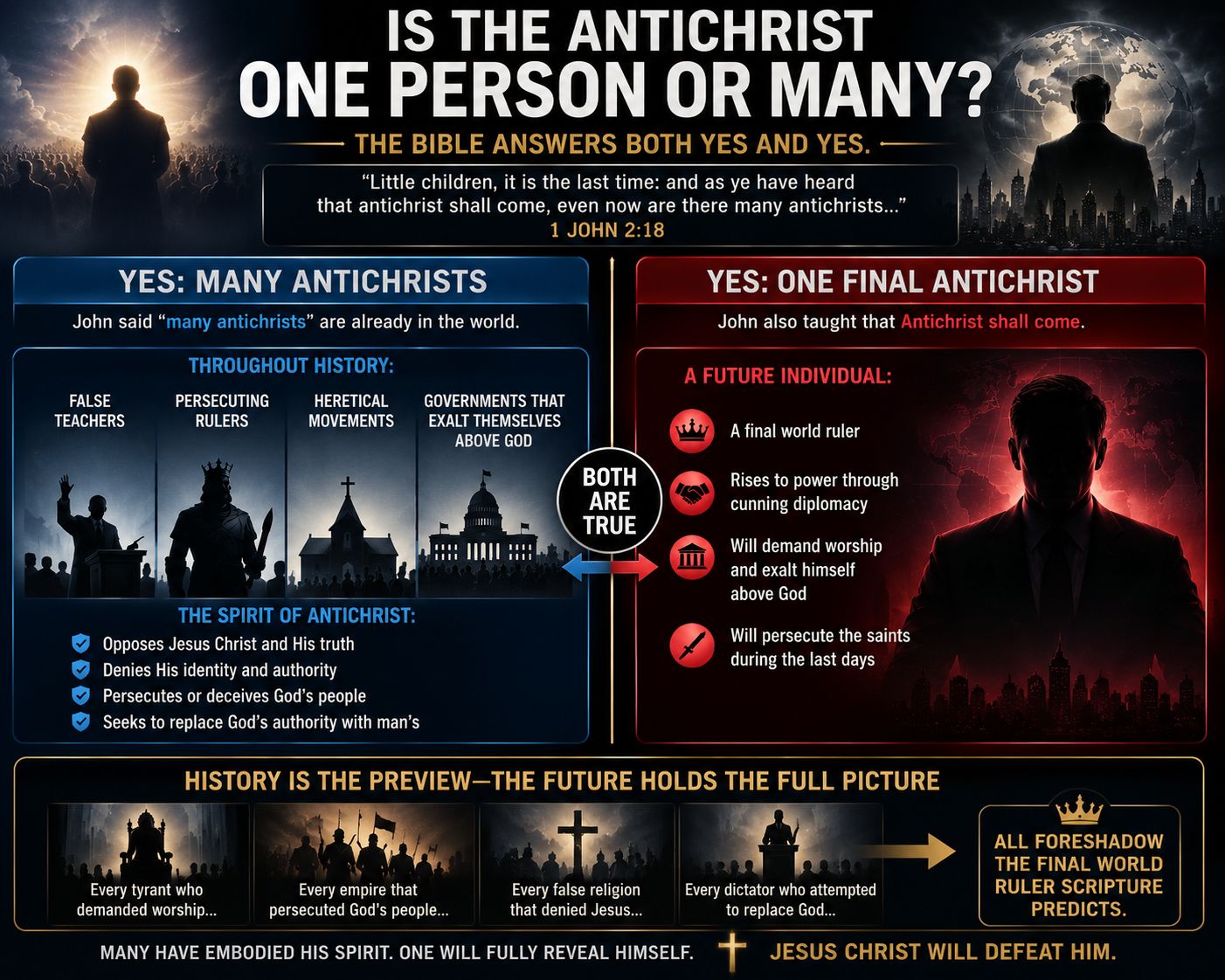
Is the Antichrist One Person or Many?
The Bible answers both yes and yes.
John writes:
“Little children, it is the last time: and as ye have heard that antichrist shall come, even now are there many antichrists…” (1 John 2:18)
Notice John’s careful wording.
He acknowledges that believers had already been taught that Antichrist shall come.
That is singular.
Yet he immediately says many antichrists were already present.
Those are plural.
This distinction is foundational.
Throughout history there have been countless individuals who embodied the spirit of opposition to Christ.
False teachers. Persecuting rulers. Heretical religious movements.
Governments that exalt themselves above God.
All display characteristics of the spirit of antichrist.
Yet John still points forward to a future individual whom the early Church expected to appear.
The existence of many antichrists throughout history does not eliminate the expectation of one final Antichrist.
Instead, history serves as a preview.
Every tyrant who demanded worship…
Every empire that persecuted God’s people…
Every false religion that denied Jesus…
Every dictator who attempted to replace God…
All foreshadow the final world ruler Scripture predicts.
The Spirit of Antichrist
John develops this idea even further.
He writes:
“Who is a liar but he that denieth that Jesus is the Christ? He is antichrist…” (1 John 2:22)
Later he explains:
“Every spirit that confesseth not that Jesus Christ [i.e., Almighty God in flesh / 1 Timothy 3:16, Rev. 1:8] is come in the flesh is not of God: and this is that spirit of antichrist…” (1 John 4:3)
Then again:
“For many deceivers are entered into the world…” (2 John 7)
These passages teach that the spirit of antichrist is fundamentally theological before it is political.
It rejects the true identity of Jesus Christ.
It opposes His authority.
It substitutes another gospel.
It attempts to replace God’s truth with human philosophy.
This spirit has been active since the days of the apostles.
It can influence governments.
Religious systems.
Educational institutions.
Cultures.
Even individuals.
Wherever Christ is rejected and man’s authority is elevated above God’s, the spirit of antichrist is at work.
Yet these verses never suggest the spirit of antichrist replaces the future appearance of the Antichrist.
Rather, the spirit prepares the world to receive him.
Why So Many Different Names?
One reason Bible prophecy can seem overwhelming is that Scripture rarely introduces prophetic figures with only one title.
Consider Jesus Himself.
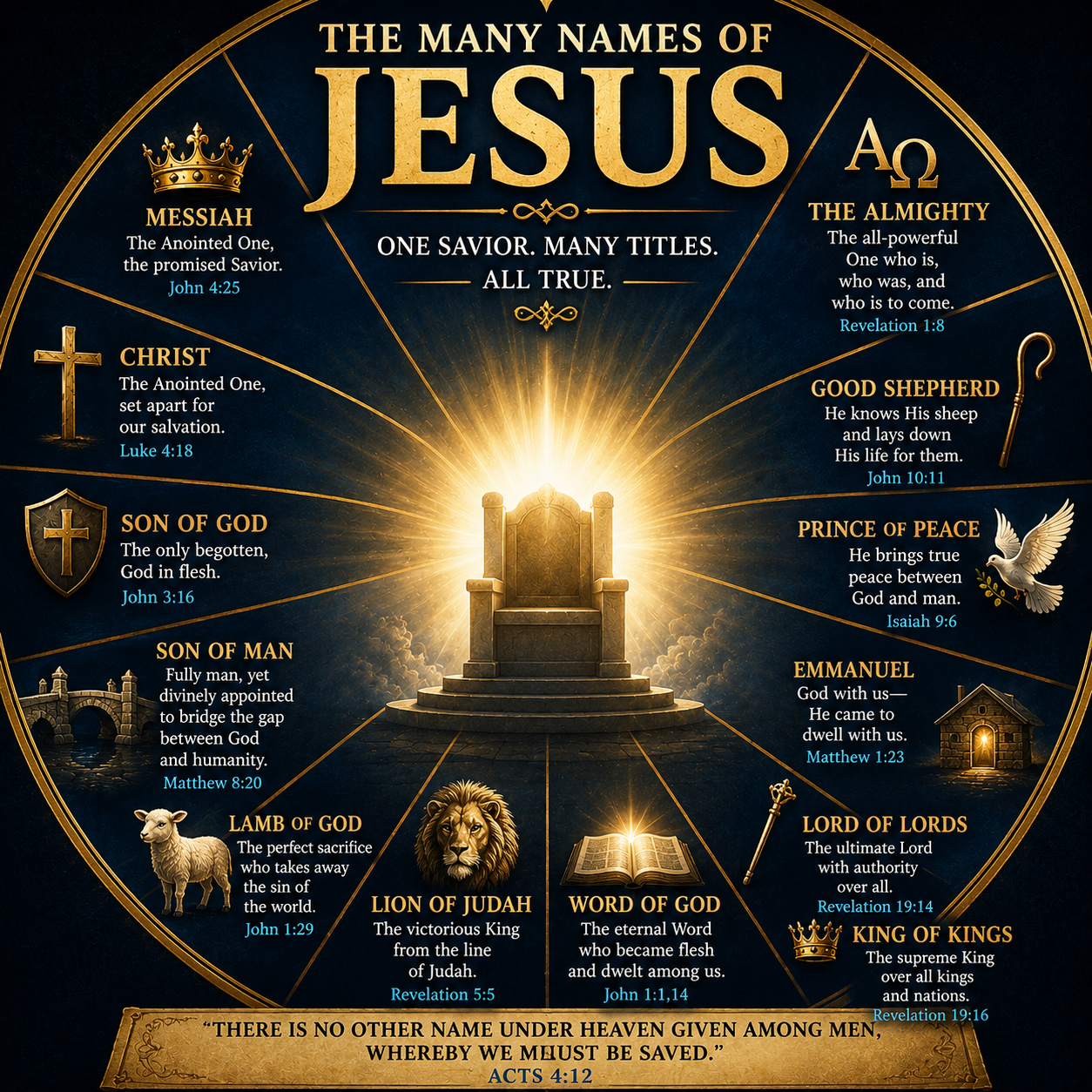
According to Scripture – Jesus is called:
- Messiah. Click Here ==> to Learn More about Jesus the Messiah
- Christ
- Son of God
- Son of Man
- Lamb of God
- Lion of Judah
- Word of God
- King of Kings
- Lord of Lords
- Emmanuel
- Prince of Peace
- Good Shepherd
- The Almighty
Each title reveals another aspect of His identity.
The same principle applies to the Antichrist.
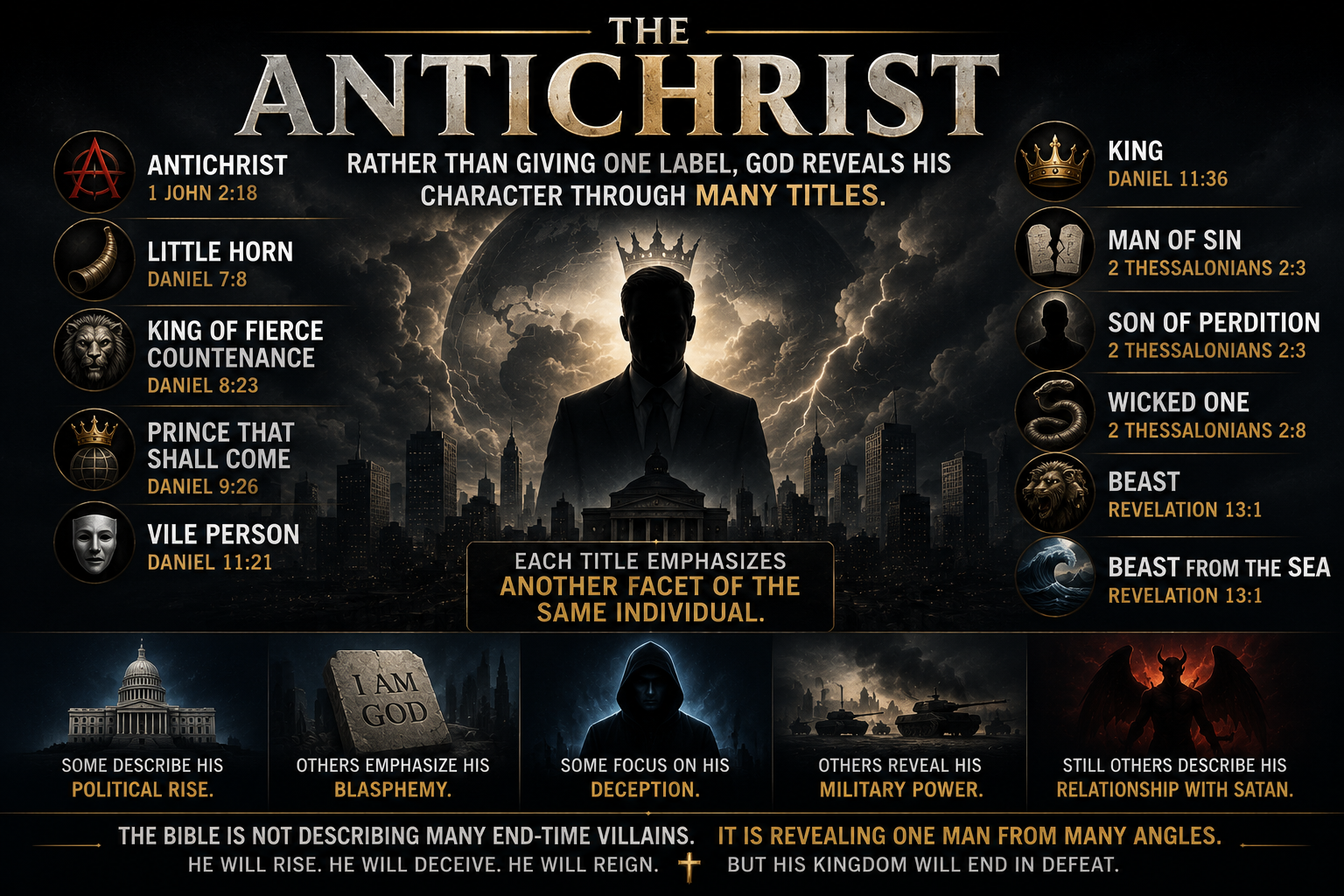
Rather than giving one label, God reveals his character through many titles.
These include:
- Antichrist
- Little Horn
- King of Fierce Countenance
- Prince That Shall Come
- Vile Person
- King
- Man of Sin
- Son of Perdition
- Wicked One
- Beast
- Beast from the Sea
Each title emphasizes another facet of the same individual.
Some describe his political rise.
Others emphasize his blasphemy.
Some focus on his deception.
Others reveal his military power.
Still others describe his relationship with Satan.
As we progress through Scripture, these individual pieces begin fitting together like a prophetic puzzle.
Why Doesn’t Revelation Use the Word “Antichrist”?
Perhaps surprisingly, the Book of Revelation never uses the word Antichrist.
Instead, Revelation repeatedly calls him:
“the beast”
(Revelation 11, 13, 17, and 19)
This has led some readers to wonder whether the Beast and the Antichrist are actually different individuals.
The biblical evidence strongly indicates they are the same person.
Consider the parallels.
John’s Antichrist opposes Christ.
Paul’s Man of Sin exalts himself above God.
Daniel’s Little Horn persecutes the saints.
Revelation’s Beast blasphemes God and makes war against believers.
Each:
- opposes God
- persecutes God’s people
- deceives the nations
- exercises extraordinary political authority
- is empowered by Satan
- is destroyed by Jesus Christ at His coming
Rather than describing different villains, these passages reveal different perspectives of the same end-time leader.
Titles of the Antichrist: A Deeper Look
Rather than assigning the Antichrist a single title, Scripture progressively reveals him through numerous names spread across both the Old and New Testaments. Some emphasize his political rise, others his religious deception, his military power, his blasphemy, or his relationship with Satan. Like assembling the pieces of a puzzle, these various titles combine to form one complete prophetic portrait.
Before examining the major prophetic passages in Daniel, Jesus’ Olivet Discourse, Paul’s writings, and Revelation, it is helpful to become familiar with each of these biblical titles, so let’s take a deeper look into them.
Antichrist
Primary Passage: 1 John 2:18, 22; 1 John 4:3; 2 John 7
The title Antichrist appears only five times in Scripture, all within John’s epistles.
John introduces both a coming individual and a present spiritual influence.
“Little children, it is the last time: and as ye have heard that antichrist shall come, even now are there many antichrists…” (1 John 2:18)
This verse is foundational because it distinguishes between the spirit of antichrist, which has opposed Christ throughout history, and the Antichrist, a future individual who will arise during the last days.
The Greek word antichristos means both against Christ and in place of Christ.
The coming Antichrist will do both. He will oppose Jesus Christ while simultaneously presenting himself as humanity’s answer to the world’s greatest problems.
The Little Horn
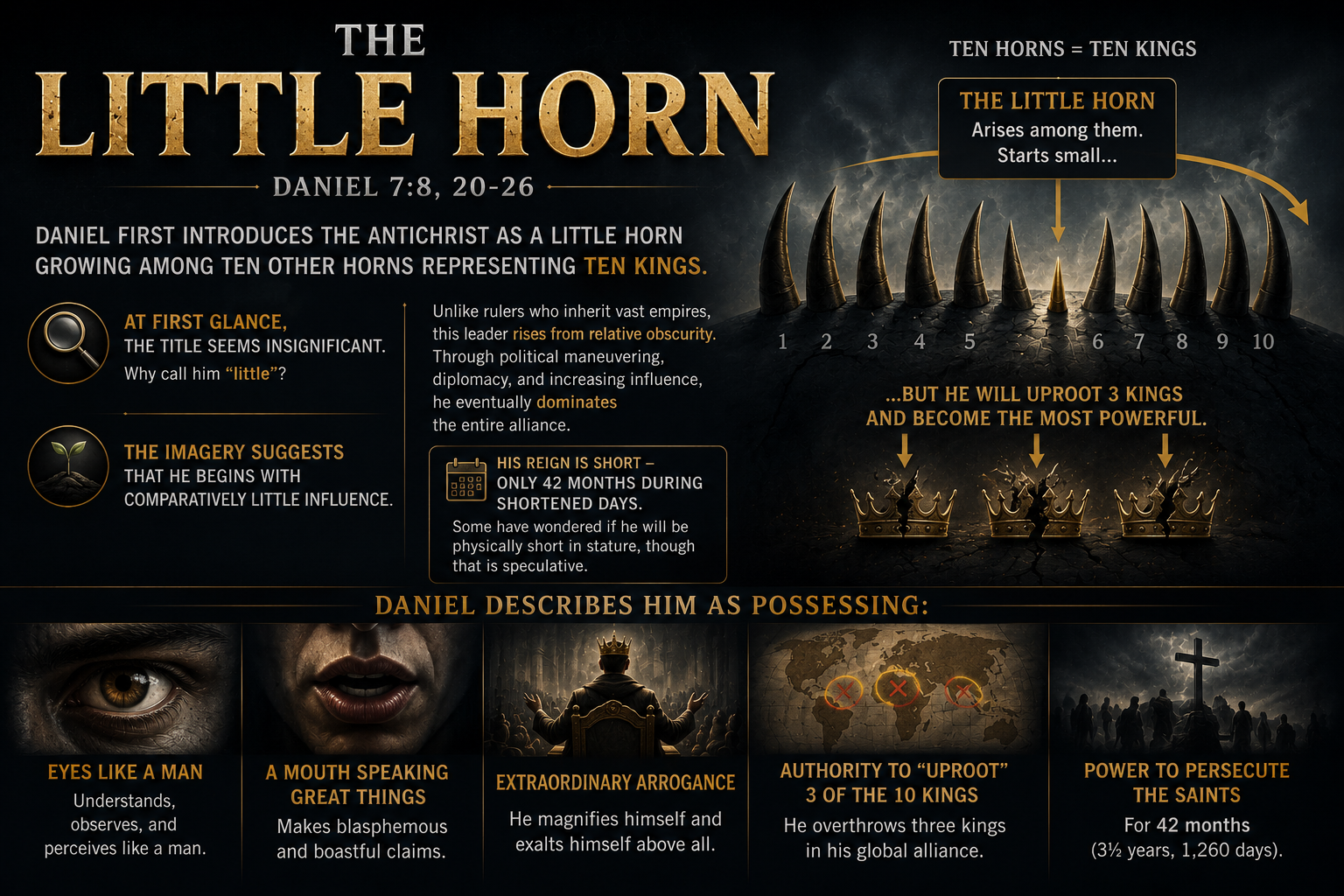
Primary Passage: Daniel 7:8, 20-26
Daniel first introduces the Antichrist as a little horn growing among ten other horns representing ten kings.
Click Here ==> To Learn More about The 10 Kings Prophecy
At first glance, the title seems insignificant.
Why call him “little”?
The imagery suggests that he begins with comparatively little influence. Unlike rulers who inherit vast empires, this leader rises from relative obscurity. Through political maneuvering, diplomacy, and increasing influence, he eventually dominates the entire alliance. Additionally, his reign is short (only 42 months) during shortened days. Some have wondered if he will be physically short in stature, though that is speculative.
Daniel describes him as possessing:
- eyes like a man
- a mouth speaking great things
- extraordinary arrogance
- authority to “uproot” 3 of the 10 kings in his global alliance
- power to persecute the saints for 42 months (i.e., 3 1/2 years, 1,260 days)
The Little Horn reminds us that some of history’s most influential leaders began where few expected them.
The King of Fierce Countenance
Primary Passage: Daniel 8:23-25
Later, Daniel describes another end-time ruler.
“A king of fierce countenance…”
The phrase does not merely describe physical appearance, although it will certainly play a part.
It portrays someone possessing remarkable confidence, intelligence, and determination.
Daniel says he understands “dark sentences,” suggesting unusual political insight and strategic ability.
Unlike many dictators who rise primarily through military conquest, this ruler combines intellectual brilliance with extraordinary deception.
He becomes powerful because people underestimate him.
The Prince That Shall Come
Primary Passage: Daniel 9:26-27
Following Daniel’s prophecy of the Seventy Weeks, another title appears.
“…the prince that shall come…”
This title emphasizes political leadership.
Daniel 9:26 notes that
“…the people of the prince [Antichrist] that shall come shall destroy the city [Jerusalem] and the sanctuary…”
Titus and the Romans fulfilled this prophecy in A.D. 70, pointing to the European bloodline (i.e., the people of the futuristic prince to come / the Antichrist ruling a revived Holy Roman Empire) as the people over which the Antichrist shall rule.
A prince is someone possessing governmental authority, and may suggest the Antichrist will not only have a presidential title but also the title of a “prince.”
Daniel immediately connects this prince to the famous prophecy that “he shall confirm the covenant with many for one week (i.e., 7 years / cf Daniel 9:27; Genesis 29:15-30 / see Genesis 29:27 particularly).”
This future political leader either helps to broker, or at the least is one of the signers, confirming a seven-year agreement involving Israel and many nations.
Although he confirms the covenant, the Antichrist is not openly revealed until 3 1/2 years later, at an event Jesus called “the abomination of desolation” (Matthew 24:15-21).
The 7-year agreement (according to Daniel 9:24-27) marks the beginning of the final seven years before the return of Jesus Christ at the battle of Armageddon.
Click Here ==> to Learn More about Armageddon
The Vile Person
Primary Passage: Daniel 11:21
Daniel later calls him:
“a vile person…”
This description reveals something fascinating.
The Antichrist will almost certainly appear respectable, even with his fierce countenance (Daniel 8:23) and chiefly stature (Daniel 7:20).
History demonstrates that charismatic leaders often conceal corrupt motives behind polished public images.
Daniel reminds us that God evaluates character differently than humanity.
While the world may celebrate him as a peacemaker, negotiator, or visionary statesman, God sees what lies beneath the surface.
His heart is morally corrupt.
The Self-Exalting King
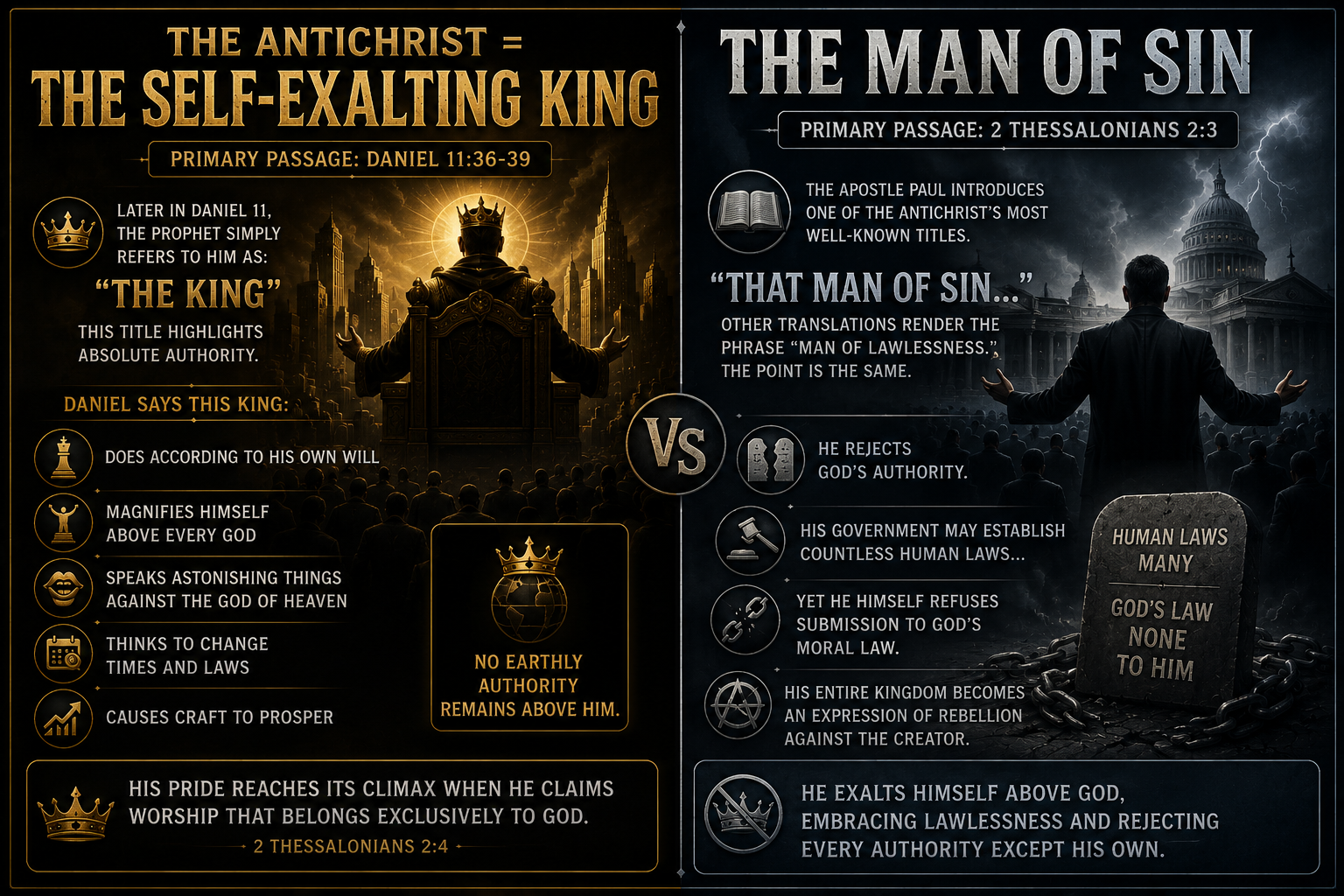
Primary Passage: Daniel 11:36-39
Later in Daniel 11, the prophet simply refers to him as:
“the king”
This title highlights absolute authority.
Daniel says this king:
- does according to his own will
- magnifies himself above every god
- speaks astonishing things against the God of heaven
- thinks to change times and laws
- causes craft to prosper
No earthly authority remains above him.
His pride reaches its climax when he claims worship that belongs exclusively to God (2 Thessalonians 2:4).
The Man of Sin
Primary Passage: 2 Thessalonians 2:3
The Apostle Paul introduces one of the Antichrist’s most well-known titles.
“That man of sin…”
Other translations render the phrase “man of lawlessness.”
The point is the same.
He rejects God’s authority.
His government may establish countless human laws, yet he himself refuses submission to God’s moral law.
His entire kingdom becomes an expression of rebellion against the Creator.
The Son of Perdition
Primary Passage: 2 Thessalonians 2:3
Only two individuals in Scripture receive this title.
Judas Iscariot and the Antichrist.
The phrase literally refers to one destined for destruction.
Both men share remarkable similarities.
Each betrays.
Each opposes God’s redemptive plan.
Each ultimately experiences divine judgment.
Paul’s use of this title emphasizes the certainty of the Antichrist’s final destruction.
His doom is already determined.
The Wicked One
Primary Passage: 2 Thessalonians 2:8
Paul later calls him:
“that Wicked”
The title emphasizes moral corruption.
Everything about his kingdom stands in opposition to God’s righteousness.
Yet Paul immediately provides hope.
“…whom the Lord shall consume with the spirit of his mouth, and shall destroy with the brightness of his coming.”
The Wicked One’s reign ends instantly when Jesus Christ returns.
The Beast
Primary Passage: Revelation 11, 13, 17, and 19
Revelation never calls him the Antichrist.
Instead, John consistently refers to him as the Beast.
The imagery is intentional.
Throughout Scripture, beasts symbolize kingdoms and governments operating independently of God’s authority.
This title reminds us that the Antichrist represents more than an individual.
He leads the final human governmental system organized in rebellion against God’s Kingdom.
His political authority becomes unlike anything the world has previously witnessed.
The Beast from the Sea
Primary Passage: Revelation 13:1
John writes:
“I stood upon the sand of the sea, and saw a beast rise up out of the sea…”
Throughout prophetic literature, the sea often symbolizes the restless nations of humanity (Isaiah 17:12-13; Revelation 17:15).
The Beast emerging from the sea portrays a political leader arising from among the nations rather than descending from heaven.
He is fully human.
He is not God, as he suggests; rather, he is an imposter.
Yet he receives supernatural authority from Satan.
He is a man empowered by Satan for a specific prophetic purpose.
One Man, Many Titles
When these names are studied together, a remarkable picture emerges.
The Bible is not describing multiple end-time villains.
It is describing one future world leader from many different perspectives.
Daniel emphasizes his political rise.
Paul highlights his rebellion against God.
John exposes his deception.
Revelation reveals his global influence.
Taken together, these titles form one of the most detailed prophetic portraits in all of Scripture.
With all these names in mind, we are now prepared to examine the prophetic foundation upon which the New Testament builds. As Jesus Himself instructed, we begin with the book of Daniel, where God first unveils the rise, reign, and ultimate downfall of the coming Antichrist.
Daniel: The Prophetic Backbone of the Antichrist story
- Daniel 7 and the Little Horn
- Daniel 8 and the King of Fierce Countenance
- Daniel 9 and the Prince That Shall Come
- Daniel 11 and the Vile Person
- Daniel 12 and the final countdown to the Second Coming
These chapters provide the most detailed Old Testament portrait of the coming Antichrist and form the foundation for everything Jesus, Paul, and John later revealed.
Why Daniel Is the Foundation for Understanding the Antichrist
Many Christians begin studying the Antichrist in Revelation.
Jesus began somewhere else.
In Matthew 24, when discussing the last days, Jesus did not point first to Revelation, because Revelation had not yet been written.
Instead, He directed His disciples back to the prophet Daniel.
“When ye therefore shall see the abomination of desolation, spoken of by Daniel the prophet…” (Matthew 24:15)
That statement is enormously significant.
Jesus tells us that Daniel contains the foundational framework for understanding end-time prophecy.
Without Daniel:
- Revelation becomes difficult to interpret.
- The Abomination of Desolation remains mysterious.
- The Antichrist’s rise lacks historical context.
- The timing of the Great Tribulation becomes confusing.
Daniel supplies the blueprint.
Revelation fills in additional details.
The two books work together, not independently.
That is why our study will next turn to the Book of Daniel, where God first introduces the world ruler who will dominate the final years before the return of Jesus Christ.
Daniel’s Complete Portrait of the Antichrist
Earlier, we learned that the Bible describes the Antichrist using many different names and titles.
We also saw that the Apostle John distinguished between the spirit of antichrist, which has been active throughout history, and the Antichrist, a future individual who will emerge during the final years before the return of Jesus Christ.
Now we turn to the Old Testament book that forms the foundation for virtually every New Testament prophecy about the Antichrist.
Jesus pointed His disciples to Daniel when explaining the end times (Matthew 24:15). The Apostle Paul echoed Daniel’s language in describing the “man of sin” (2 Thessalonians 2:3-4). John’s visions in Revelation build upon Daniel’s imagery of beasts, horns, kingdoms, and blasphemous rulers.
If we want to understand the Antichrist correctly, we must first understand Daniel.
Why Daniel Is the Foundation of End-Time Prophecy
Daniel was taken captive to Babylon around 605 B.C. During Israel’s exile, God revealed to him sweeping visions that span from the Babylonian Empire all the way to the establishment of Christ’s Kingdom.
These prophecies are remarkable because they correctly predicted the rise and fall of empires centuries before they occurred. They also extend beyond history into events that have not yet been fulfilled.
Many Bible scholars recognize that portions of Daniel have both a historical fulfillment and a future prophetic fulfillment. Certain rulers, such as Antiochus IV Epiphanes, foreshadow the final Antichrist. However, several details reach beyond any historical figure and point to the last days.
This pattern is common throughout biblical prophecy. A near fulfillment often serves as a preview of a greater fulfillment still to come.
Daniel 7: The Little Horn
Four Beasts Represent Four Powerful End-Time Nations
Daniel’s first major prophecy concerning the Antichrist appears in Daniel 7.
The prophet sees four great beasts rising from the sea.
Daniel 7 teaches that these beasts represent both a kingdom (or nation), along with the ruler of those nations.
It also notes that these nations will all exist at the time of the Second Coming of Jesus Christ.
Click Here ==> to Learn More about these Modern Nations in Bible Prophecy (including America)
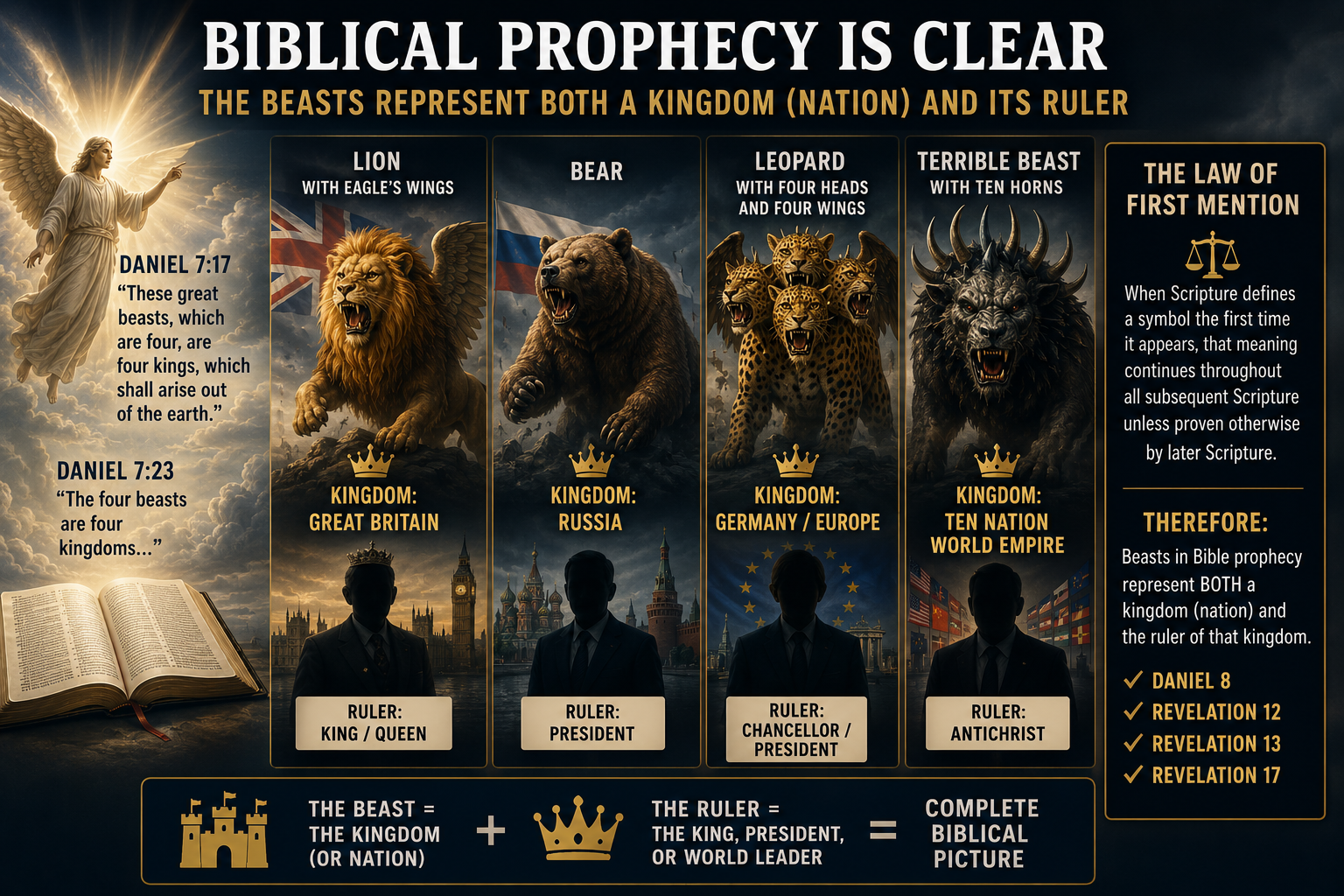
The fourth kingdom (i.e., The 10-Horned Beast) receives the greatest attention because it eventually develops into the final world governing system from which the Antichrist emerges (cf. Daniel 7; Revelation 13).
The Ten Horns
Daniel writes:
“And it had ten horns.” (Daniel 7:7)
Later the angel explains:
“And the ten horns out of this kingdom are ten kings that shall arise…” (Daniel 7:24)
This detail becomes extremely important because Revelation 17 also speaks of ten kings who give their authority to the Beast.
Rather than isolated prophecies, Daniel and Revelation describe the same end-time political structure from different perspectives.
According to this understanding, the Antichrist does not seize power in isolation. He rises within an international political alliance represented by ten rulers.
The Little Horn Appears
Daniel continues:
“I considered the horns, and, behold, there came up among them another little horn…” (Daniel 7:8)
This “little horn” begins with comparatively little influence.
Yet before long he uproots three of the original ten kings.
The prophecy suggests remarkable political skill.
Rather than inheriting power outright, he ascends through diplomacy, conflict, and strategic leadership until he dominates the coalition.
Characteristics of the Little Horn
Daniel provides several identifying characteristics.
He Speaks Great Things
Daniel says the little horn possessed:
“…a mouth speaking great things.” (Daniel 7:8)
Later he adds:
“He shall speak great words against the most High.” (Daniel 7:25)
The Antichrist will be an extraordinary communicator.
He will persuade nations.
He will captivate political leaders.
Yet his rhetoric ultimately becomes blasphemous as he elevates himself above God’s authority.
He Makes War Against the Saints
One of the clearest statements appears in Daniel 7:21.
“The same horn made war with the saints, and prevailed against them.”
This verse challenges one of the most common assumptions in modern prophecy teaching.
Many Christians believe the Church will be removed before the Antichrist persecutes believers.
However, Daniel plainly states that the saints are present.
There is no biblical evidence for 2 different sets of saints (i.e., pretribulation saints, and tribulation saints).
Technically, you’re either a “saint” or an “ain’t.”
Jesus later echoes this same sequence (found in Dan. 7:24) in Matthew 24.
Paul does likewise in 2 Thessalonians 2.
Revelation chapters 12 and 13 confirms it again.
The Bible consistently teaches that believers will face persecution during the reign of the Antichrist before Christ returns.
This is one reason the post-tribulation understanding follows the natural flow of these passages.
Tribulation and persecution is simply part of the Christian experience.
To Study this Logic Further…
Consider the following verses: Matt. 5:10-12, John 15:20, Acts 14:22, Rom. 5:3-5, 2 Cor. 4:8-10, Phil. 1:29, 1 Thes. 3:3, 2 Tim. 3:12, Rev. 1:9, Rev. 2:10, just to name a few).
The Antichrist – Attempts to Change Times and Laws
Daniel continues:
“And think to change times and laws…” (Daniel 7:25)
This statement likely refers to the Antichrist’s attempt to reshape society according to his own authority.
Throughout history, tyrants have sought to redefine morality, law, worship, and human identity.
The final Antichrist appears to carry this impulse to its ultimate conclusion by asserting authority that belongs to God alone.
His Reign Lasts Three and One-Half Years
Daniel gives a remarkably specific time period.
“…they shall be given into his hand until a time and times and the dividing of time.” (Daniel 7:25)
Most biblical scholars understand this expression to mean:
- one year
- two years
- half a year
Together these equal three and one-half years, or 42 months, or 1,260 days.
Remarkably, Revelation uses all three measurements interchangeably.
This consistency demonstrates that Daniel and Revelation describe the same prophetic time period known as the Great Tribulation (the latter half of the final 7 years, commencing with the Confirmation of the Covenant).
Daniel 8: The King of Fierce Countenance
Daniel receives another vision involving a ram and a goat representing Medo-Persia and Greece.
Within that prophecy another “little horn” appears.
Historically, Antiochus IV Epiphanes fulfilled many aspects of this prophecy during the second century B.C.
He desecrated the Temple.
He persecuted the Jewish people.
He attempted to eradicate biblical worship.
Yet the prophecy also extends beyond Antiochus.
The angel specifically says:
“…at the time of the end shall be the vision.” (Daniel 8:17)
Later he adds:
“…for at the time appointed the end shall be.” (Daniel 8:19)
These statements point beyond ancient history.
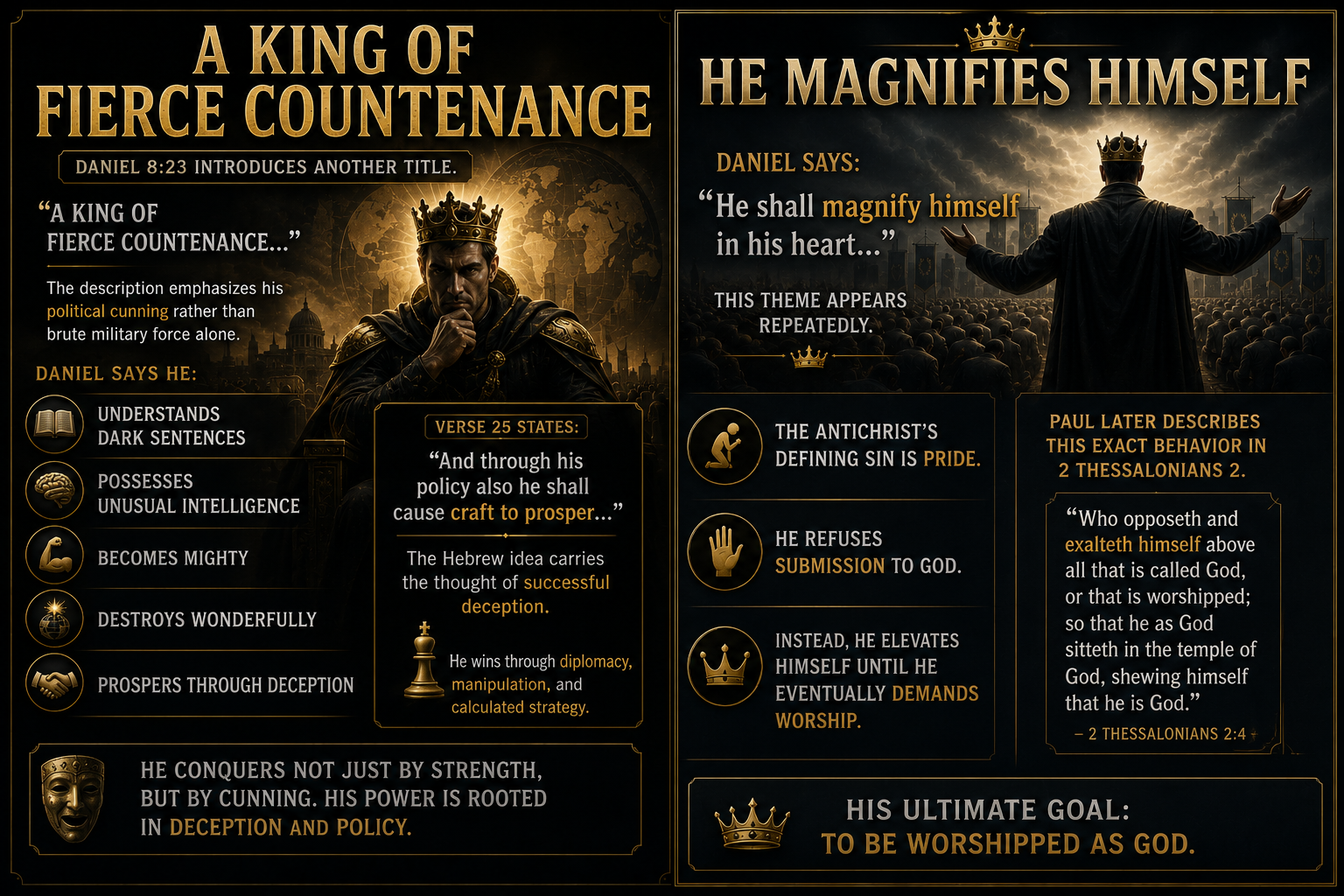
A King of Fierce Countenance
Daniel 8:23 introduces another title.
“A king of fierce countenance…”
The description emphasizes his political cunning rather than brute military force alone.
Daniel says he:
- understands dark sentences
- possesses unusual intelligence
- becomes mighty
- destroys wonderfully
- prospers through deception
Verse 25 states:
“And through his policy also he shall cause craft to prosper…”
The Hebrew idea carries the thought of successful deception.
He wins through diplomacy, manipulation, and calculated strategy.
He Magnifies Himself
Daniel says:
“He shall magnify himself in his heart…”
This theme appears repeatedly.
The Antichrist’s defining sin is pride.
He refuses submission to God.
Instead, he elevates himself until he eventually demands worship.
Paul later describes this exact behavior in 2 Thessalonians 2.
Daniel 9: The Prince That Shall Come
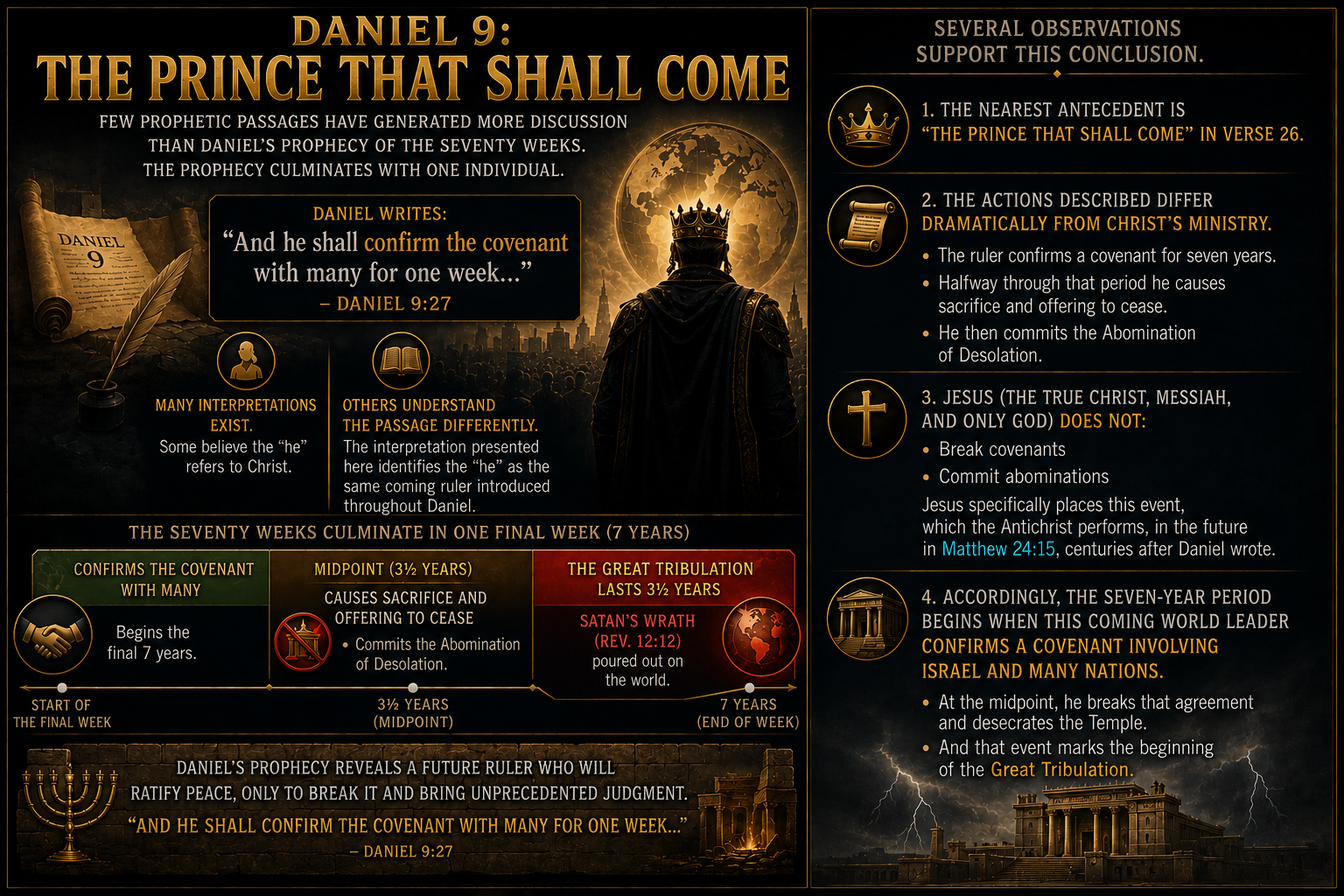
Few prophetic passages have generated more discussion than Daniel’s prophecy of the Seventy Weeks.
The prophecy culminates with one individual.
Daniel writes:
“And he shall confirm the covenant with many for one week…” (Daniel 9:27)
Many interpretations exist.
Some believe the “he” refers to Christ.
Others understand the passage differently.
The interpretation presented here identifies the “he” as the same coming ruler introduced throughout Daniel.
Several observations support this conclusion.
First, the nearest antecedent is “the prince that shall come” in verse 26.
Second, the actions described differ dramatically from Christ’s ministry.
The ruler confirms a covenant for seven years.
Halfway through that period he causes sacrifice and offering to cease.
He then commits the Abomination of Desolation.
Jesus (the true Christ, Messiah, and ONLY God) does not break covenants, and does not commit abominations.
Jesus specifically places this event, which the Antichrist performs, in the future in Matthew 24:15, centuries after Daniel wrote.
Accordingly, the seven-year period begins when this coming world leader confirms a covenant involving Israel and many nations.
At the midpoint, he breaks that agreement and desecrates the Temple.
And that event, marks the beginning of the Great Tribulation.
Daniel 11: The Most Detailed Portrait of the Antichrist
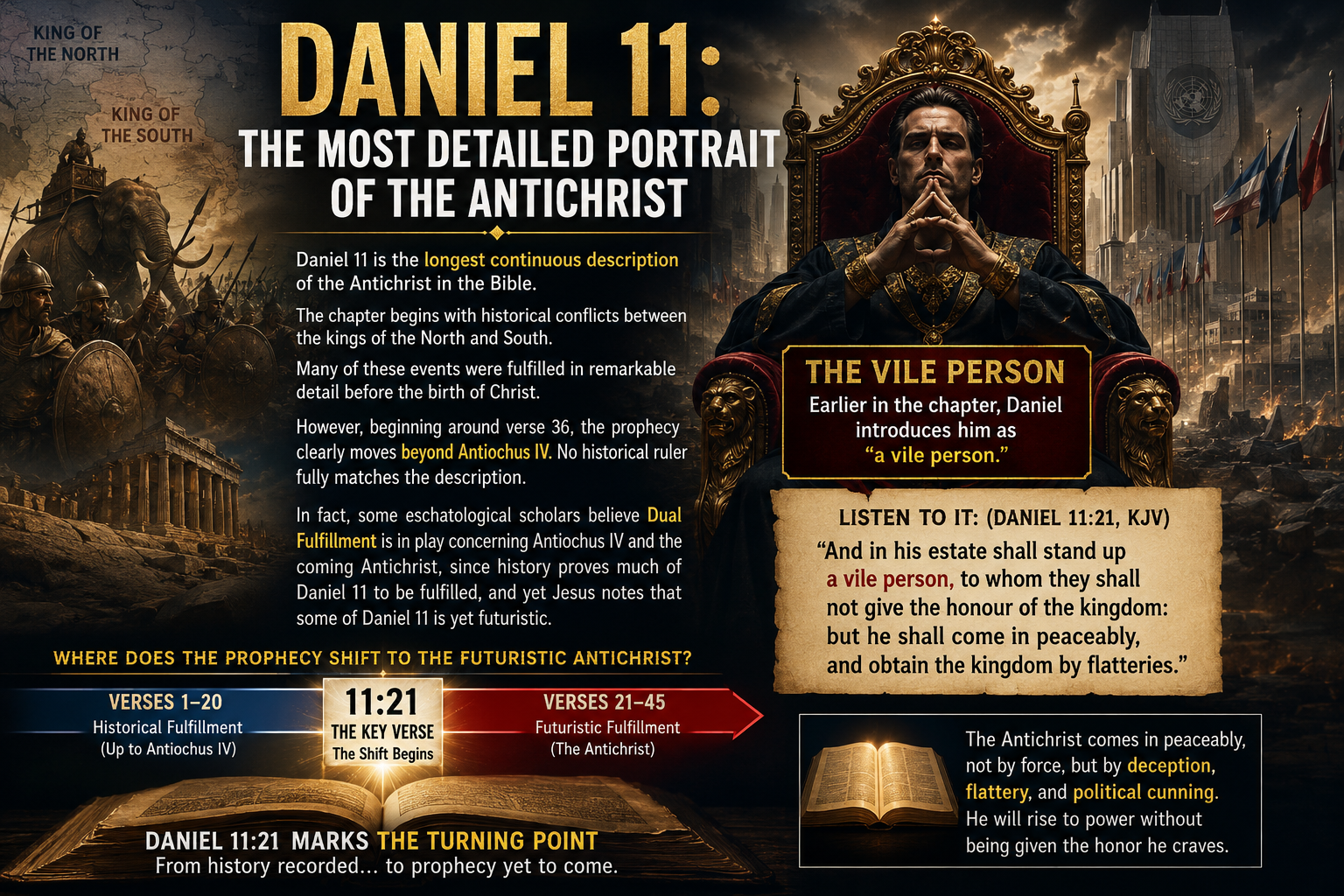
Daniel 11 is the longest continuous description of the Antichrist in the Bible.
The chapter begins with historical conflicts between the kings of the North and South.
Many of these events were fulfilled in remarkable detail before the birth of Christ.
However, beginning around verse 36, the prophecy clearly moves beyond Antiochus IV. No historical ruler fully matches the description.
In fact, some eschatological scholars believe Dual Fulfillment is in play concerning Antiochus IV and the coming Antichrist, since history proves much of Daniel 11 to be fulfilled, and yet Jesus notes that some of Daniel 11 is yet futuristic.
Where then, is that key verse that launches the dual fulfillment, switching gears toward the futuristic Antichrist? That verse appears to be Daniel 11:21.
The Vile Person
Earlier in the chapter, Daniel introduces him as “a vile person.”
Listen to it: (Daniel 11:21, KJV)
“And in his estate shall stand up a vile person, to whom they shall not give the honour of the kingdom: but he shall come in peaceably, and obtain the kingdom by flatteries.”
The term emphasizes character rather than appearance.
The Antichrist will not initially appear monstrous.
He will likely present himself as intelligent, diplomatic, and capable.
Yet beneath the public image lies profound moral corruption.
He Obtains the Kingdom Peaceably
Daniel says:
“…he shall come in peaceably, and obtain the kingdom by flatteries.”
This is significant.
The Antichrist does not first conquer the world through overwhelming military force.
He rises through political negotiation, diplomacy, alliances, and persuasive leadership.
The Abomination of Desolation
Daniel writes:
“…they shall place the abomination that maketh desolate.” (Daniel 11:31)
Jesus later identifies this event as the unmistakable signal that the Great Tribulation has begun.
This becomes one of the central prophetic markers in Scripture.
He Exalts Himself Above Every God
Daniel reaches the climax.
“And the king shall do according to his will; and he shall exalt himself, and magnify himself above every god…” (Daniel 11:36)
This language is nearly identical to Paul’s description of the Man of Sin (2 Thes. 2:1-4).
The Bible consistently portrays the Antichrist as a political ruler who ultimately claims divine authority.
His rebellion is not merely against Israel or Christianity. It is against God Himself.
All verses beyond Daniel 11:21 – point back toward verse 21 as the key verse and introduction of the “vile man” (i.e., the Antichrist to come), whom the LORD shall destroy at His Second Coming.
Daniel 12: Looking Beyond the Tribulation
Daniel’s final chapter completes the prophetic picture.
Michael stands for Israel, at a time of unparalleled trouble (called the Great Tribulation).
The dead are resurrected (immediately after the Great Tribulation / Matt. 24:15, 21, 29-31).
The righteous inherit everlasting life (at the event called “The Rapture”).
Chapter 12 reminds us that the Antichrist’s reign is temporary.
His authority lasts only as long as God permits, which is 3 and 1/2 years (i.e., 42 months / 1,260 days).
His kingdom ends.
Christ’s Kingdom does not.
Looking Ahead – The New Testament
Now let’s see how Jesus, Paul, and John expand upon Daniel’s prophecies by examining:
- Matthew 24
- Mark 13
- Luke 21
- 2 Thessalonians 2
- Revelation’s Beast, False Prophet, Mark of the Beast, and final destruction
These New Testament passages complete the Bible’s portrait of the Antichrist and reveal how his rise fits into God’s prophetic timeline.
Jesus, Paul, and John Complete the Picture of the Antichrist
Earlier, we explored Daniel’s remarkable prophecies concerning the Antichrist. We met the Little Horn, the King of Fierce Countenance, the prince that Shall Come, and the Vile Person. Together, those passages established the Old Testament foundation for understanding the final world ruler who will oppose God, persecute His people, and deceive the nations.
Now we turn to the New Testament.
One of the most fascinating aspects of biblical prophecy is how consistently the New Testament builds upon Daniel rather than replacing him. Jesus quotes Daniel. Paul echoes Daniel. John expands Daniel. None of them introduce an entirely new prophetic system. Instead, each adds another layer of detail until a complete portrait of the Antichrist emerges.
How is that? Simple. God is the author of the entire Bible; He merely changed secretaries (i.e., Daniel, Paul, John, etc.).
Jesus Identifies the Antichrist’s Defining Moment
Matthew 24: The Olivet Discourse
Just days before His crucifixion, Jesus sat on the Mount of Olives overlooking Jerusalem. His disciples asked Him three questions:
“Tell us, when shall these things be? and what shall be the sign of thy coming, and of the end of the world (or the end of this “age” / the church age / the dispensation of grace / the era of human government existing today before God’s coming kingdom)?” (Matthew 24:3)
Jesus’ answer forms the backbone of New Testament prophecy.
He described deception, wars, famines, pestilences, earthquakes, persecution, false prophets, worldwide evangelism, and finally one event that serves as the unmistakable turning point.
“When ye therefore shall see the abomination of desolation, spoken of by Daniel the prophet…” (Matthew 24:15)
He directed them to Daniel’s prophecy.
The Abomination of Desolation (which begins half way through the final 7 years) becomes the prophetic signpost announcing that the final three and one-half years (called the Great Tribulation) have begun.
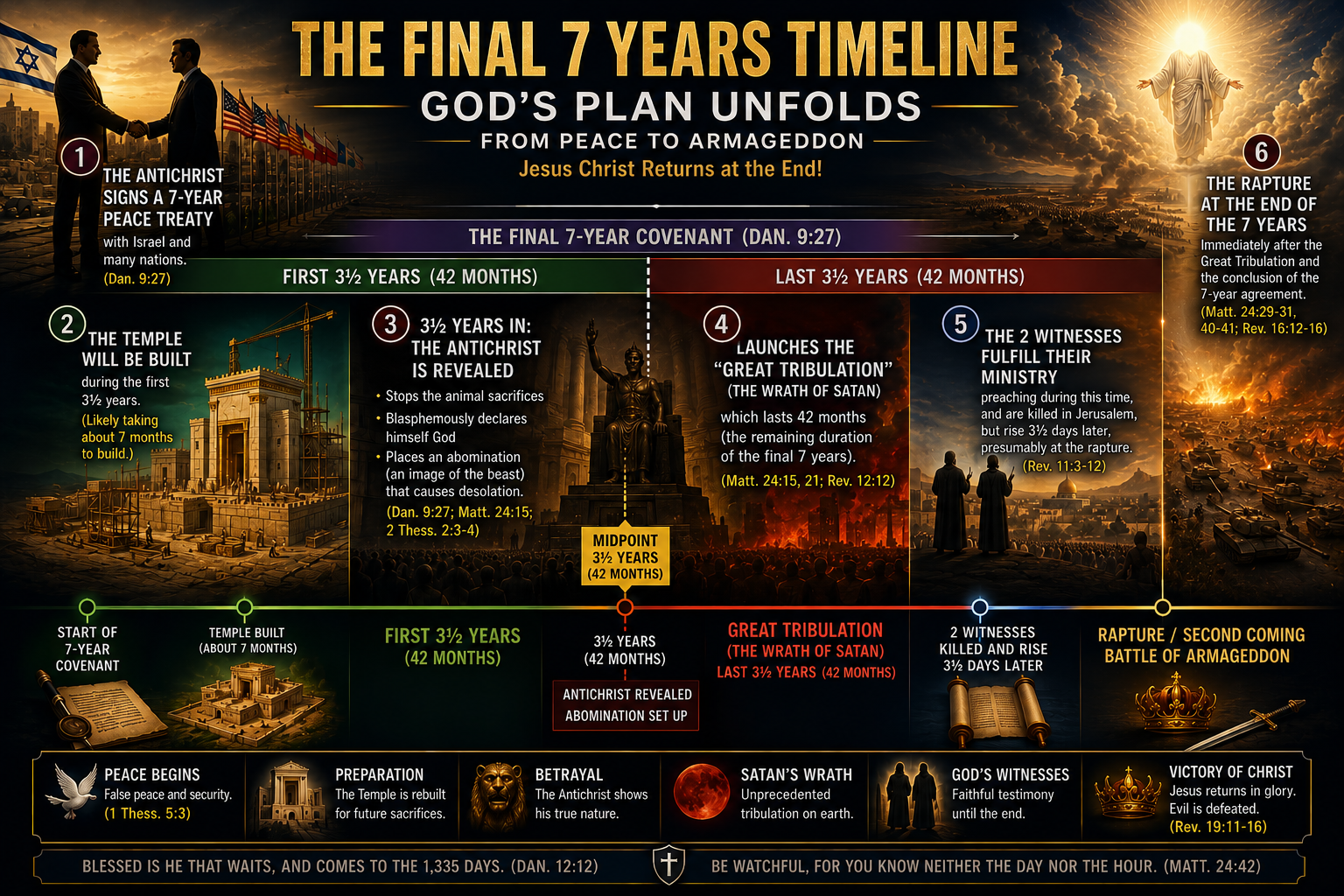
To make the Timeline Clear:
- The Antichrist signs a 7-year Peace Treaty with Israel and many nations (launching the final 7 years till the return of Jesus Christ at the battle of Armageddon).
- The Temple will be then built during the first 3 and 1/2 years (likely taking about 7 months to build).
- 3 and 1/2 years into the 7-year covenant, the Antichrist is revealed by stoping the animal sacrifices, blasphemously declaring himself God, and placing an abomination (an image of the beast) that causes desolation.
- That event launches the “Great Tribulation” (Matt. 24:15, 21), known as the Wrath of Satan, which lasts 42 months (the remaining duration of the final 7 years).
- The 2 Witness of Rev. 11 fulfill their ministry preaching during this time, and are killed in Jerusalem, but rise 3 and 1/2 days later, presumably at the rapture.
- The Rapture (or gathering) happens immediately after the Great Tribulation and the conclusion of the final 7 year agreement, just as Jesus said (Matt. 24:29-31, 40-41), during the battle of Armageddon (Rev. 16:12-16).
What Is the Abomination of Desolation?
The phrase appears several times in Daniel (Daniel 9:27; 11:31; 12:11).
According to biblical eschatology, the Abomination of Desolation occurs when the Antichrist enters the rebuilt Temple in Jerusalem, stops the daily sacrifices, and proclaims himself to be God.
Paul describes the same event.
“…he as God sitteth in the temple of God, shewing himself that he is God.” (2 Thessalonians 2:4)
This event marks the midpoint of Daniel’s Seventieth Week.
It also begins the Great Tribulation.
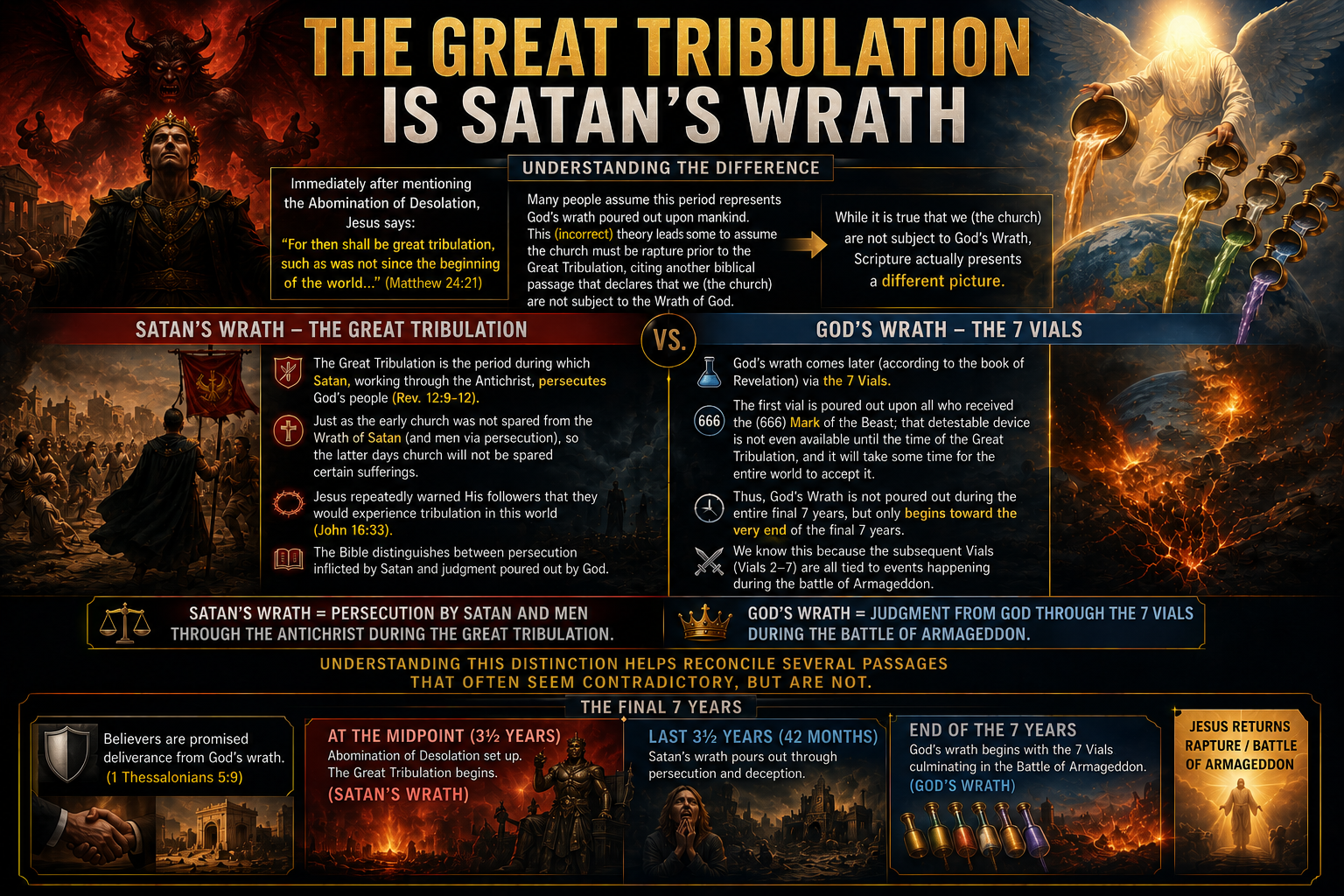
The Great Tribulation Is Satan’s Wrath
Immediately after mentioning the Abomination of Desolation, Jesus says:
“For then shall be great tribulation, such as was not since the beginning of the world…” (Matthew 24:21)
Many people assume this period represents God’s wrath poured out upon mankind. This (incorrect) theory leads some to assume the church must be rapture prior to the Great Tribulation, citing another biblical passage that declares that we (the church) are not subject to the Wrath of God.
While it is true that we (the church) are not subject to God’s Wrath, Scripture actually presents a different picture.
The Great Tribulation is the period during which Satan, working through the Antichrist, persecutes God’s people (Rev. 12:9-12). Just as the early church was not spared from the Wrath of Satan (and men via persecution), so the latter days church will not be spared certain sufferings.
God’s wrath comes later (according to the book of Revelation) via the 7 Vials. The first vial is poured out upon all who received the (666) Mark of the Beast; that detestable device is not even available until the time of the Great Tribulation, and it will take some time for the entire world to accept it.
Thus, God’s Wrath is not poured out during the entire final 7 years, but only begins toward the very end of the final 7 years. We know this because the subsequent Vials (Vials 2 -7) are all tied to events happening during the battle of Armageddon.
Understanding the distinction between Satan’s Wrath (i.e., the Great Tribulation) and God’s Wrath (i.e., The 7 Vials) helps reconcile several passages that often seem as contradictory, but are not.
Believers are promised deliverance from God’s wrath (1 Thessalonians 5:9). And Hell itself, is the ultimate Wrath of God.
However, Jesus repeatedly warned His followers that they would experience tribulation in this world (John 16:33).
The Bible distinguishes between persecution inflicted by Satan and judgment poured out by God.
Jesus Places His Coming After the Tribulation
Perhaps no statement of Jesus (in the Olivet Discourse) is more significant than in Matthew 24:29-31.
Jesus declares:
“Immediately after the tribulation of those days…”
He then describes:
- the sun being darkened
- the moon withholding its light
- the stars falling
- the sign of the Son of Man appearing
- Christ returning in glory (which is His Second Coming, since He’s already come once – ending at Calvary).
- the gathering together of His elect
The sequence is unmistakable.
The gathering (i.e., Rapture) of believers occurs after the Great Tribulation.
This forms one of the strongest biblical foundations for the post-tribulation view.
Jesus never mentions a separate coming before the Tribulation followed by another coming afterward.
Instead, He describes one visible return. The “elect” that are gathered and raptured up to meet Jesus Christ in the air, are not Jews only (as some suppose, citing Matthew 24 as being written only to the Jews). The church is noted as the “election” (or elect) in the New Testament, and the Jews (as a whole) are distinctly noted now (in the New Testament) as not being the elect.
Romans 11:7
“What then? Israel (the Jews) hath not obtained that which he seeketh for [thy missed their Messiah]; but the election [the church] hath obtained it, and the rest [of the Jews] were blinded.”
Notice the distinction in the passage (Rom. 11:7) between the Jews who rejected Christ, and all (Jews, Samaritans, and Gentiles) who did NOT reject Jesus Christ (the true and only Messiah). The “elect” that are a part of the Church of the Living God; thus, they are those who will be saved and make the Rapture.
God indeed, still has a covenant with the Jewish people. We as Christians should bless and pray for them even today, as we know Revelation notes a mighty revival that is coming for the 144,000 Jews of Israel.
However, whether one is a Jew, Samaritan, or Gentile – only those who are Born Again and in right-standing with Jesus Christ (Almighty God, Rev. 1:8) will take part in the event known as “the Rapture” (or gathering together of the “elect”).
For a spiritual Heart Surgery – and a Check-up from the Neck-up (Click Here)
Mark 13 and Luke 21 Confirm the Same Timeline
Mark 13 parallels Matthew 24 almost verse for verse.
Again Jesus emphasizes:
- deception
- persecution
- the Abomination of Desolation
- unprecedented tribulation
- cosmic signs
- His visible return
Luke 21 records the same discourse with additional emphasis upon Jerusalem.
Together these three accounts present remarkable consistency.
Rather than offering competing timelines, they reinforce one another.
Paul Describes the Man of Sin
2 Thessalonians 2
If Daniel provides the Old Testament foundation, then 2 Thessalonians 2 is the clearest New Testament explanation of the Antichrist.
Paul wrote because believers feared they had somehow missed the coming of Christ.
His answer is simple.
Certain events must happen first.
The Falling Away
Paul begins:
“That day shall not come, except there come a falling away first…” (2 Thessalonians 2:3)
The Greek word apostasia refers to a departure or rebellion.
Many understand this as a widespread abandonment of biblical truth.
Others have suggested it refers to the rapture itself.
The surrounding context strongly favors a spiritual rebellion, not a rapture.
Some have suggested that the rapture means God is taking His Spirit out of the earth.
That notion is literally impossible, for God is omnipresent (i.e., everywhere present, nowhere absent, simultaneously).
David said: (Psalms 139:7-10)
7 Whither shall I go from thy spirit? or whither shall I flee from thy presence?
8 If I ascend up into heaven, thou art there: if I make my bed in hell, behold, thou art there.
9 If I take the wings of the morning, and dwell in the uttermost parts of the sea;
10 Even there shall thy hand lead me, and thy right hand shall hold me.
In 2 Thes. 2:3 – Paul is warning believers not to be deceived by increasing apostasy before Christ returns, but to recognize the timing of Christ’s return as drawing nigh, upon observation of the swift decline in Christianity globally.
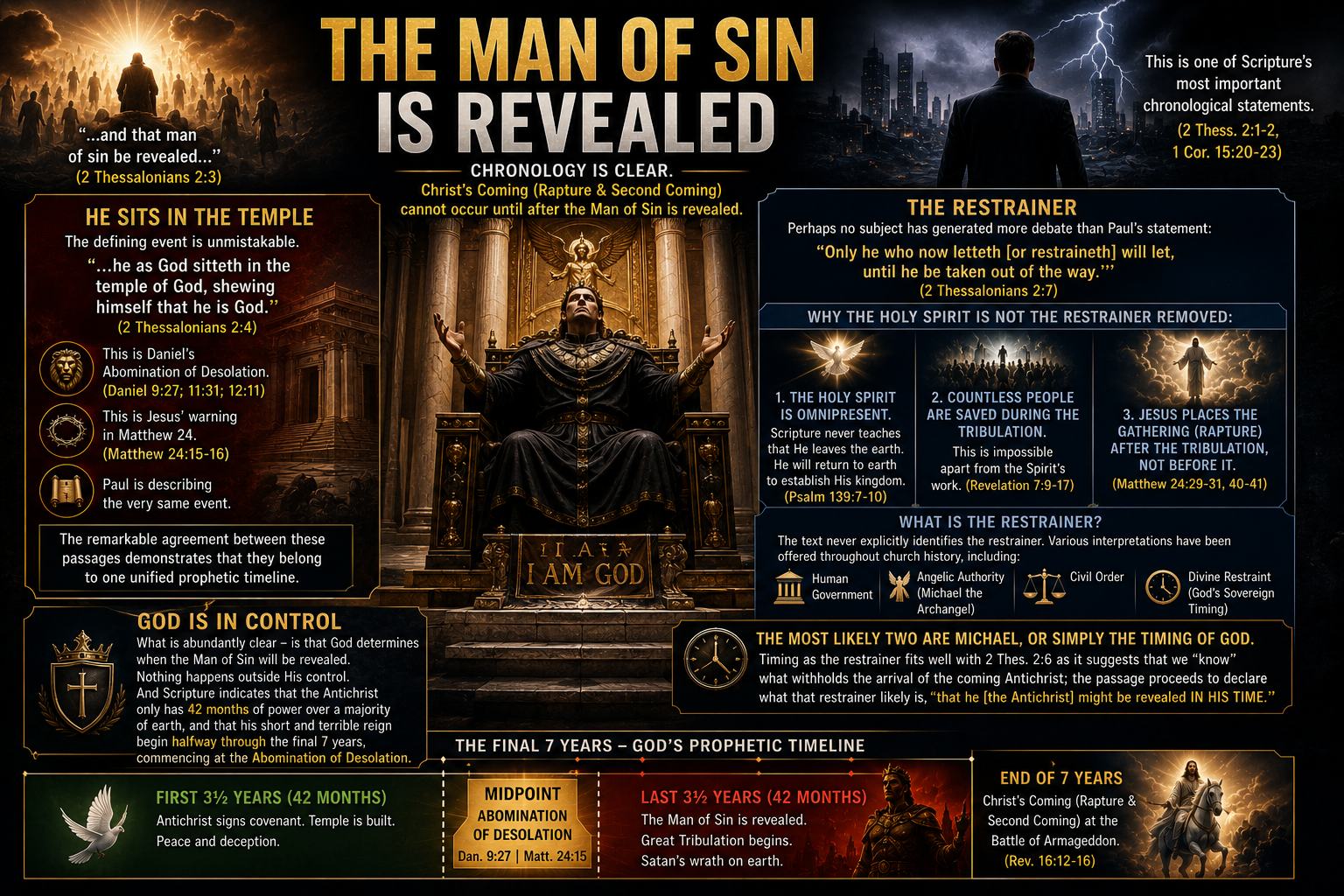
The Man of Sin Is Revealed
Paul continues:
“…and that man of sin be revealed…”
This is one of Scripture’s most important chronological statements.
The coming of Christ (i.e., which is both His Second Coming, and the Rapture simultaneously / 2 Thes. 2:1-2, 1 Cor. 15:20-23 / note our rapture happens “at His Coming”) cannot occur until after the Man of Sin is revealed.
How is he revealed?
Paul explains.
He Sits in the Temple
The defining event is unmistakable.
“…he as God sitteth in the temple of God, shewing himself that he is God.” (2 Thessalonians 2:4)
This is Daniel’s Abomination of Desolation.
This is Jesus’ warning in Matthew 24.
Paul is describing the very same event.
The remarkable agreement between these passages demonstrates that they belong to one unified prophetic timeline.
The Restrainer
Perhaps no subject has generated more debate than Paul’s statement:
“Only he who now letteth [or restraineth] will let, until he be taken out of the way.” (2 Thessalonians 2:7)
Many interpret the restrainer as the Holy Spirit removed through a pre-tribulation rapture.
However, several observations suggest another understanding.
First, the Holy Spirit is omnipresent, as prior noted.
Scripture never teaches that He leaves the earth, as He is returning to earth to establish a kingdom on earth’s terra firma.
Second, countless people are saved during the Tribulation (Revelation 7), something impossible apart from the Spirit’s work.
Third, Jesus places the gathering (or Rapture) of believers after the Tribulation, not before it.
The text never explicitly identifies the restrainer.
Various interpretations have been offered throughout church history, including human government, angelic authority (i.e., Michael the archangel), civil order, and divine restraint exercised through God’s sovereign timing.
The most likely two are Michael, or simply the timing of God. Timing as the restrainer fits well with 2 Thes. 2:6 as it suggests that we “know” what withholds the arrival of the coming Antichrist; the passage proceeds to declare what that restrainer likely is, “that he [the Antichrist] might be revealed IN HIS TIME.”
What is abundantly clear – is that God determines when the Man of Sin will be revealed.
Nothing happens outside His control. And Scripture indicates that the Antichrist only has 42 months of power over a majority of earth, and that his short and terrible reign begin halfway through the final 7 years, commencing at the Abomination of Desolation.
Revelation Completes the Antichrist’s Portrait
If Daniel provides the blueprint and Jesus gives the timeline, Revelation fills in the remaining details.
Revelation 11: The Beast Kills the Two Witnesses
At the conclusion of the Two Witnesses’ ministry (lasting 1,260 days in length), John writes:
“The beast that ascendeth out of the bottomless pit shall make war against them…” (Revelation 11:7)
Here the Beast directly opposes God’s prophetic end-time witnesses.
They will be two modern-day prophets preaching the soon-coming Kingdom of God via the return of Jesus Christ.
God will use them both to perform extraordinary miracles, and protecting them supernaturally until their mission is complete.
Although empowered by Satan, the Antichrist cannot act (i.e., kill them) until God permits.
Even his apparent victory is temporary. To the world whom the Antichrist deceives, the death of God’s 2 true prophets will seem like a victory and proof of their error.
However, three and one-half days later, God resurrects the Two Witnesses before the watching world, during the event we call “the Rapture.” Here is yet another nail in the pre-tribulation-theory’s coffin, as it would seem extremely odd for God to choose and use the two most mighty prophets of the end-time, after both missing the Rapture (as one would have to assume, if they adhere to the pre-tribulation rapture theory).
Revelation 12: Satan Gives the Beast His Mission
Revelation 12 shifts behind the scenes.
John reveals the spiritual war occurring beneath world events.
The Dragon, identified as Satan, persecutes Israel after being cast from heaven.
Knowing his time is short, he intensifies his efforts.
This chapter explains why the Antichrist becomes increasingly violent during the final three and one-half years.
He operates under satanic authority.
Revelation 13: The Definitive Antichrist Chapter
No chapter describes the Antichrist more completely than Revelation 13.
John introduces two distinct figures.
The first Beast rises from the sea.
The second Beast rises from the earth.
The second later becomes known as the False Prophet (Revelation 19:20).
The Beast Receives Satan’s Authority
John writes:
“The dragon [Satan / Rev. 12:9] gave him his power, and his seat, and great authority.” (Revelation 13:2)
Unlike ordinary political leaders, the Antichrist receives supernatural empowerment from Satan himself.
This explains both his extraordinary influence and his astonishing global success.
The Whole World Wonders After the Beast
Revelation says:
“…all the world wondered after the beast.” (Revelation 13:3)
This does not necessarily mean every individual willingly follows him.
Rather, his influence becomes global.
His leadership astonishes the nations.
His political power reaches unprecedented levels.
He Makes War with the Saints
Again we encounter familiar language.
“…it was given unto him to make war with the saints…” (Revelation 13:7)
Daniel said it.
Jesus implied it.
Paul anticipated it.
John confirms it.
The saints remain present during the Antichrist’s reign.
This remarkable consistency forms one of the strongest biblical arguments for the post-tribulation understanding of prophecy.
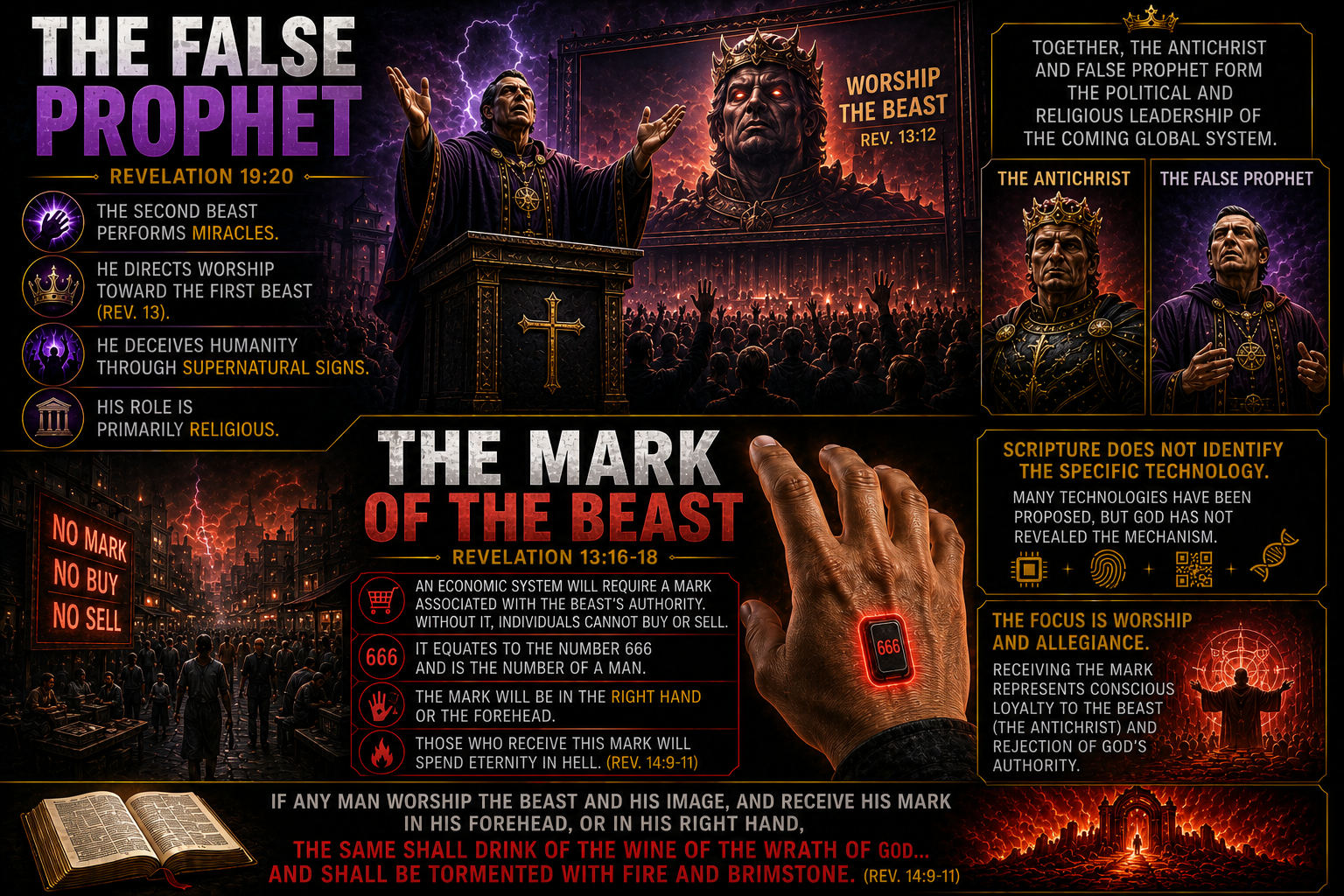
The False Prophet
The second Beast performs miracles.
He directs worship toward the first Beast (Rev. 13), and acquires his “False Prophet” title biblically from Revelation 19:20.
He deceives humanity through supernatural signs.
His role is primarily religious.
Together, the Antichrist and False Prophet form the political and religious leadership of the coming global system.
The Mark of the Beast
Perhaps no prophecy is more widely recognized than Revelation 13:16-18.
John describes an economic system requiring a mark associated with the Beast’s authority.
Without it, individuals cannot buy or sell. It equates to the number 666 and is the number of a man.
Scripture indicates those who receive this mark (in their right hand, or forehead) will spend eternity in Hell (Rev. 14:9-11).
While many technologies have been proposed as possible mechanisms, Scripture does not identify the specific technology.
The focus of the prophecy is worship and allegiance.
Receiving the mark represents conscious loyalty to the Beast (the Antichrist) and rejection of God’s authority.
Wrapping Things Up
Now, let’s examine:
- Revelation 14 through 20
- The destruction of the Beast at the Second Coming
- Old Testament foreshadowings such as Nimrod, Pharaoh, Haman, and Antiochus IV
- Common misconceptions about the Antichrist
- Why this doctrine matters today
- Frequently Asked Questions
- Practical application
- The Conclusion
Herein, we bring together every major passage into one unified biblical portrait of the Antichrist and his ultimate defeat by Jesus Christ.
The Antichrist’s Defeat, Common Misunderstandings, and Why This Matters
Throughout this study, we’ve followed the Antichrist from Daniel’s earliest visions to John’s Revelation. We’ve seen him described as the Little Horn, the Prince That Shall Come, the Man of Sin, and the Beast. We’ve watched his rise through diplomacy, his betrayal of Israel, his persecution of believers, and his demand for worldwide allegiance.
Yet one truth stands above every prophecy about the Antichrist.
His story ends in defeat.
The Bible spends far more time describing the victory of Jesus Christ than the temporary reign of the Beast.
The purpose of prophecy is not to magnify the Antichrist.
It is to magnify the true Christ, King Jesus.
Revelation 14: A Warning and a Promise
Immediately after describing the Mark of the Beast in Revelation 13, John records one of the strongest warnings in all of Scripture.
Those who knowingly worship the Beast and receive his mark will face God’s judgment (Revelation 14:9-11).
This warning demonstrates that the Mark of the Beast is not merely an economic convenience.
It represents a conscious act of allegiance.
The issue is worship. The issue has always been worship.
Throughout history Satan has desired what belongs only to God.
The Antichrist becomes the final human instrument through whom Satan attempts to receive worldwide worship.
Yet Revelation 14 also provides tremendous encouragement.
John sees the redeemed (saved individuals) standing with the Lamb on Mount Zion.
Despite the Beast’s apparent victories, God’s people remain secure in Christ.
The chapter reminds believers that endurance is not only possible, it is expected.
“Here is the patience of the saints…” (Revelation 14:12)
Throughout Scripture, patience refers to steadfast endurance under pressure.
God never promises His people exemption from persecution.
He promises His presence through it (Matthew 28:20), saying:
“…lo, I am with you always, even unto the end of the world. Amen.”
Revelation 16: The World Moves Toward Armageddon
By Revelation 16, God’s wrath is being poured out upon an unrepentant world.
This is distinct from the Great Tribulation.
Earlier, Satan poured out his wrath against God’s people.
Now God responds with righteous judgment against persistent rebellion.
Near the end of the chapter, three unclean spirits go out to gather the kings of the earth for the final battle.
“…to gather them to the battle of that great day of God Almighty.” (Revelation 16:14)
John then identifies the location.
“And he gathered them together into a place called in the Hebrew tongue Armageddon.” (Revelation 16:16)
Armageddon is not merely a military engagement.
It is the climax of human rebellion against God.
The Antichrist unites political powers against Jerusalem and against the returning Cosmic King.
The nations believe they are fighting one another.
Ultimately, they find themselves opposing Jesus Christ.
Revelation 17: The Beast and the Ten Kings
One of the most fascinating prophetic chapters is Revelation 17.
John sees a scarlet-colored (i.e., red) beast carrying a woman called “Mystery, Babylon the Great.”
Many readers focus almost exclusively on the woman.
However, the Beast remains central to the chapter.
John explains:
“The ten horns which thou sawest are ten kings…” (Revelation 17:12)
These ten rulers receive authority for a short period and voluntarily unite their power under the Beast.
This perfectly complements Daniel 7.
Daniel saw ten horns.
John sees ten kings.
In King Nebuchadnezzar’s Dream (in Daniel 2), these same ten kings are represented by ten toes.
Rather than describing different events, both prophets reveal the same final governmental alliance.
This future coalition becomes the political foundation upon which the Antichrist exercises worldwide authority.
Revelation 19: The Antichrist Meets the King of Kings
Every earthly dictator eventually dies.
Every empire eventually falls.
Every kingdom eventually ends.
So does the Antichrist’s.
Revelation 19 records one of the most triumphant scenes in Scripture.
Heaven opens.
Jesus returns riding a white horse, along with the saints (as they’ve just met Him in the sky and are being transported to Jerusalem for battle).
The Second Coming of Christ comes unmistakably, with power and great glory and every eye shall see him (Rev. 1:7). This truth testifies against the Antichrist being God (or the true Messiah), for Christ depicts His Second Coming, not at a mere man (like his first coming), but as Almighty God from the clouds of heaven.
John describes Him as:
- Faithful and True
- The Word of God
- King of Kings
- Lord of Lords
The Beast gathers the world’s armies.
Yet there is no prolonged battle.
John simply records:
“And the beast was taken…” (Revelation 19:20)
The False Prophet is seized with him.
Both are cast alive into the Lake of Fire according to the passage.
Notice what is missing.
There is no struggle.
No uncertainty.
No close contest.
The Antichrist who deceived the nations for years is effortlessly defeated by the returning Messiah.
His reign ends the moment Christ appears.
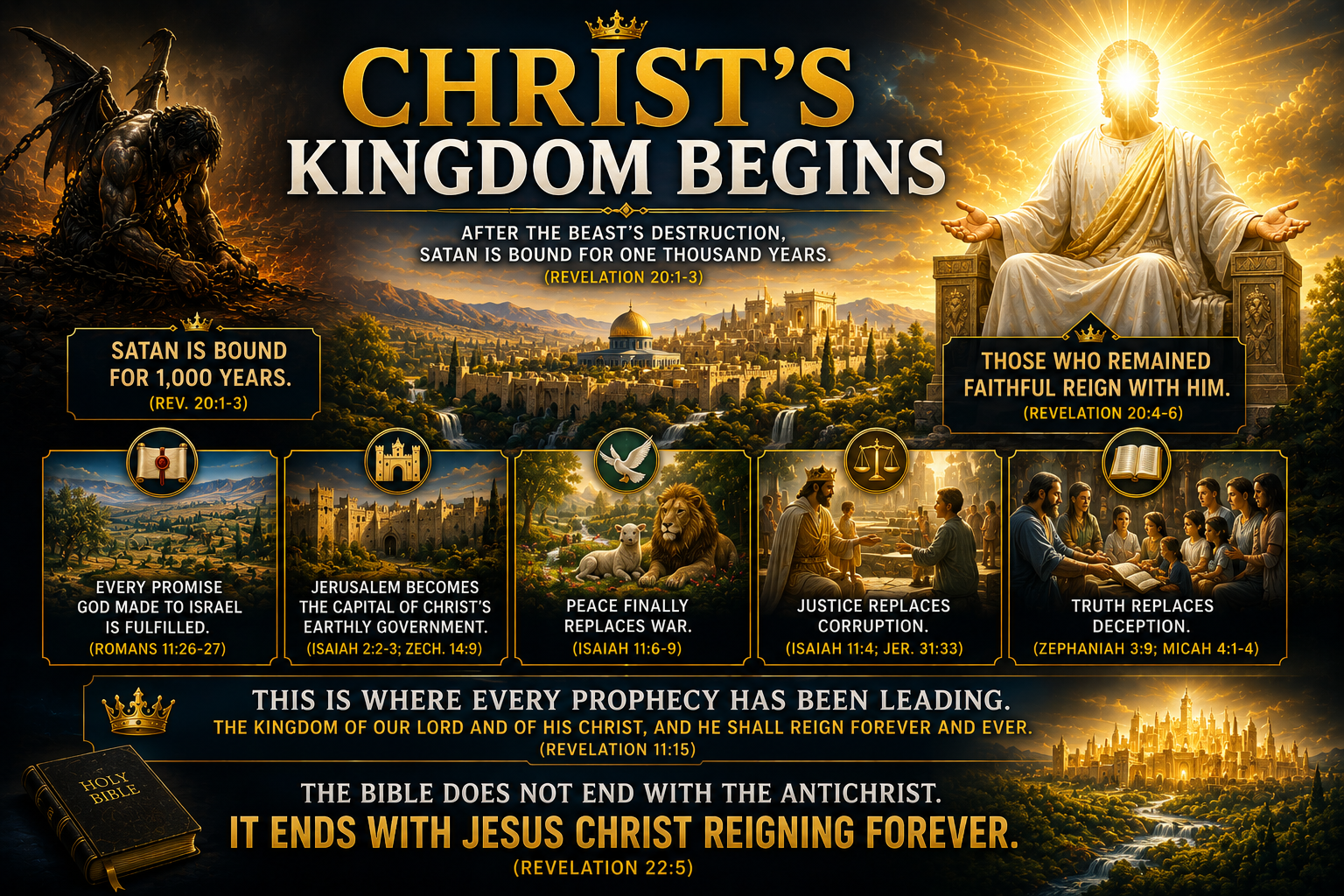
Revelation 20: Christ’s Kingdom Begins
After the Beast’s destruction, Satan is bound for one thousand years.
Christ establishes His Kingdom on earth.
Those who remained faithful reign with Him.
Every promise God made to Israel is fulfilled.
Jerusalem becomes the capital of Christ’s earthly government.
Peace finally replaces war.
Justice replaces corruption.
Truth replaces deception.
This is where every prophecy has been leading.
The Bible does not end with the Antichrist.
It ends with Jesus Christ reigning forever.
Old Testament Foreshadowings of the Antichrist
Before the final Antichrist appears, Scripture presents several historical figures who foreshadow aspects of his character.
These individuals are not the Antichrist himself.
Rather, they serve as prophetic previews.
Nimrod
Genesis 10 introduces Nimrod as a mighty ruler whose kingdom centered around Babel.
He represents mankind’s earliest attempt at centralized government in defiance of God.
His empire anticipates the future global system led by the Beast.
Pharaoh
Pharaoh repeatedly hardened his heart against God.
He enslaved God’s covenant people and refused to submit to divine authority.
Like the Antichrist, he opposed God’s redemptive plan.
Goliath
The giant from Gath, with a look more stout than his fellows, openly mocked the armies of the living God.
His arrogance, intimidation, and confidence foreshadow the pride that ultimately characterizes the Antichrist.
Haman
The villain of Esther sought the complete destruction of the Jewish people.
His hatred toward Israel reflects Satan’s continuing opposition to God’s covenant nation.
Antiochus IV Epiphanes
Perhaps no Old Testament figure serves as a clearer type of the Antichrist.
He desecrated the Temple.
He outlawed biblical worship.
He persecuted faithful Jews.
He attempted to replace God’s truth with paganism.
Yet even Antiochus only foreshadowed the greater fulfillment Jesus said was still future.
Even in modern times, some have attributed Adolf Hitler to the spirit of Antichrist seeking to rise before his time, killing 6 million Jews and arising from Europe.
The Antichrist – will be far worse than them all.
Common Misunderstandings About the Antichrist
Misunderstanding #1: The Antichrist Is Satan
The Antichrist is not Satan.
He is a human political leader empowered by Satan. Although he very well could be demon possessed by Satan himself, he is not Satan (he is but a man).
Revelation carefully distinguishes between the Dragon (Satan, Rev 12:9) and the Beast (the Antichrist and His One World Government, Rev. 13:1-8).
Misunderstanding #2: The Antichrist Is Merely Symbolic
Some interpret the Beast as representing evil governments in general.
While the Beast certainly governs a political system, Scripture repeatedly presents him as an identifiable individual.
Daniel calls him a king.
Paul calls him the Man of Sin.
John describes his destruction as a specific historical event.
Unequivocally, the Antichrist will be a human being, born a male.
Misunderstanding #3: Every Evil Leader Is the Antichrist
History has produced many candidates.
Nero.
Napoleon.
Hitler.
Stalin.
Various popes.
Modern presidents.
European leaders.
Middle Eastern rulers.
While many have displayed characteristics associated with the spirit of antichrist, none fulfilled the complete biblical portrait.
Believers should exercise caution before declaring any contemporary figure to be the Antichrist.
Jesus instructed us to watch, not speculate. When the Abomination of Desolation occurs, the Antichrist will finally be revealed.
Misunderstanding #4: Christians Will Never Encounter the Antichrist
This remains one of the most significant areas of disagreement among Bible-believing Christians.
Many sincere believers hold a pre-tribulation view.
Others advocate a mid-tribulation or pre-wrath position.
The interpretation presented in this article concludes that believers will be present during the Antichrist’s reign based upon the consistent testimony of Daniel 7, Matthew 24, 2 Thessalonians 2, and Revelation 13.
The Church is never promised exemption from persecution.
Instead, believers are repeatedly encouraged to remain faithful, even in the face of opposition.
How This Fits Into the End-Time Timeline
When these passages are studied together, they present a remarkably consistent sequence:
- Increasing global instability prepares the world for unprecedented international cooperation.
- A future political leader rises to prominence through diplomacy and strategic leadership.
- He confirms a covenant involving Israel and many nations, marking the beginning of Daniel’s Seventieth Week.
- A rebuilt Temple functions in Jerusalem.
- Midway through the seven years, he commits the Abomination of Desolation by exalting himself above God.
- The Great Tribulation (Wrath of Satan) begins as Satan persecutes God’s people.
- The False Prophet establishes a global religious system and enforces the (666) Mark of the Beast.
- The nations gather against Jerusalem, led by Russia, Iran (Persia), Turkey, Ethiopia, and Libya.
- Jesus Christ returns immediately after the Tribulation, gathers His saints, defeats the Beast and False Prophet at the battle of Armageddon, and establishes His Millennial Kingdom.
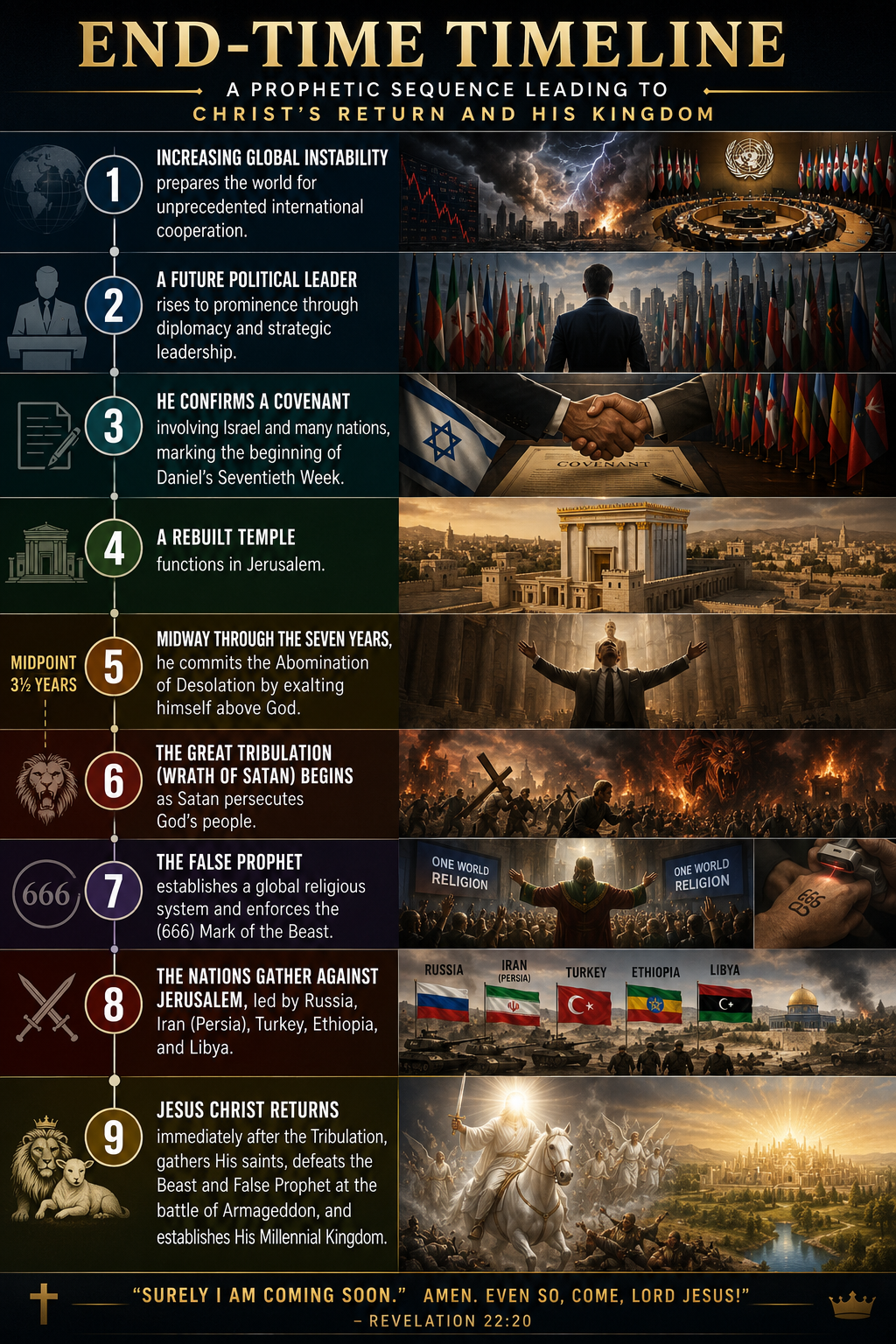
Rather than isolated prophecies, these passages form one unified prophetic timeline stretching from Daniel to Revelation.
Why Does Understanding the Antichrist Matter?
Some ask, “Why spend so much time studying the Antichrist? Shouldn’t we just focus on the real Christ (i.e., Jesus)?”
The answer is simple.
Studying the Antichrist helps us understand Jesus’ warnings.
Nearly one-third of the Bible contains prophecy.
Jesus repeatedly instructed His followers to watch.
Understanding prophecy strengthens faith because it demonstrates God’s sovereign control over history.
It also prepares believers to recognize deception.
The Antichrist’s greatest weapon will not be military power.
It will be counterfeit truth.
The best defense against deception is a deep knowledge of Scripture.
Prophecy should never produce fear.
It should produce confidence, and faith in God’s Word.
God revealed these events because He wanted His people to be prepared (primarily spiritually, but also mentally and perhaps other ways).
Frequently Asked Questions
Who is the Antichrist according to the Bible?
The Antichrist is a future political leader who will rise during the final seven years before Christ’s return. He is described as the Little Horn (Daniel 7), the Man of Sin (2 Thessalonians 2), and the Beast (Revelation 13).
Does the Bible actually use the word “Antichrist”?
Yes. The word appears five times, all in 1 John and 2 John. However, the same individual is described by many additional titles throughout Scripture.
Is the Antichrist alive today?
The Bible does not identify him by name. While the spirit of antichrist is already active in the world (1 John 4:3), believers should avoid identifying specific individuals before the biblical signs occur. He could be alive on earth today; it’s highly likely.
Will the Antichrist rule the whole world?
Revelation 13 describes a global system of political and economic influence. While interpretations vary regarding the extent of his authority, Scripture presents his rule as unprecedented in scope. Only a few nations and pockets of resistance will exist.
What is the Mark of the Beast?
The Mark of the Beast is an end-time system of economic participation linked to allegiance and worship of the Beast (Revelation 13:16-18). Whatever form it ultimately takes, its primary significance is spiritual rather than technological.
Will Christians face the Antichrist?
Based on Daniel 7, Matthew 24, 2 Thessalonians 2, and Revelation 13, believers will witness the Antichrist’s reign before Jesus returns, while remaining under God’s care and ultimately sharing in Christ’s victory.
Conclusion
Who is the Antichrist? The Bible answers that question with remarkable clarity. He is a future world ruler who will emerge during the last days, unite political and religious power, oppose God, persecute the saints, deceive the nations, and demand worship that belongs only to Jesus Christ.
Yet Scripture never leaves us focused on the Beast.
Instead, it directs our eyes to the Lamb.
The Antichrist’s kingdom will last only a short time.
Christ’s Kingdom will never end.
The final message of biblical prophecy is not fear. It is hope.
Jesus Christ wins.
Because He wins, those who remain faithful to Him will share in His victory.
Until that day, believers are called to know God’s Word, discern the times, boldly proclaim the Gospel, and eagerly await the glorious appearing of our great God and Savior, Jesus Christ.
Bibliography
Primary Source
- The Holy Bible, King James Version (KJV)
Additional References
- Daniel 2, 7-12
- Matthew 24
- Mark 13
- Luke 21
- John 16:33
- 1 Thessalonians 5:9
- 2 Thessalonians 2
- 1 John 2, 4
- 2 John
- Revelation 6, 9, 11-20
For historical background and context:
- Josephus, The Antiquities of the Jews
- Josephus, The Wars of the Jews
- Collins, John J. Daniel (Hermeneia)
- Keil, C. F., and Delitzsch, F. Commentary on the Old Testament
- Walvoord, John F. Daniel: The Key to Prophetic Revelation (consulted for comparative interpretation)
- Beale, G. K. The Book of Revelation (consulted for comparative interpretation)
About the Author
 Bryan Smith serves as Content & Teaching Pastor at Endtime Ministries and has been part of the Endtime family for more than 25 years. He has been engaged in pastoral ministry for two decades, served as Academic Dean, Registrar, and Professor for Valor University, and is a frequent teacher of the Understanding the End Time class. Bryan holds a Bachelor of Arts (B.A.) in Theology, a Master of Arts (M.A.) in Leadership, has completed advanced studies in the history of prophecy through HarvardX’s certificate program with Harvard University, and is pursuing a Doctor of Ministry (D.Min.) in Biblical Studies. In addition to hosting The Bible Prophecy Show podcast, Bryan is a regular contributor to Endtime magazine and writes on the intersection of Bible prophecy, theology, and global current events.