What is the Battle of Armageddon?
Short Answer
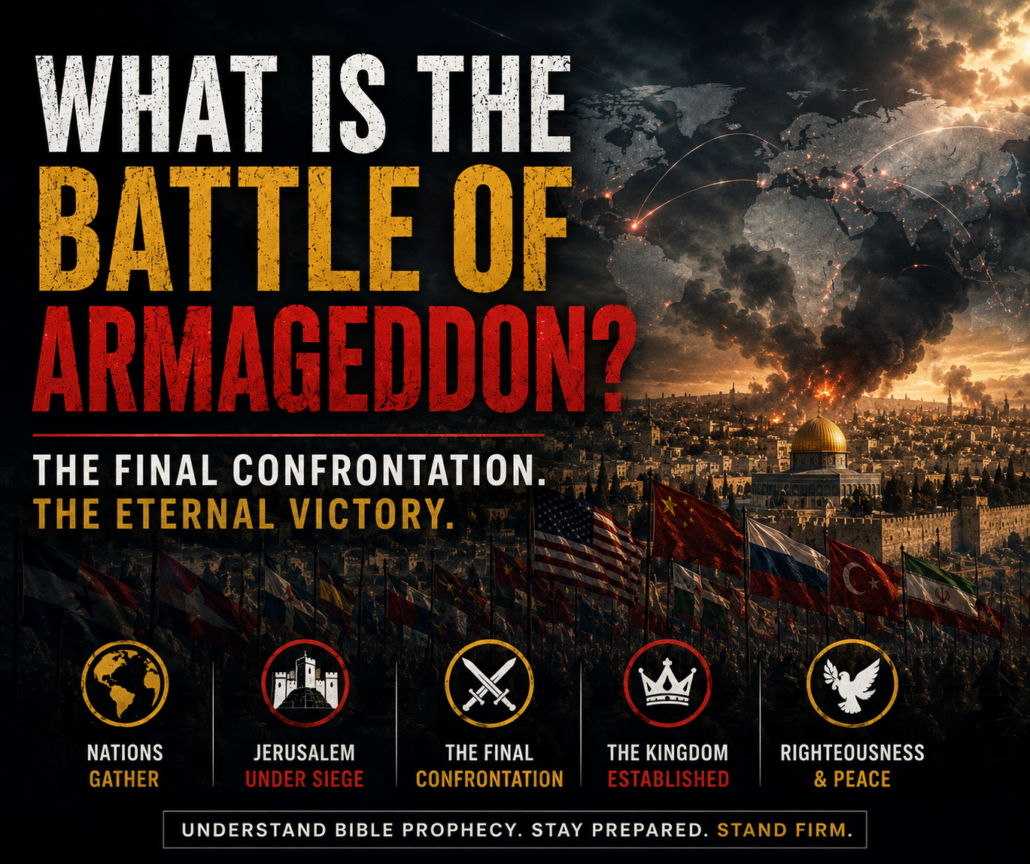
Armageddon is the climactic battle described in the Bible that occurs immediately before the Second Coming of Jesus Christ. It represents humanity’s final rebellion against God and the moment when Jesus returns to establish His kingdom on earth.
While many people use the word “Armageddon” to describe any catastrophic event, the Bible presents Armageddon as a specific future gathering of nations in the land of Israel. According to Scripture, the armies of the world will converge against Jerusalem, leading to a conflict that culminates in the visible return of Jesus Christ from the sky.
Armageddon is not merely a battle; it is the event that brings an end to man’s rule of all government structures and begins the reign of Jesus Christ on earth as King of kings and Lord of lords.
Revelation 17:14 (King James Version)
“These shall make war with the Lamb, and the Lamb shall overcome them: for he is Lord of lords, and King of kings: and they that are with him are called, and chosen, and faithful.”
Understanding the Issue
The word “Armageddon” appears only once in the Bible:
“And he gathered them together into a place called in the Hebrew tongue Armageddon” (Rev. 16:16, KJV).
The term is generally understood to mean “Mount Megiddo” or the “Hill of Megiddo.” Megiddo is an ancient location in northern Israel that overlooks the Jezreel Valley, one of the most strategic military corridors in the world. It’s also quite beautiful; however, soon it will host the end-time cataclysmic war of God versus Satan.
Throughout history, numerous battles have been fought in this region. Because of its strategic significance, Megiddo became a fitting symbol for the final military confrontation between the forces of this world and the kingdom of God.
However, Armageddon is often misunderstood. Many assume it refers to the actual battlefield where the entire conflict occurs. In reality, Revelation indicates that Armageddon is the gathering place for the armies of the world. The broader conflict extends throughout Israel and ultimately centers on Jerusalem.
The Bible describes Armageddon as the culmination of events that unfold during the final 7 years preceding Christ’s return. Those final 7 years begin with what the Bible references as “The confirmation of the covenant;” a peace treaty that will essentially be a 7-year interim agreement (Dan. 9:27) between Israel and the Palestinians (along with many others). Seven years after this agreement is signed, the battle of Armageddon will ensue.
What Does the Bible Say?
Several passages provide insight into Armageddon and the events surrounding it.
The Gathering of Nations
Revelation 16 describes demonic spirits influencing the rulers of the earth to gather for battle:
Revelation 16:14 (KJV)
“For they are the spirits of devils, working miracles, which go forth unto the kings of the earth and of the whole world, to gather them to the battle of that great day of God Almighty.”
This gathering is not accidental. Scripture reveals that spiritual forces will influence world leaders, drawing them into a confrontation that ultimately fulfills God’s prophetic plan.
Jerusalem Under Siege
The prophet Zechariah foretold a time when the nations would come against Jerusalem:
Zechariah 14:2 (KJV)
“For I will gather all nations against Jerusalem to battle…”
According to biblical prophecy, Jerusalem becomes the focal point of the world’s attention in the last days. The city that has long stood at the center of religious and political controversy will become the center of the final conflict.
The Return of Jesus Christ
The battle reaches its climax when Jesus returns to earth.
Zechariah prophesied:
“And his feet shall stand in that day upon the mount of Olives…” (Zechariah 14:4)
Revelation provides a parallel account:
“And I saw heaven opened, and behold a white horse; and he that sat upon him was called Faithful and True…” (Revelation 19:11)
Jesus returns with power and glory, defeats the armies gathered against Him, and establishes His kingdom on earth.
The Beginning of Christ’s Reign
Armageddon is not the end of the story. It is the transition point between the kingdoms of this world and the Kingdom of God. It’s also when the Saints of the ages rule and reign with Jesus Christ for 1,000 years.
Revelation 20:4–6 (KJV)
4 And I saw thrones, and they sat upon them, and judgment was given unto them: and I saw the souls of them that were beheaded for the witness of Jesus, and for the word of God, and which had not worshipped the beast, neither his image, neither had received his mark upon their foreheads, or in their hands; and they lived and reigned with Christ a thousand years.
5 But the rest of the dead lived not again until the thousand years were finished. This is the first resurrection.
6 Blessed and holy is he that hath part in the first resurrection: on such the second death hath no power, but they shall be priests of God and of Christ, and shall reign with him a thousand years.
Daniel foresaw this moment centuries before Christ:
“And in the days of these kings shall the God of heaven set up a kingdom, which shall never be destroyed…” (Daniel 2:44)
The battle of Armageddon concludes man’s efforts to govern the earth apart from God and ushers in the Messianic reign of Jesus Christ.
Common Misunderstandings
Armageddon Is Not the End of the Earth
Many assume Armageddon marks the destruction of the planet. Scripture teaches otherwise.
Armageddon precedes Christ’s millennial reign. Rather than ending the earth, it begins a new era in which Jesus governs the nations.
Armageddon Is More Than a Single Day and Battle
The term is often used as if it refers to one brief military engagement. Although Scripture certainly uses terminology like “the day of the Lord” (Zech. 14:1-2) in reference to the battle of Armageddon, it is highlighting the final day of the conflict and the conclusion of the battle; a battle that may last several days.
Biblical prophecy suggests a larger campaign involving multiple events, military movements, and conflicts that culminate in Christ’s return. Armageddon refers to the gathering and final confrontation rather than a single moment in time.
Armageddon Is Not Satan Versus God in an Equal Contest
The Bible does not portray Armageddon as a close battle between equally matched forces. God has no antithesis, for He has no equal. As powerful as God is (on the side of “good”), Satan is not the equal of God (on the side of “evil”). There is no contest. God is simply greater.
Jesus Christ returns as the victorious King. The outcome is never in doubt. God’s victory is certain before the conflict even begins.
Prophetic Perspective
Armageddon occupies a central place in the understanding of Bible prophecy. The church was birthed at Jerusalem, and the victory of the church shall culminate in Jerusalem.
The battle occurs at the conclusion of the Great Tribulation and immediately before the establishment of the Kingdom of God on earth.
The Final Rebellion
The Scriptures reveal a period of unprecedented global turmoil preceding Christ’s return. Political, military, economic, and religious systems will increasingly align under a global structure commonly referred to in prophecy as the Beast (or the One World Government of the Antichrist).
As these events unfold, Jerusalem becomes the epicenter of world attention.
The nations will eventually gather against Israel and Jerusalem, setting the stage for the fulfillment of Zechariah 14 and Revelation 16.
The Sixth Trumpet and Global Conflict
Major international conflicts, including the war associated with the Sixth Trumpet prophecy of Revelation 9:13-21, contribute to the geopolitical conditions that lead toward Armageddon.
While these conflicts are distinct from Armageddon itself, they help shape the environment in which the final battle occurs. As the eschatology gurus at Endtime Ministries often say, the seeds of Armageddon have been sown.
The Second Coming and Armageddon
One of the most significant prophetic truths concerning Armageddon is that it coincides with the Second Coming of Jesus Christ.
Rather than viewing Christ’s return as a separate event occurring years earlier, the Bible teaches that the Second Coming occurs immediately after the Great Tribulation and is directly connected to the defeat of the nations gathered against Jerusalem. Listen to the words of Jesus Himself:
Matthew 24:29-31 (KJV)
29 Immediately after the tribulation of those days shall the sun be darkened, and the moon shall not give her light, and the stars shall fall from heaven, and the powers of the heavens shall be shaken:
30 And then shall appear the sign of the Son of man in heaven: and then shall all the tribes of the earth mourn, and they shall see the Son of man coming in the clouds of heaven with power and great glory.
31 And he shall send his angels with a great sound of a trumpet, and they shall gather together his elect from the four winds, from one end of heaven to the other.
Armageddon is therefore not simply a military event—it is the moment Jesus returns to take authority over the kingdoms of this world.
The Establishment of God’s Kingdom
Following Armageddon, Revelation 20 describes the beginning of Christ’s millennial reign.
For believers, Armageddon is not primarily a message of destruction but a message of hope. It marks the end of war, rebellion, and human misrule and the beginning of God’s righteous government on earth.
Why This Matters Today
Many people view Armageddon as a frightening subject. Yet Scripture presents it as part of God’s plan to restore justice and establish peace.
Understanding Armageddon helps believers:
- Recognize the significance of Israel and Jerusalem in biblical prophecy.
- Understand where current world events fit within God’s prophetic timeline.
- Avoid fear when confronted with international crises.
- Place their confidence in God’s sovereignty rather than human governments.
- Live with urgency and spiritual preparedness.
The Bible repeatedly teaches that prophecy was not given to create panic but to produce faith.
As global tensions increase and the nations continue to focus on Jerusalem, believers should remember that God remains in control. The events leading to Armageddon do not signal God’s absence, they demonstrate that His prophetic Word is unfolding exactly as He foretold.
Final Thought
Armageddon is the final battle that precedes the visible return of Jesus Christ to earth. It represents humanity’s last attempt to resist God’s authority, yet it also marks the moment when Jesus establishes His kingdom and fulfills the promises spoken by the prophets.
For Christians, Armageddon should not inspire fear but confidence. The same Scriptures that predict this battle also declare its outcome. Jesus Christ returns victorious, evil is defeated, and God’s kingdom is established forever.
In a world marked by uncertainty, Armageddon reminds us that history is moving toward a divinely appointed conclusion; that conclusion belongs to Jesus Christ.
About the Author
 Bryan Smith serves as Content & Teaching Pastor at Endtime Ministries and has been part of the Endtime family for more than 25 years. He has been engaged in pastoral ministry for two decades, served as Academic Dean, Registrar, and Professor for Valor University, and is a frequent teacher of the Understanding the End Time class. Bryan holds a Bachelor of Arts (B.A.) in Theology, a Master of Arts (M.A.) in Leadership, has completed advanced studies in the history of prophecy through HarvardX’s certificate program with Harvard University, and is pursuing a Doctor of Ministry (D.Min.) in Biblical Studies. In addition to hosting The Bible Prophecy Show podcast, Bryan is a regular contributor to Endtime magazine and writes on the intersection of Bible prophecy, theology, and global current events.