
Is America in the Bible?
Is America in the Bible?
By Bryan Smith
Discover what Daniel 7 reveals about the United States, Great Britain, Russia, Europe, and God’s prophetic plan for the last days.
____________________
Quick Answer
Is America in the Bible? Yes (sort of). While the Bible never mentions the United States by its modern name, many biblical scholars believe Scripture symbolically identifies America in Daniel 7 through the imagery of the eagle’s wings attached to the lion. According to this interpretation, the lion represents Great Britain, while the eagle’s wings symbolize the United States emerging from its British roots.
This understanding is not based on speculation or national pride. Rather, it comes from comparing biblical symbolism with history, the timing of prophecy, and the prophetic framework found throughout Daniel and Revelation. While sincere Christians hold differing views, this interpretation sees America’s rise as one piece of God’s unfolding prophetic timeline leading to the Second Coming of Jesus Christ.
More important than identifying any nation is recognizing why God revealed these prophecies. Bible prophecy is not given merely to satisfy curiosity about world events. It is intended to strengthen our faith, prepare believers for the days ahead, and point every generation toward the soon return of Jesus Christ.
Why Does the Question Matter?
Few questions generate as much discussion among students of Bible prophecy as this one: Is America in the Bible?
Considering America’s influence on world affairs, its military strength, economic leadership, and longstanding relationship with Israel, many people assume the United States must occupy a significant place in biblical prophecy. Others argue that because America is never mentioned by name, it has no prophetic role whatsoever.
The answer depends largely on how one understands biblical symbolism.
The prophets did not use modern country names. Instead, God often revealed future kingdoms through symbolic imagery. Daniel saw beasts rising from the sea. John described beasts, horns, heads, and crowns in Revelation. Zechariah saw flying scrolls and lampstands. Ezekiel described dry bones coming back to life.
These symbols were never intended to confuse God’s people forever. Daniel was told that many of his prophecies would remain sealed until “the time of the end” (Daniel 12:9). As history unfolded and nations emerged, many prophetic symbols became increasingly recognizable.
If Daniel’s vision truly depicts nations existing immediately before Christ’s return, then identifying those nations becomes more than an academic exercise. It becomes evidence that God’s prophetic Word continues unfolding exactly as He declared thousands of years ago. It also points to the fact that, there is a God and He is eternal (i.e., outside of time, and inside of time, knowing all things including the past, present, and future from our vantage).
What Does the Bible Say About Nations in the Last Days?
The central passage in this discussion is Daniel 7.
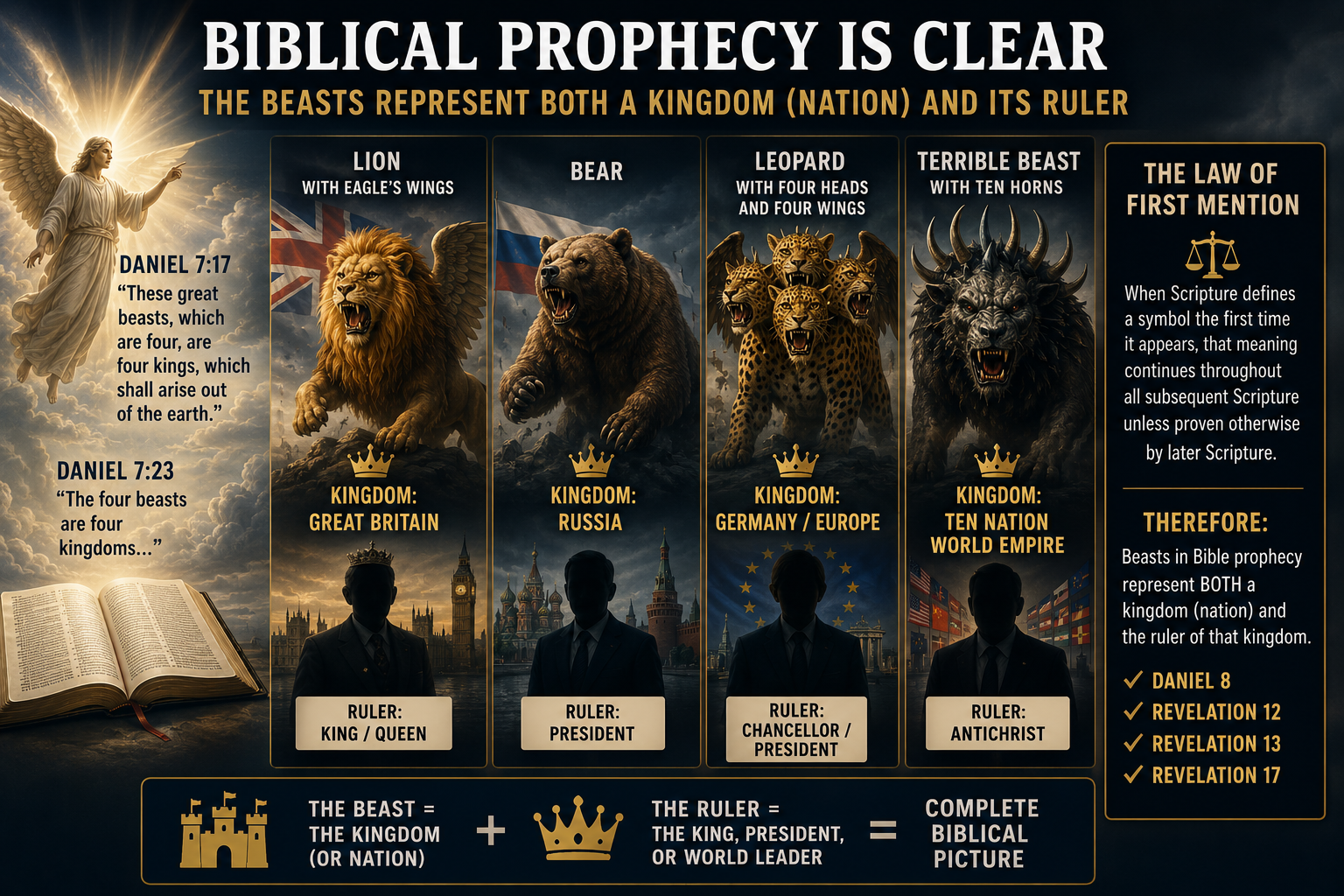
Daniel records a dramatic vision in which four great beasts rise from the sea. Unlike ordinary animals, each creature carries symbolic characteristics pointing to kingdoms that would play significant roles in God’s prophetic plan during the end times.
Daniel writes:
“Four great beasts came up from the sea, diverse one from another.” (Daniel 7:3)
The four beasts are:
- A lion with eagle’s wings (Daniel 7:4)
- A bear (Daniel 7:5)
- A leopard with four heads and four wings (Daniel 7:6)
- A terrifying beast possessing ten horns (Daniel 7:7)
Fortunately, Scripture does not leave readers wondering what these beasts represent.
Later in the chapter, the angel explains:
“These great beasts, which are four, are four kings, which shall arise out of the earth.” (Daniel 7:17)
Daniel 7:23 further clarifies that the beasts also represent kingdoms.
These 2 passages reveal clearly that beasts in eschatological terminology represent 2 things: both a kingdom (or nation), along with the ruler (e.g., King, President) of that nation.
Utilizing what biblical scholars call “The Law of First Mention,” this truth (i.e., beasts in Bible prophecy representing both a kingdom or nation, along with the ruler of that nation) then continues throughout all subsequent Scripture unless proven (by later Scripture elsewhere) that this law has changed.
Meaning: we can also assume that beasts elsewhere in Scripture represent a kingdom (or nation), along with the ruler of that nation (cf. Daniel 8, Revelation 12, 13, 17).
Throughout prophetic Scripture, kings and kingdoms are inseparable because rulers represent the nations they govern. The symbolism therefore points beyond individuals to political powers that exist within God’s prophetic timeline.
Understanding Prophetic Symbols
One common question is why God chose symbolic language instead of simply naming future nations.
The answer lies within Scripture itself.
Jesus frequently taught in parables. When His disciples asked why, He explained that truth would be revealed to those sincerely seeking God while remaining hidden from those who rejected Him (Matthew 13:10-17).
Old Testament prophecy often follows the same pattern.
Rather than listing future nations by name centuries before they existed, God used recognizable symbols whose meaning would become clear when the proper time arrived.
This approach also demonstrates God’s sovereignty.
No one living during Daniel’s lifetime could have identified nations that would not emerge for centuries. Yet once history unfolded, the prophetic imagery became remarkably relevant.
Daniel himself desired to understand these visions.
God responded:
“Go thy way, Daniel: for the words are closed up and sealed till the time of the end.” (Daniel 12:9)
This statement serves as one of the foundational principles for understanding Bible prophecy. Certain prophecies become clearer as history progresses toward their fulfillment.
Note: To be sure, God could very well have named each nation on earth existing today during the days of Adam and Eve. Here are a few examples of God’s foreknowledge written in Scripture long before they occurred, but proven to have come to pass later in history (cf. Ezek. 37:1-14 / Isa. 44:28 & Isa. 45:1 / Dan. 9:25 / Jer. 25:12-14). God even knows the and lists the nations that join and lead the charge against Israel at the yet futuristic battle of Armageddon (Ezek. 38:2-6 / namely: Russia (Meshech and Tubal), Iran (Persia), Ethiopia, Lybia, Turkey (Gomer of Togarmah).
Why Timing Is the Key to Daniel 7
Perhaps the most overlooked aspect of Daniel’s vision is when these beasts exist.
Many commentators identify the lion, bear, leopard, and fourth beast exclusively as Babylon, Medo-Persia, Greece, and ancient Rome.
While those empires unquestionably appear elsewhere in Daniel’s prophecies, Daniel 7 presents an important detail that deserves careful consideration.
Later in the vision, Daniel sees the Ancient of Days taking His seat in judgment (Daniel 7:9-10) against those nations simultaneously.
This scene culminates in the establishment of God’s everlasting Kingdom.
The timing is unmistakable.
Jesus Christ returns.
Human governments end.
The Kingdom of God begins.
Yet Daniel records something remarkable.
After describing the destruction of the final beast, he says concerning the others:
“As concerning the rest of the beasts, they had their dominion taken away: yet their lives were prolonged for a season and time.” (Daniel 7:12)
If the lion, bear, and leopard represented only long-extinct empires, how could their “lives” continue after Christ establishes His Kingdom?
This verse suggests that these symbolic nations remain present on Earth at the time of the Second Coming. Their political authority ends, but the nations themselves continue into Christ’s Millennial Reign.
This observation forms the basis for interpreting Daniel’s beasts as modern nations existing immediately before Christ returns rather than only ancient empires that disappeared centuries ago. Besides these things, Daniel 8 clearly identifies Greece to be a He-Goat (not a 4-headed Leopard) and Medo-Persia as the Ram with 2 horns (not a Bear).
Thus, the interpretation of “the lion, bear, leopard, and fourth beast exclusively as Babylon, Medo-Persia, Greece, and ancient Rome” – contradicts Scripture.
A Prophetic Timeline
Understanding Daniel 7 becomes much easier when viewed within the larger biblical narrative.
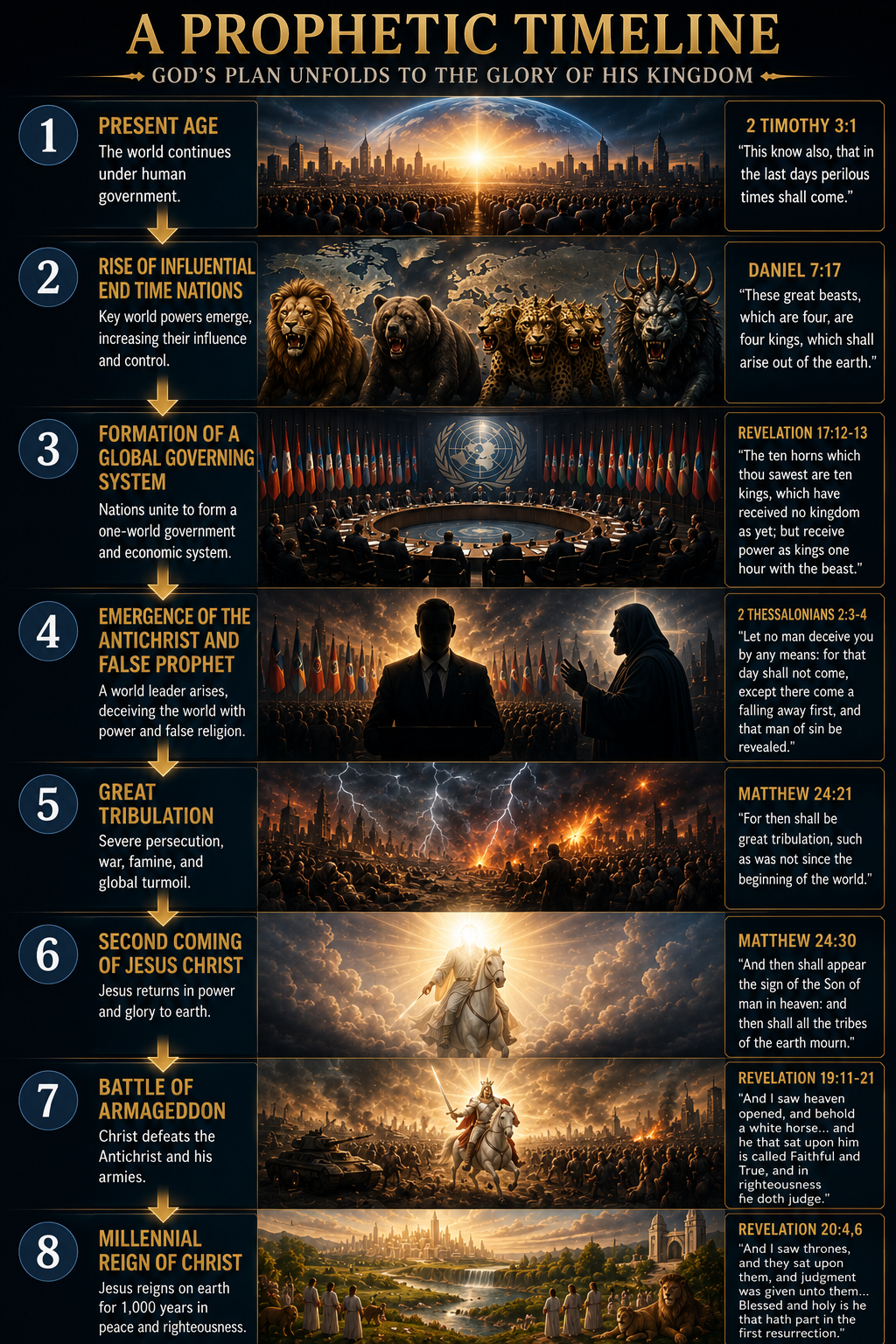
Daniel’s vision does not stand alone.
It connects directly with Revelation 13, Revelation 17, Zechariah 14, Matthew 24, and numerous other prophetic passages describing the closing years of human government before Christ establishes His eternal Kingdom.
Recognizing this larger framework helps explain why identifying these symbolic nations matters. The goal is not merely to identify countries. The goal is to understand where humanity stands within God’s prophetic calendar and to prepare our hearts for the return of our King.
Now let’s examine the lion with eagle’s wings in detail and consider why many students of prophecy believe this remarkable symbol points to Great Britain and the emergence of the United States from its mother nation, while also exploring alternative interpretations and measuring each against the biblical text.
__________________
The Lion with Eagle’s Wings: Is America Symbolized in Daniel 7?
The first beast Daniel describes is unlike anything found in nature.
“The first was like a lion, and had eagle’s wings: I beheld till the wings thereof were plucked, and it was lifted up from the earth, and made stand upon the feet as a man, and a man’s heart was given to it.” (Daniel 7:4)
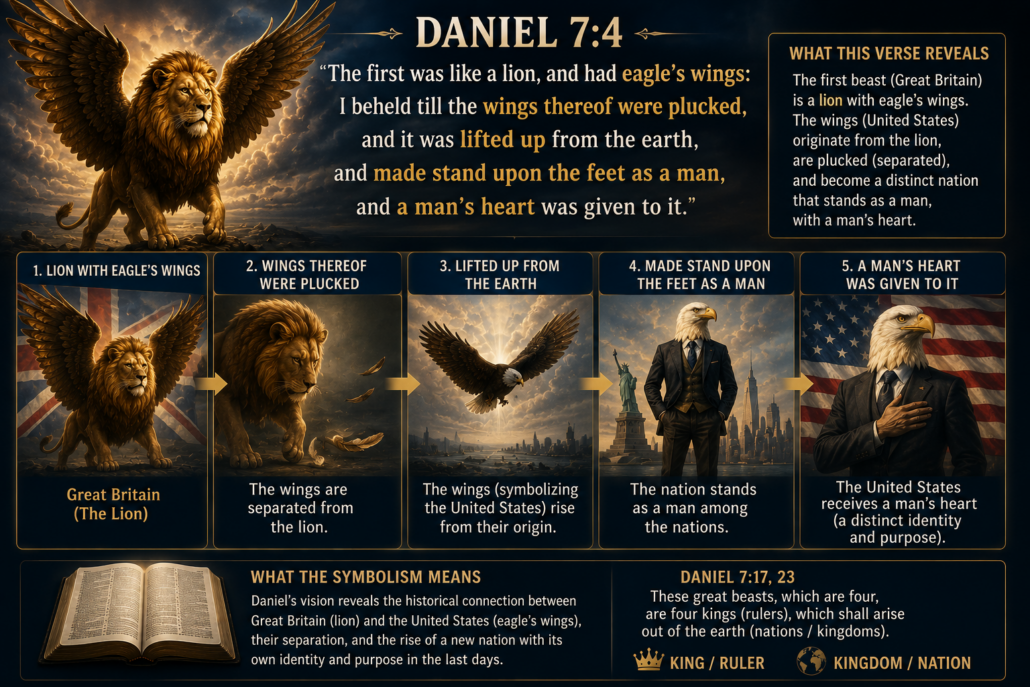
This unusual image has prompted centuries of discussion. Why would God combine a lion and an eagle into a single prophetic symbol? More importantly, what does it represent?
The interpretation presented here begins with a simple observation. Throughout history, nations have commonly been identified by recognizable animal symbols. If God intended these symbols to communicate something to the end time generation, it is reasonable to ask whether those national symbols correspond to Daniel’s vision.
Does the Lion Represent Great Britain?
Few national symbols are more recognizable than the British lion.
For centuries, the lion has appeared in British heraldry, royal coats of arms, military insignia, political cartoons, and international journalism. It has become synonymous with the strength and influence of Great Britain.
This widespread association makes Daniel’s first beast particularly interesting.
If the lion represents Great Britain, then the next detail becomes even more remarkable.
Daniel does not see an ordinary lion.
He sees a lion with eagle’s wings.
The Eagle’s Wings Were Plucked
Daniel records an important sequence of events.
The eagle’s wings are attached to the lion.
Later, those wings are plucked away from the lion.
The symbolism closely parallels the historical relationship between Great Britain and the United States.
America did not arise independently. It emerged from British colonial expansion.
The thirteen colonies were governed by Great Britain until the American Revolution culminated in the Declaration of Independence in 1776.
From that point forward, a new nation stood on its own.
Daniel’s description appears striking:
- The wings originate from the lion.
- The wings are separated from the lion.
- The separated symbol develops its own identity.
Those who hold this interpretation believe the imagery corresponds naturally with America’s birth from its British parent nation over two millennia after Daniel received his vision.
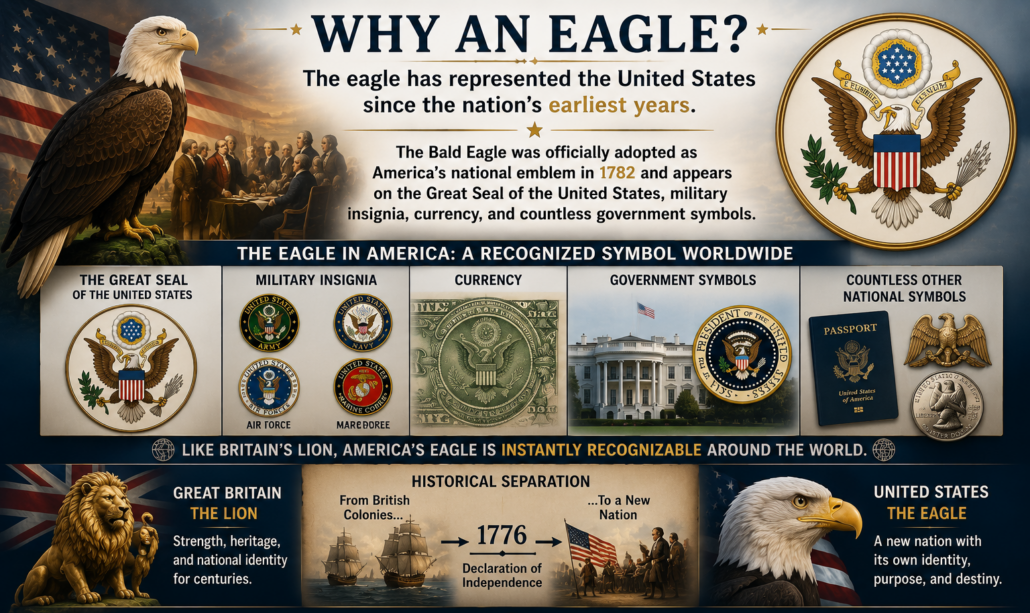
Why an Eagle?
The eagle has represented the United States since the nation’s earliest years.
The Bald Eagle was officially adopted as America’s national emblem in 1782 and appears on the Great Seal of the United States, military insignia, currency, and countless government symbols.
Like Britain’s lion, America’s eagle is instantly recognizable around the world.
This does not prove Daniel intended the eagle to represent America.
However, when considered alongside the historical separation from Great Britain, many students of prophecy conclude that the symbolism is too consistent to ignore.
“Made Stand Upon the Feet as a Man”
Daniel adds another fascinating detail.
After the wings are plucked,
“…it was lifted up from the earth, and made stand upon the feet as a man, and a man’s heart was given to it.” (Daniel 7:4)
Some biblical scholars see this as another symbolic connection to the United States.
For generations, America has often been personified as Uncle Sam, a human figure representing the nation in political cartoons, military recruitment, and public discourse.
Unlike the lion or eagle, Uncle Sam portrays America as a man.
While Scripture does not explicitly identify Uncle Sam, advocates of this interpretation view the progression as another layer of symbolic consistency within Daniel’s vision.
The Bear: Russia’s Place in Bible Prophecy
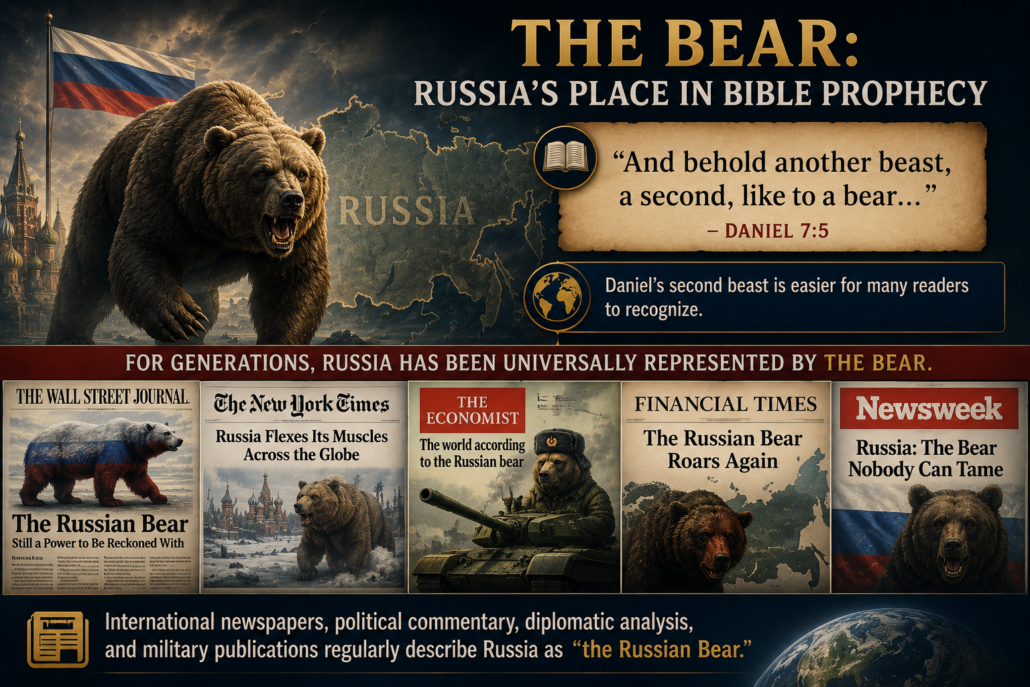
Daniel’s second beast is easier for many readers to recognize.
“And behold another beast, a second, like to a bear…” (Daniel 7:5)
For generations, Russia has been universally represented by the bear.
International newspapers, political commentary, diplomatic analysis, and military publications regularly describe Russia as “the Russian Bear.”
Daniel also notes that the bear is raised on one side and possesses three ribs in its mouth.
Various interpretations exist concerning these details.
While students of prophecy differ regarding the meaning of the ribs, the larger emphasis of the passage is the bear’s aggressive character and military strength.
Throughout modern history, Russia has consistently occupied a central position in global affairs, making it one of the dominant powers of the present age.
The Leopard and a Revived European Power
The third beast introduces additional complexity.
“After this I beheld, and lo another, like a leopard, which had upon the back of it four wings of a fowl; the beast had also four heads; and dominion was given to it.” (Daniel 7:6)
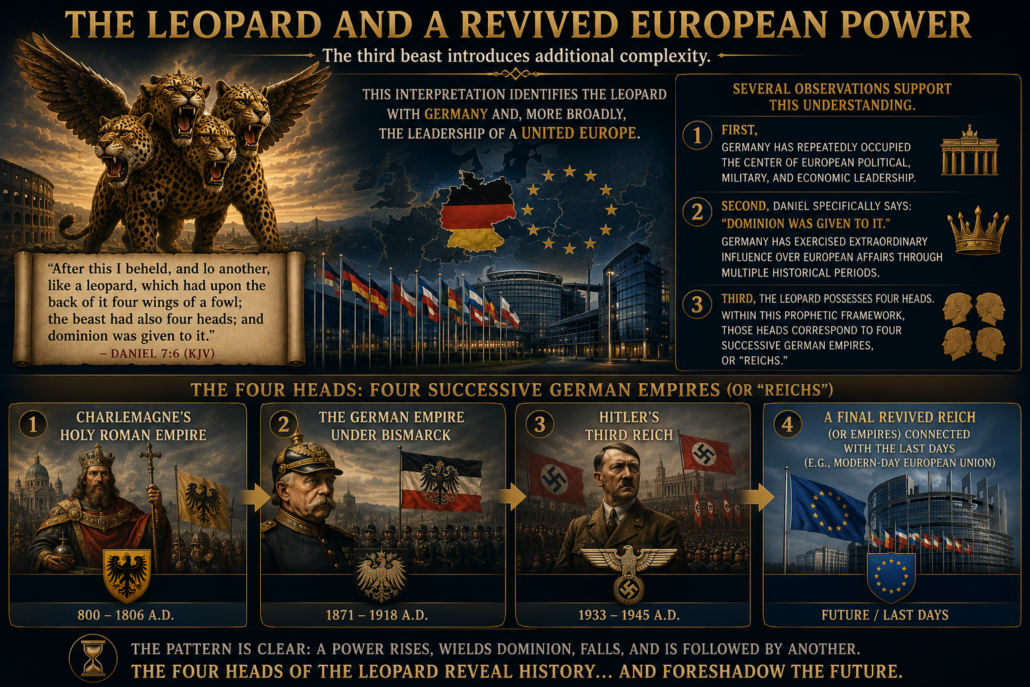
This interpretation identifies the leopard with Germany and, more broadly, the leadership of a united Europe.
Several observations support this understanding.
First, Germany has repeatedly occupied the center of European political, military, and economic leadership.
Second, Daniel specifically says:
“Dominion was given to it.”
Germany has exercised extraordinary influence over European affairs through multiple historical periods.
Third, the leopard possesses four heads.
Within this prophetic framework, those heads correspond to four successive German empires, or “Reichs.”
- Charlemagne’s Holy Roman Empire
- The German Empire under Bismarck
- Hitler’s Third Reich
- A final revived Reich (or empires) connected with the last days (e.g., Modern-day European Union)
Although historians debate this interpretation, proponents argue that the repeated rise of German leadership within Europe aligns with Daniel’s symbolic imagery.
The Four Wings
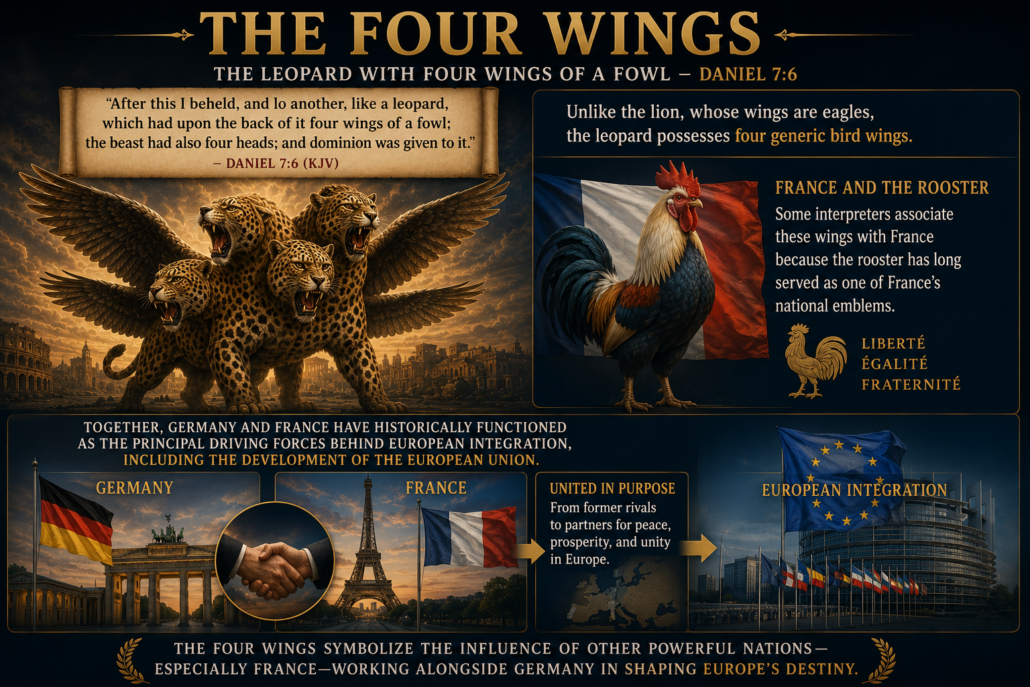
Unlike the lion, whose wings are eagles, the leopard possesses four generic bird wings.
Some interpreters associate these wings with France because the rooster has long served as one of France’s national emblems.
Together, Germany and France have historically functioned as the principal driving forces behind European integration, including the development of the European Union.
Whether every symbolic detail can be established with certainty remains open to discussion.
Nevertheless, the overall picture points toward a powerful European bloc playing a central role during the final years before Christ’s return.
The Fourth Beast: A Coming Global Government
Daniel’s final beast differs dramatically from the others.
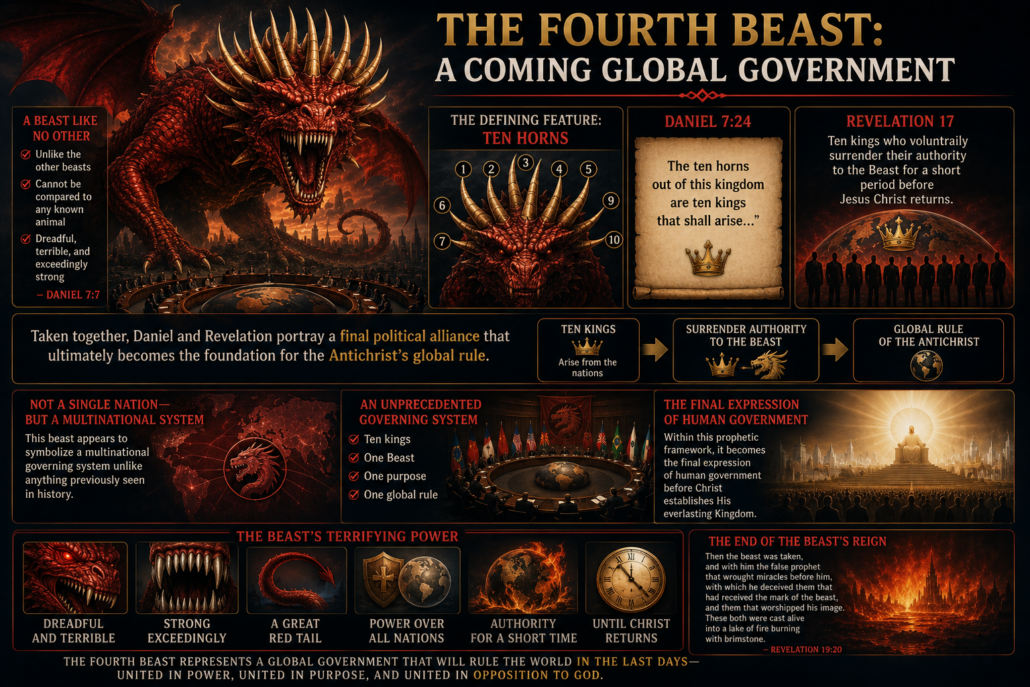
He cannot compare it to any known animal.
Instead, he emphasizes its terrifying power.
“A fourth beast, dreadful and terrible, and strong exceedingly…” (Daniel 7:7)
The defining feature is not its appearance.
It is its ten horns.
Later in the chapter, Scripture explains:
“The ten horns out of this kingdom are ten kings that shall arise…” (Daniel 7:24)
Revelation 17 expands this prophecy by describing ten kings who voluntarily surrender their authority to the Beast for a short period before Jesus Christ returns.
Taken together, Daniel and Revelation portray a final political alliance that ultimately becomes the foundation for the Antichrist’s global rule.
Rather than representing a single nation, this beast appears to symbolize a multinational governing system unlike anything previously seen in history.
Within this prophetic framework, it becomes the final expression of human government before Christ establishes His everlasting Kingdom.
Why This Interpretation Differs from Traditional Views
Many respected Bible scholars understand Daniel’s four beasts differently.
The most common interpretation identifies them as:
- Babylon
- Medo-Persia
- Greece
- Rome
This view has been held by many evangelical commentators and has significant historical support.
Those who identify the lion, bear, leopard, and fourth beast as modern nations are not denying that Daniel also addresses ancient empires elsewhere in his book.
Rather, they observe that Daniel 7 includes details suggesting these kingdoms remain present at the time of Christ’s Second Coming.
Particularly significant is Daniel 7:12, which states that after the destruction of the final beast, the other beasts continue living even though their dominion has been removed.
This detail raises an important question.
If Babylon, Medo-Persia, and ancient Greece disappeared long before the birth of Christ, how are they still present when Jesus establishes His Kingdom?
Those who adopt the modern-nation interpretation conclude that Daniel’s vision ultimately points beyond ancient history to nations existing during the generation that witnesses Christ’s return.
Whether one agrees with that conclusion or not, the discussion illustrates an important principle.
Bible prophecy deserves careful study, humility, and a willingness to examine Scripture in its full context rather than relying solely on traditional assumptions. Additionally, we may expect some older eschatological interpretations to be outdated and/or incorrect, for Scripture notes that the understanding of these prophecies were closed up and sealed by God (during the days of Daniel), not forever; but until the time of the end.
Daniel 12:9
“…Go thy way, Daniel: for the words are closed up and sealed till the time of the end.”
Let’s further examine how these nations fit within the broader prophetic timeline, the rise of the Antichrist, the coming world government, and why identifying these symbols ultimately points us not toward America itself, but toward the soon return of Jesus Christ.
The Rise of a One World Government
The fourth beast receives the greatest attention in Daniel’s vision.
Unlike the lion, bear, or leopard, this beast cannot be compared to any known animal. Its defining characteristic is its unparalleled power.
Daniel writes:
“The fourth beast shall be the fourth kingdom upon earth, which shall be diverse from all kingdoms, and shall devour the whole earth…” (Daniel 7:23)
This language suggests something unprecedented.
Unlike previous empires that exercised regional dominance, this final kingdom extends its influence across the entire world.
Revelation 13 echoes this description by declaring that authority will be given to the Beast “over all kindreds, and tongues, and nations” (Revelation 13:7).
Taken together, these passages point toward a global political system unlike anything humanity has previously experienced.
Within this prophetic understanding, the growing interconnectedness of governments, international institutions, economic systems, and technology demonstrates how such a global structure could exist in the last days.
The Antichrist Emerges from the Ten Kings
Daniel’s attention soon shifts from the beast itself to one particular horn.
“There came up among them another little horn…” (Daniel 7:8)
This “little horn” becomes one of the Bible’s clearest descriptions of The Antichrist (a political dictator possessed by Satan himself) who will claim to be God and demand worship above all Gods, as he sits in the rebuilt 3rd Jewish Temple soon to be built, showing himself to be God (2 Thes. 2:1-4).
Daniel explains that this ruler will:
- Rise from among the ten kings.
- Remove three rulers from power (“uproot 3 of the 10 horns”).
- Speak great words against God.
- Persecute God’s people.
- Exercise authority for 3 1/2 years (42 months) until Jesus Christ returns.
Paul describes the same individual in 2 Thessalonians 2 as the “man of sin.”
John calls him “the Beast” in Revelation 13 (as that beast represents both the world government and the ruler of it).
Although these passages use different titles, they describe the same end time world dictator.
The Antichrist’s authority will not be permanent.
His reign will be brief, intense, and ultimately defeated by the appearing of Jesus Christ at the battle of Armageddon.
The Great Tribulation
One of Daniel’s sobering statements concerns God’s people.
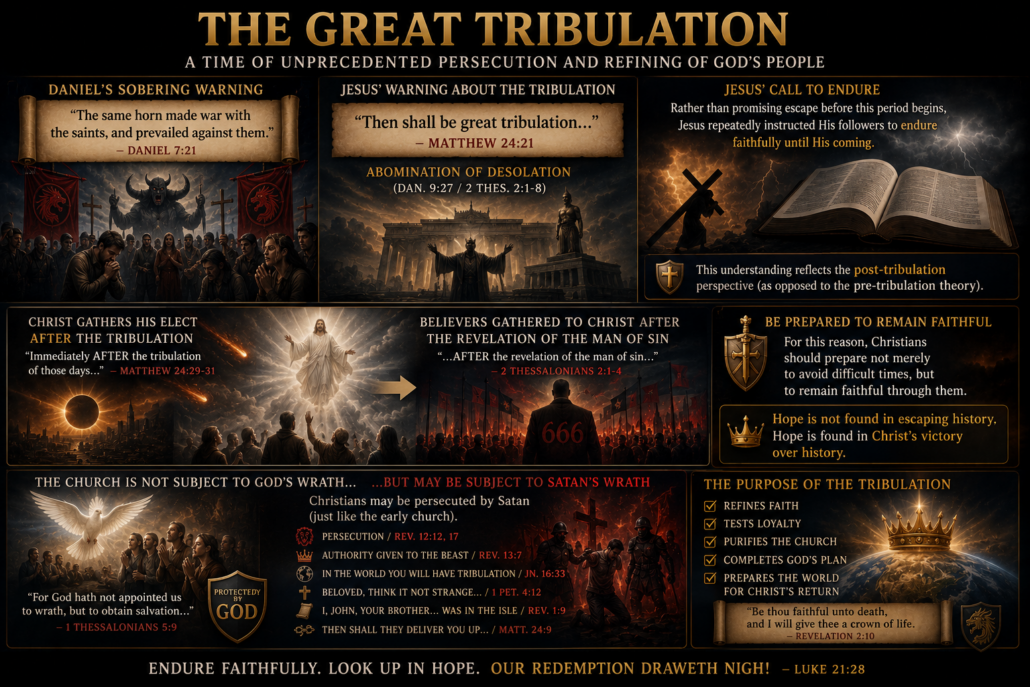
“The same horn made war with the saints, and prevailed against them.” (Daniel 7:21)
Jesus similarly warned His disciples, that at the time of the Abomination of Desolation (Dan. 9:27 / 2 Thes. 2:1-8):
“Then shall be great tribulation…” (Matthew 24:21)
Rather than promising believers escape before this period begins, Jesus repeatedly instructed His followers to endure faithfully until His coming. This understanding reflects the post-tribulation perspective (as opposed to the pre-tribulation theory).
According to Matthew 24:29-31, Christ gathers His elect AFTER the tribulation of those days, immediately following the cosmic signs that precede His visible return.
Likewise, Paul teaches that believers are gathered to Christ AFTER the revelation of the man of sin (2 Thessalonians 2:1-4).
For this reason, Christians should prepare not merely to avoid difficult times, but to remain faithful through them.
Hope is not found in escaping history. Hope is found in Christ’s victory over history.
Although the Church is not subject (or appointed) to the wrath of God (1 Thes. 5:9), we certainly may be subjected to the wrath of Satan (i.e., persecution / cf. Rev. 12:12, 17 / Rev. 13:7 / Jn. 16:33 / 1 Pet. 4:12 / Rev. 1:9 / Matt. 24:9) just like the early church.
The Battle of Armageddon
Daniel’s vision reaches its climax when heaven intervenes.
The Antichrist’s kingdom appears unstoppable.
Human government reaches its highest expression.
Then Jesus Christ returns.
Revelation 19 describes Christ descending from heaven as King of kings and Lord of lords.
The Beast and the False Prophet are cast alive into the Lake of Fire (Revelation 19:20).
Satan is bound.
The kingdoms of this world become the Kingdom of our Lord.
Daniel foresaw this moment centuries earlier.
“The kingdom and dominion… shall be given to the people of the saints of the most High…” (Daniel 7:27)
Every earthly empire eventually falls.
Christ’s Kingdom never will.
Common Misunderstandings About America in Bible Prophecy
Misunderstanding #1: America Must Be Mentioned by Name
Some argue that because the word “America” never appears in Scripture, the United States cannot be part of Bible prophecy.
However, neither Germany, Russia, the United Kingdom, nor countless other modern nations appear by their contemporary names.
Biblical prophecy commonly uses symbols rather than future political names.
The question is not whether America is named explicitly.
The question is whether Daniel’s symbolism reasonably corresponds to modern nations existing at the time of Christ’s return. Interestingly, God is batting 1.000 (as all prophecies are emerging and seem to fit perfectly).
Misunderstanding #2: This Interpretation Is Certain
It is important to approach prophecy with humility.
Bible prophecy contains truths that are absolutely clear, such as the bodily return of Jesus Christ.
Other details require careful interpretation.
The identification of America’s role in Daniel 7 belongs to the latter category.
This interpretation seeks to follow the biblical evidence while acknowledging that sincere believers may reach different conclusions.
Christians should hold firmly to Scripture while exercising charity toward fellow believers who differ on prophetic details.
Misunderstanding #3: Prophecy Is About Predicting Headlines
One of the greatest dangers in prophecy teaching is allowing today’s news cycle to dictate biblical interpretation.
Current events should never become the foundation of doctrine.
Instead, Scripture provides the framework through which current events are evaluated.
Our confidence rests in God’s Word, not in newspaper headlines.
What This Means for Christians Today
Whether one fully embraces this interpretation of Daniel 7 or not, its central message remains unchanged.
Jesus Christ is coming again, and from all given indicators, His return is soon.
Human governments are temporary. God’s Kingdom is eternal.
That truth should change how Christians live today.
Live with Spiritual Readiness
Jesus repeatedly instructed His followers to watch.
Watching is not fearful speculation.
Watching means remaining spiritually awake, faithful, and obedient while anticipating His return.
Develop Biblical Discernment
The increasing complexity of global politics makes biblical understanding more important than ever.
Christians should evaluate world events through the lens of Scripture rather than through partisan ideology or sensational media.
A biblical worldview produces confidence rather than confusion.
Share the Gospel
Prophecy is never an end in itself.
Every prophecy ultimately points people toward Jesus Christ.
If Daniel’s vision reminds us that Christ’s return is drawing near, then it should also increase our urgency to share the Gospel with those who have never trusted Him.
Jesus taught that unless we are Born Again, we cannot see or enter the kingdom of God.
Make sure you are Born Again (the Bible way): visit Endtime.com/Reborn
Place Your Hope in Christ
Nations rise.
Empires fall.
Political systems change.
Economic powers shift.
But Hebrews 13:8 reminds us:
“Jesus Christ the same yesterday, and to day, and for ever.”
Our confidence is not in America.
It is not in Britain.
It is not in Europe.
It is not in any earthly government.
Our hope rests entirely in the coming King whose Kingdom shall never end.
As Daniel concludes his vision, every beast eventually disappears from the center of history.
Only one Kingdom remains forever.
That is the Kingdom every believer should be preparing to enter.
Frequently Asked Questions
Is America mentioned by name anywhere in the Bible?
No. The Bible does not mention the United States by its modern name. Those who believe America appears in prophecy understand it to be represented symbolically rather than explicitly. Daniel 7 uses symbolic imagery throughout the chapter, identifying kingdoms through beasts rather than by their future political names (Daniel 7:3-7, 17).
Why do some believe the eagle’s wings represent America?
The interpretation is based on three primary observations. First, the eagle has long been America’s national symbol. Second, the eagle’s wings are attached to the lion, which many identify as Great Britain. Third, the wings are separated from the lion, corresponding to America’s emergence from British rule. Supporters believe this sequence aligns closely with the historical relationship between Great Britain and the United States (Daniel 7:4).
Add to that, many Scriptures indicate that the days in which we now live, are the “last days” (or end time). Remember, the nations (beasts) of Daniel 7 must all be in existence on Earth at the time of Christ’s Second Coming.
Doesn’t Daniel 7 refer only to Babylon, Medo-Persia, Greece, and Rome?
Many respected Bible scholars hold that interpretation, and it remains one of the most widely accepted views within evangelical scholarship. This article presents another interpretation that understands Daniel 7 as describing nations existing immediately before the Second Coming of Jesus Christ because Daniel 7:11-12 places these beasts at the time when Christ establishes His Kingdom. Readers should study the Scriptures carefully and examine the evidence for themselves (Acts 17:11).
Why is identifying America in prophecy important?
The purpose is not to elevate one nation above another. Rather, understanding prophecy helps believers recognize that God directs human history according to His sovereign plan. Identifying modern nations within prophetic Scripture, if the interpretation is correct, reminds us that Christ’s return is drawing nearer and encourages spiritual readiness (Matthew 24:42-44).
What role does America play in the last days?
According to this interpretation, America is symbolized by the eagle’s wings connected to the British lion. While Daniel 7 does not describe every detail of America’s future, it suggests that the nation exists during the generation that witnesses Christ’s return. Scripture ultimately places greater emphasis on the rise of the Antichrist, the final world government, and the coming Kingdom of God than on the future of any individual nation (Daniel 7:23-27); however, America is depicted as protecting Israel all throughout the Great Tribulation, until the return of Christ at the battle of Armageddon (Rev. 12:14).
Does this interpretation change the message of the Gospel?
Not at all.
Whether someone agrees with this interpretation of Daniel 7 or prefers another view, the central message of Scripture remains unchanged. Jesus Christ died for our sins, was buried, rose from the dead on the 3rd day, and will return in power and glory to establish His everlasting Kingdom (1 Corinthians 15:3-4; Revelation 19:11-16). The faithful Born Again believers will get to enjoy this marvelous kingdom and eternal life.
Should Christians be afraid of end time prophecy?
No.
Bible prophecy was given to produce faith, not fear. – John 14:29
Jesus repeatedly encouraged His followers to watch, pray, and remain faithful. Prophecy reminds believers that God remains in complete control of history and that Christ’s victory is certain (John 14:1-3; Luke 21:28).
How should Christians respond to these prophecies?
The proper response is not speculation but preparation.
Believers should cultivate a deeper relationship with Jesus Christ, faithfully study God’s Word, share the Gospel, and remain steadfast regardless of the challenges that lie ahead.
As Paul wrote:
“Therefore, my beloved brethren, be ye steadfast, unmoveable, always abounding in the work of the Lord…” (1 Corinthians 15:58 – KJV).
Conclusion
So, is America in the Bible?
While the Scriptures never mention the United States by name, Daniel’s vision presents compelling symbolism that many students of Bible prophecy and eschatology scholars and experts believe corresponds to America through the eagle’s wings attached to the British lion. When considered alongside the historical relationship between Great Britain and the United States, the continued existence of these symbolic nations at the time of Christ’s return, and the broader prophetic framework of Daniel and Revelation, this interpretation offers a coherent understanding of America’s possible (and in my mind, absolute) place within biblical prophecy.
After all – as U.S. Vice President J.D. Vance (recently) said:
“America is Israel’s only ally.”
At the same time, Christians should remember that identifying nations is never the ultimate goal of prophecy.
The focus of Daniel’s vision is not just America.
It is not Great Britain.
It is not Russia.
It is not Europe.
The focus is Jesus Christ.
Every prophecy moves history toward one climactic moment when “the kingdoms of this world are become the kingdoms of our Lord, and of his Christ; and he shall reign for ever and ever” (Revelation 11:15).
That truth should fill believers with confidence rather than anxiety.
Our hope does not rest in the strength of any earthly nation. Governments rise and fall according to God’s sovereign purposes, but Christ’s Kingdom will never be shaken.
Whether we witness dramatic geopolitical changes, increasing global instability, or the fulfillment of prophecies yet to come, our calling remains the same.
Remain faithful.
Study the Scriptures.
Obey and Proclaim the Gospel.
Live with expectancy.
And look forward to the glorious appearing of our great God and Savior, Jesus Christ.
Bibliography
Primary Source
- The Holy Bible (Scripture references throughout. Recommended translations: KJV, NKJV, ESV).
Books
- Baxter, Irvin. Understanding the End Time. Endtime Ministries. Chapter 1: “United States in Bible Prophecy.”
Online Resources
- Endtime. “United States Discovered in the Bible.” https://www.endtime.com/united-states-discovered-in-the-bible/
- Britannica. “Uncle Sam.”
- Encyclopaedia Britannica. “Bald Eagle.”
About the Author
Bryan Smith serves as Content & Teaching Pastor at Endtime Ministries and has been part of the Endtime family for more than 25 years. He has been engaged in pastoral ministry for two decades, served as Academic Dean, Registrar, and Professor for Valor University, and is a frequent teacher of the Understanding the End Time class. Bryan holds a Bachelor of Arts (B.A.) in Theology, a Master of Arts (M.A.) in Leadership, has completed advanced studies in the history of prophecy through HarvardX’s certificate program with Harvard University, and is pursuing a Doctor of Ministry (D.MIN.) in Biblical Studies. In addition to hosting The Bible Prophecy Show podcast, Bryan is a regular contributor to Endtime magazine and writes on the intersection of Bible prophecy, theology, and global current events.