
When Love Grows Cold: The Cultural Decline of Love
By Bryan Smith
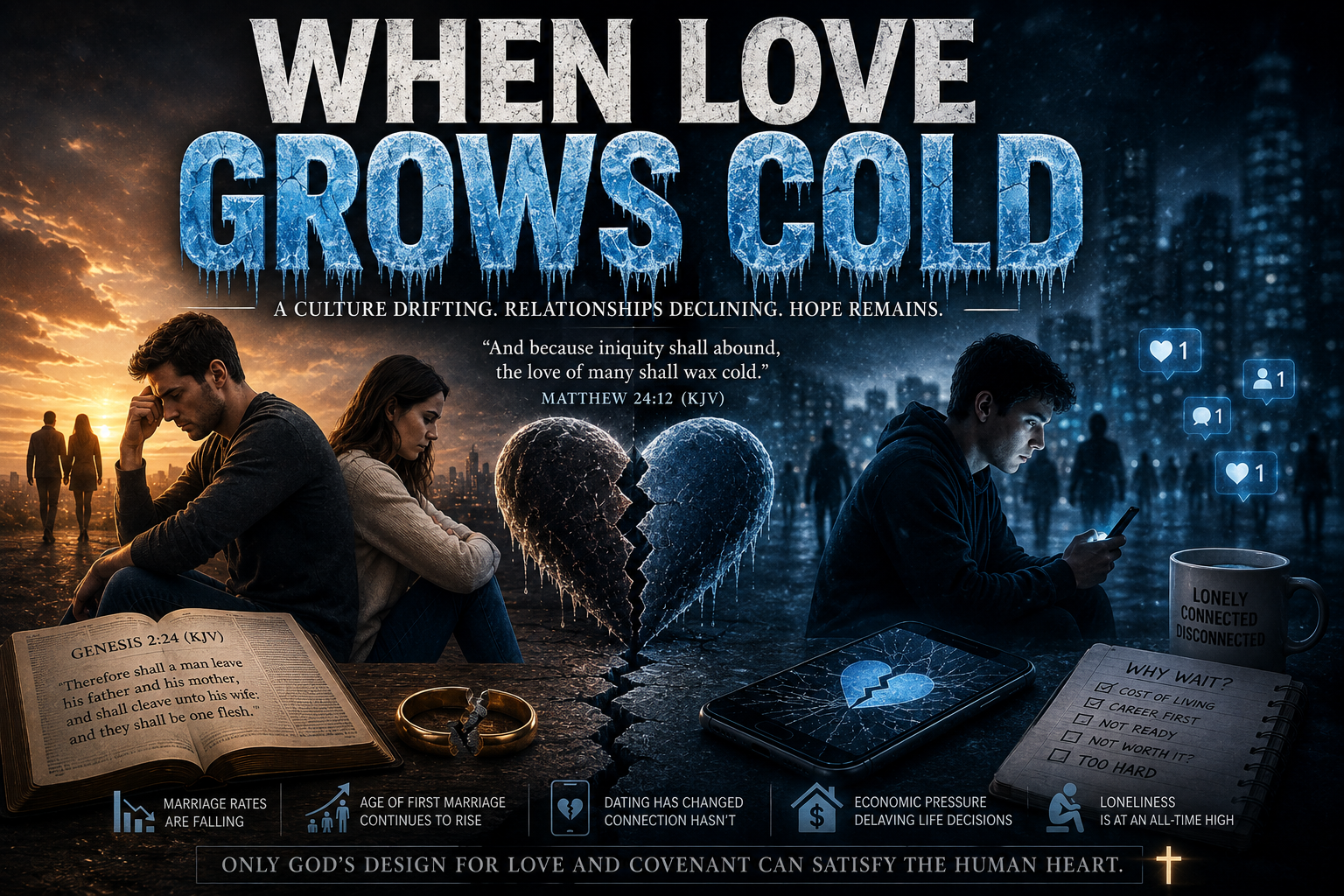
A growing retreat from marriage and meaningful relationships reflects deeper cultural shifts, raising important questions about the future of family, community, and the moral fabric of society.
Well, it’s happening; the love of many is growing cold, just as Jesus predicted approximately 2,000 years ago. For generations, marriage and family served as foundational institutions that strengthened communities and provided stability across cultures. Today, however, a growing body of research suggests those foundations are weakening. Fewer young adults are dating, marriage rates continue to decline, and many people report increasing loneliness despite living in an age of unprecedented digital connectivity.
Recent analysis examining what many researchers have labeled a “romance recession” highlights an unmistakable trend. Young adults are postponing or avoiding committed relationships at historic levels. While economic pressures, changing social expectations, and technological developments all contribute to the phenomenon, many observers believe the decline reaches beyond sociology into something much deeper. Is there a spiritual element?
The question is no longer simply why fewer people are dating.
The greater question is what these changing relationships reveal about the condition of modern society.
What Happened?
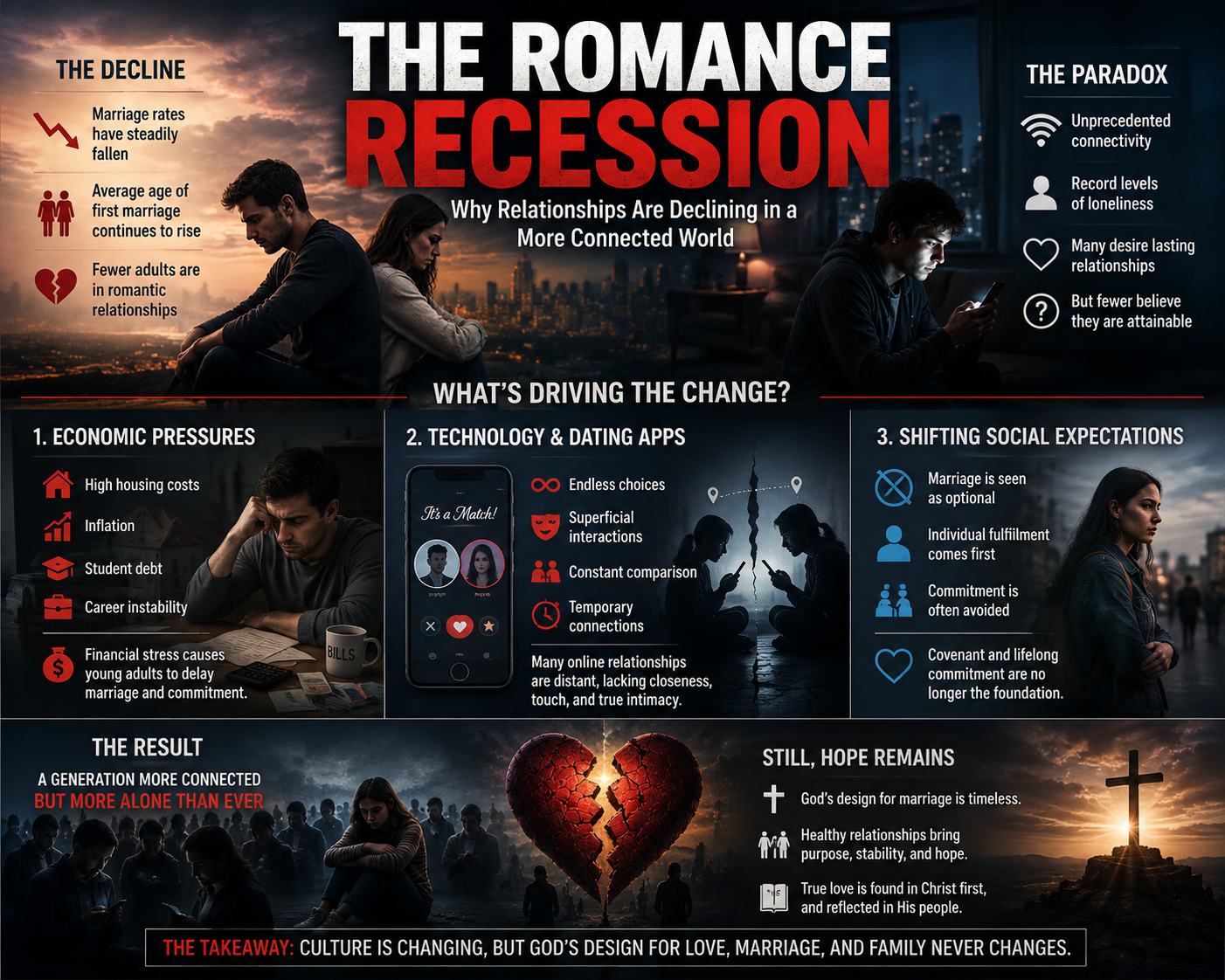
Researchers examining relationship trends have documented significant changes over the past two decades. Marriage rates have steadily fallen, the average age of first marriage continues to rise, and many adults report participating in fewer romantic relationships than previous generations.
Several factors appear to be driving these developments.
Economic uncertainty has caused many young adults to delay major life decisions. Housing costs, inflation, student debt, and career instability have made marriage seem financially unattainable for many couples.
Technology has also fundamentally altered the dating landscape. While dating applications have made meeting new people easier in theory, many users report feeling overwhelmed by endless choices, superficial interactions, and increasing dissatisfaction. Instead of fostering deeper commitment, digital platforms often encourage constant comparison and temporary connections. Many of these online relationship are additionally engaged in as “distant relationship,” which are a strain and hard to manage, missing elements like closeness and touch.
Social expectations have shifted as well. Marriage is increasingly viewed as optional rather than foundational, and individual fulfillment is often prioritized above lifelong covenant commitment.
The result is a generation experiencing unprecedented connectivity through technology while simultaneously reporting record levels of loneliness and relational isolation.
Although many still express a desire for lasting relationships, fewer appear confident that such relationships are attainable.
Why This Matters
The decline of healthy relationships affects far more than individual happiness.
Strong marriages and families have historically served as the basic building blocks of stable societies. They provide environments where children are nurtured, values are transmitted, communities are strengthened, and future generations are prepared for responsible citizenship.
When those institutions weaken, the effects ripple throughout society.
Economically, declining marriage rates contribute to lower birth rates and shrinking populations across many developed nations. Governments increasingly face challenges associated with aging populations, workforce shortages, and expanding entitlement obligations.
Socially, loneliness has become one of the defining public health concerns of modern society. Numerous studies have linked chronic isolation with depression, anxiety, declining physical health, and shortened life expectancy. The overall quality of life is, therefore, diminished.
Culturally, the erosion of lifelong commitment has contributed to greater instability in family structures and diminished confidence in institutions that once fostered long-term responsibility.
While policymakers often focus on economic incentives or technological reforms, these solutions rarely address the underlying moral and spiritual dimensions that shape human relationships.
The symptoms are increasingly visible.
The causes are considerably deeper.
A Biblical View of Love and Covenant
From the opening chapters of Genesis, marriage is presented as part of God’s created order, and ultimately reflects our relationship with God as the Bride-groom and the church as “the Bride of Christ” (cf. John 3:29; Matt. 9:15; Matt. 25:1-13).
Scripture declares,
“Therefore shall a man leave his father and his mother, and shall cleave unto his wife: and they shall be one flesh” (Genesis 2:24, KJV).
Marriage is portrayed not merely as a social contract but as a covenant established by God. Throughout both the Old and New Testaments, faithful marriage serves as a picture of God’s covenant relationship with His people.
When society minimizes covenant commitment, the consequences extend beyond changing cultural preferences.
They reveal changing hearts.
The Bible consistently teaches that genuine love involves sacrifice, faithfulness, forgiveness, and perseverance rather than mere emotional fulfillment.
Those biblical qualities increasingly stand in contrast to a culture that often prizes convenience, self-expression, and immediate gratification.

Prophetic Perspective
Scripture does not predict a “romance recession” per se, but it does predict a love decline as one sign of the times just prior to the return of Jesus Christ. The agape love (for God and others) is paramount to our relationship with God and our fellow man (Matt. 22:37-39).
In Matthew 24, Christ warned His disciples about increasing deception, persecution, and widespread lawlessness during the last days. In that context, He made a profound statement:
“And because iniquity shall abound, the love of many shall wax cold.” (Matthew 24:12, KJV)
This prophecy appears within Jesus’ Olivet Discourse, His comprehensive teaching concerning events leading to His Second Coming.
The word translated “love” extends well beyond romantic affection. It speaks of genuine compassion, covenant faithfulness, and selfless concern for others. This kind of love also connects with God and all those around us, which certainly includes our closest relationships (e.g., those whom we date, and/or marry).
Jesus connected the cooling of love directly to the increase of iniquity.
- As sin becomes normalized, love diminishes.
- As truth is rejected, relationships deteriorate.
- As biblical morality erodes, selfishness increasingly replaces sacrificial commitment.
Today’s challenges surrounding marriage, family, and meaningful relationships illustrate that principle in tangible ways.
While Matthew 24:12 should not be interpreted as referring exclusively to romance or marriage, the weakening of lifelong covenant relationships certainly reflects a broader cooling of love throughout society. Our love for God must never falter or fade. The fire and passion for Him must remain strong until the very end.
Matthew 24:13 – “But he that shall endure unto the end, the same shall be saved.”
These developments should not surprise students of Bible prophecy.
Neither should they produce fear.
Instead, they remind believers that God’s Word accurately describes the spiritual climate that will characterize the generation preceding Christ’s return. We do not have to succumb to the spiritual decline surrounding us, merely because they were prophesied. We have a will, and the power to choose our destiny.
Therefore, choose love. Love the Lord thy God with all thy heart, soul, mind, and strength, and love thy neighbor as thyself. Those who obey Christ’s command, living out this love until the end – shall be saved.
To learn more about how to be Born Again (the Bible way) ==> CLICK HERE.
What Bible Prophecy Students Should Watch
The Future of Marriage and Family
Watch whether governments, educational systems, and cultural institutions continue redefining marriage, family, and gender roles. These trends shape the moral environment Scripture says will exist during the last days.
Growing Moral Relativism
Jesus connected increasing lawlessness with diminishing love. As societies increasingly reject objective moral standards, believers should expect further deterioration in personal relationships, civic trust, and family stability.
Spiritual Readiness
Rather than becoming discouraged by cultural decline, Christians should remain committed to biblical marriage, healthy families, and authentic Christian community. Faithful living provides a powerful testimony in an increasingly fractured world.
Final Thought
Every generation experiences cultural change, but Scripture reminds us that the deepest problems facing humanity are ultimately spiritual rather than merely political, economic, or sociological.
The growing challenges surrounding relationships are not simply evidence of changing preferences. They reveal hearts searching for lasting hope apart from God’s design.
Jesus warned that the love of many would grow cold before His return, yet He also promised that those who remain faithful will endure. In a culture marked by increasing isolation and uncertainty, believers have an opportunity to demonstrate the enduring love, faithfulness, and covenant commitment that reflect the character of Jesus Christ.
As society continues searching for answers, God’s design for marriage, family, and genuine love remains as relevant today as it has always been.
Sources
- https://www.theatlantic.com/magazine/2026/09/modern-romance-recession/687968/
- Matthew 24:12 (KJV)
- Genesis 2:24 (KJV)
About the Author
 Bryan Smith serves as Content & Teaching Pastor at Endtime Ministries and has been part of the Endtime family for more than 25 years. He has been engaged in pastoral ministry for two decades, served as Academic Dean, Registrar, and Professor for Valor University, and is a frequent teacher of the Understanding the End Time class. Bryan holds a Bachelor of Arts (B.A.) in Theology, a Master of Arts (M.A.) in Leadership, has completed advanced studies in the history of prophecy through HarvardX’s certificate program with Harvard University, and is pursuing a Doctor of Ministry (D.Min.) in Biblical Studies. In addition to hosting The Bible Prophecy Show podcast, Bryan is a regular contributor to Endtime magazine and writes on the intersection of Bible prophecy, theology, and global current events.

Latest Articles