
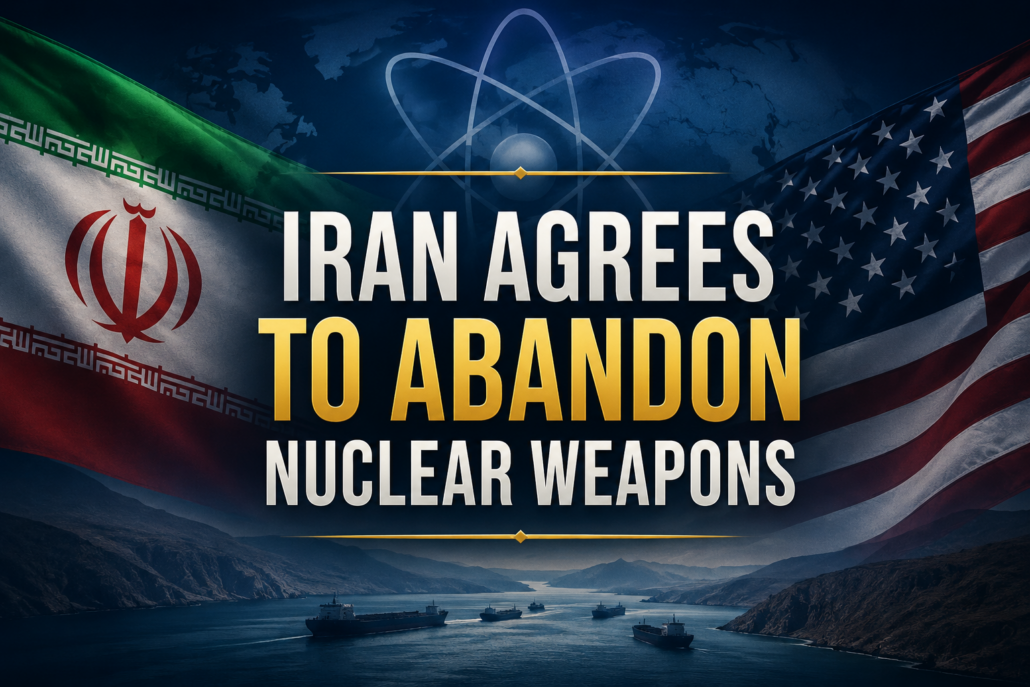
Iran Signals Willingness to Abandon Nuclear Weapons in Draft Agreement With U.S.
Iran Signals Willingness to Abandon Nuclear Weapons in Draft Agreement With U.S.
Proposed framework could reshape Middle East diplomacy as questions remain about enforcement, regional security, and long-term stability.
By Bryan Smith
A senior Iranian official says Tehran has agreed in principle that it will neither produce nor acquire nuclear weapons as part of a draft memorandum of understanding being negotiated with the United States. The reported framework, which emerged through ongoing mediation efforts involving regional partners, represents one of the most significant developments in U.S.-Iran relations in years.
According to reports, the draft agreement would include restrictions on Iran’s nuclear activities, sanctions relief from the United States, the release of frozen Iranian assets, and steps toward reopening the Strait of Hormuz, one of the world’s most strategically important maritime chokepoints.
If finalized, the agreement could affect regional security calculations across the Middle East and influence the future trajectory of one of the world’s most volatile geopolitical flashpoints.
What Happened?
Reports indicate that Iranian and American negotiators have been working through intermediaries to develop a framework aimed at reducing tensions and addressing concerns surrounding Iran’s nuclear program. A senior Iranian official told Reuters that the proposed memorandum would commit Iran to neither producing nor acquiring nuclear weapons.
The draft reportedly includes provisions requiring Iran to dilute portions of its highly enriched uranium stockpile. Details regarding implementation and verification mechanisms are expected to be discussed during a proposed 60-day negotiation period.
In exchange, the United States would reportedly waive certain oil-related sanctions for a designated period and release billions of dollars in frozen Iranian assets. The proposal also includes discussions regarding the reopening of the Strait of Hormuz, a vital shipping lane through which a significant percentage of the world’s energy supplies pass.
The reported framework follows years of tensions over Iran’s nuclear ambitions. Western governments have long expressed concern that Tehran’s enrichment capabilities could eventually be used to produce nuclear weapons. Iranian officials have consistently maintained that their nuclear program is intended for peaceful purposes.
While both sides appear to be exploring a diplomatic path forward, questions remain regarding verification, enforcement, regional security guarantees, and the durability of any final agreement.
Why This Matters
The implications of a potential U.S.-Iran agreement extend far beyond the nuclear issue itself.
From a geopolitical standpoint, a successful agreement could temporarily reduce tensions throughout the Middle East. Nations across the region have watched closely as conflicts involving Iran and its proxy networks have contributed to instability stretching from Lebanon and Syria to Iraq and Yemen.
Economically, the possibility of sanctions relief could significantly impact global energy markets. Iran possesses some of the world’s largest oil and natural gas reserves. Increased Iranian energy exports could influence global supply levels and potentially affect energy prices.
The proposed reopening and stabilization of the Strait of Hormuz carries additional economic significance. Roughly one-fifth of the world’s petroleum supply passes through this narrow waterway. Any reduction in threats to maritime commerce would likely be welcomed by international markets and shipping interests.
Diplomatically, the agreement could reshape alliances and strategic calculations throughout the region. Supporters argue that diplomacy offers an opportunity to prevent future military escalation. Critics contend that sanctions relief and financial incentives could strengthen a regime that has continued to support armed proxy organizations throughout the Middle East.
The ultimate success of any agreement will likely depend on whether both sides follow through on their commitments and whether international inspectors can verify compliance.
Prophetic Perspective
Let’s face it, Iran and others would love to wipe the nation of Israel off the map. Israel is a one nuke nation: meaning, one well designed and detonated nuclear bomb has the potential to destroy all or most of the nation of Israel.
Will God allow Israel to be wiped of the face of the earth (i.e., “from the river to the sea”)?
Not on your life. But Israel will suffer greatly during “Jacob’s Trouble” during the Great Tribulation (cf. Jer. 30:7; Matt. 24:21), as 2/3rds shall be “cut off and die” and (God said): “I will bring the third [remaining part] through the fire, and will refine them…” (Zech. 13:8-9, KJV).
At this stage, the reported agreement does not constitute a direct fulfillment of Bible prophecy, and Scripture does not specifically predict a modern nuclear agreement between Iran and the United States. Therefore, prophecy students should exercise caution and avoid drawing conclusions beyond what the biblical text supports.
However, the broader geopolitical significance of Iran remains noteworthy within a prophetic framework.
The Bible repeatedly identifies the Middle East as the focal point of major end-time developments like the coming Sixth Trumpet War that will kill 1/3rd of mankind. Nations surrounding Israel continue to play a central role in regional events, and any major shift involving Iran naturally draws attention from students of prophecy. The Sixth Trumpet War is one of the major prophetic events that are just ahead of us now, and will occur prior to the battle of Armageddon.
To learn more about Armageddon (click here):
One passage frequently discussed in connection with future Middle Eastern conflicts is Revelation 9:13-21, often referred to as the prophecy of the Sixth Trumpet War. This prophecy describes a future conflict that results in the deaths of one-third of mankind. While the current diplomatic discussions are not the fulfillment of that prophecy, they demonstrate the ongoing strategic importance of nations located within and around the Euphrates region.
Does the U.S. and Iran agreement mean it’s not yet time for the biblical 6th Trumpet War?
It could; however, it does not mean the Sixth Trumpet War will be avoided, as the prophecies of the Scripture always come to pass. Additionally, it does not mean that it is not time for the Sixth Trumpet War, as it is already set on God’s prophetic time-clock.
And the four angels were loosed, which were prepared for an hour, and a day, and a month, and a year, for to slay the third part of men.
Bible prophecy is history, written in advance. Since God is eternal, and dwells outside of time (and throughout all of time, simultaneously), He has no problem seeing into what is “the future” from our perspective in real-time.
In other words, the war that will emanate from and kill 1/3rd of mankind, cannot be stopped. It’s already occurred in the foreknowledge of God. God has foreseen it all, and recorded it in His Word (i.e., The Holy Bible). Nothing and no one, can stop it. We are called (not to stop it, but) to watch and pray; and to proclaim these prophecies before they come to pass in order to generate faith and convince unbelievers.
Listen to what Jesus said, in John 14:29 (King James Version):
And now I have told you before it come to pass, that, when it is come to pass, ye might believe.
Daniel 11:21-45 describes not only the soon-coming global dictator (called the Antichrist), but also future geopolitical struggles involving powers operating in the Middle East. While interpreters differ regarding specific details, the passage highlights the continued importance of the region in end-time events.
It is also important to recognize that Bible prophecy points toward increasing international efforts aimed at achieving peace and stability. Scripture indicates that future political agreements and diplomatic initiatives will play a role in setting the stage for major prophetic end-time events, including the final seven years to the Second Coming of Jesus Christ (Dan. 9:24-27).
That does not mean every peace agreement fulfills prophecy. It does mean believers should pay attention to diplomatic developments that affect Israel, regional security, and the balance of power in the Middle East.
The distinction is important.
This reported agreement is not itself a prophetic fulfillment. It may, however, contribute to broader geopolitical conditions that could influence future prophetic developments. It looks (today) like the war in Iran is dwindling down. But, we’ve already seen that change on a dime, numerous times. Therefore, we must remain spiritually and prophetically vigilant.
What Bible Prophecy Students Should Watch
Several developments deserve continued attention:
- Whether a final agreement is formally signed and implemented.
- How verification and enforcement mechanisms are structured.
- Iran’s future nuclear capabilities and compliance record.
- The role of regional powers such as Saudi Arabia, Turkey, and Israel.
- Security developments involving the Strait of Hormuz.
- Ongoing efforts toward broader Middle East peace initiatives.
- Any future agreements directly involving Israel and its neighbors.
Students of prophecy should focus on long-term trends rather than reacting to every headline. Scripture encourages believers to watch world events with discernment, understanding that God’s prophetic plan unfolds according to His timetable.
Final Thought
Headlines come and go, treaties are signed and broken, and political leaders rise and fall. Yet Scripture reminds us that God remains sovereign over the affairs of nations.
Whether this agreement succeeds or fails, believers can approach world events with confidence rather than fear. Jesus instructed His followers to watch, pray, and remain spiritually prepared. Current events should not produce panic but should encourage a deeper awareness of God’s unfolding plan and a renewed commitment to faithful living.
About the Author
 Bryan Smith serves as Content & Teaching Pastor at Endtime Ministries and has been part of the Endtime family for more than 25 years. He has been engaged in pastoral ministry for two decades, served as Academic Dean, Registrar, and Professor for Valor University, and is a frequent teacher of the Understanding the End Time class. Bryan holds a Bachelor of Arts (B.A.) in Theology, a Master of Arts (M.A.) in Leadership, has completed advanced studies in the history of prophecy through HarvardX’s certificate program with Harvard University, and is pursuing a Doctor of Ministry (D.Min.) in Biblical Studies. In addition to hosting The Bible Prophecy Show podcast, Bryan is a regular contributor to Endtime magazine and writes on the intersection of Bible prophecy, theology, and global current events.