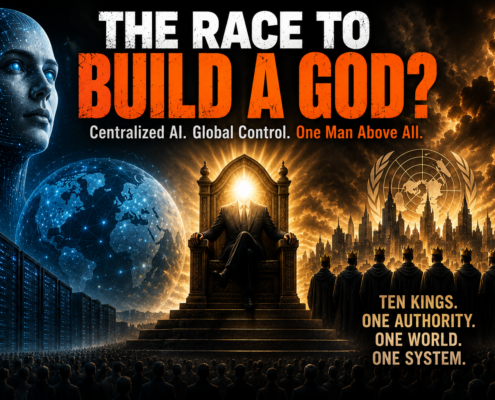
The Race to Build a God?
By Bryan Smith
Mark Zuckerberg warns against concentrating artificial intelligence in the hands of a few powerful institutions, raising questions that reach far beyond Silicon Valley and into the biblical story of mankind’s oldest rebellion.
Long before computers, algorithms, or artificial intelligence existed, Scripture recorded the first attempt to replace God.
The prophet Isaiah describes Lucifer’s rebellion with five chilling declarations, each beginning with the words, “I will.” His ambition culminated in perhaps the most audacious statement ever made by a created being:
“I will ascend above the heights of the clouds; I will be like the most High.” (Isaiah 14:14)
From that moment forward, Satan’s objective has remained remarkably consistent. He has always sought centralized authority, not merely for power’s sake, but so that he might receive the worship that belongs to God alone.
That is why recent comments from Meta CEO Mark Zuckerberg deserve more than a passing glance.
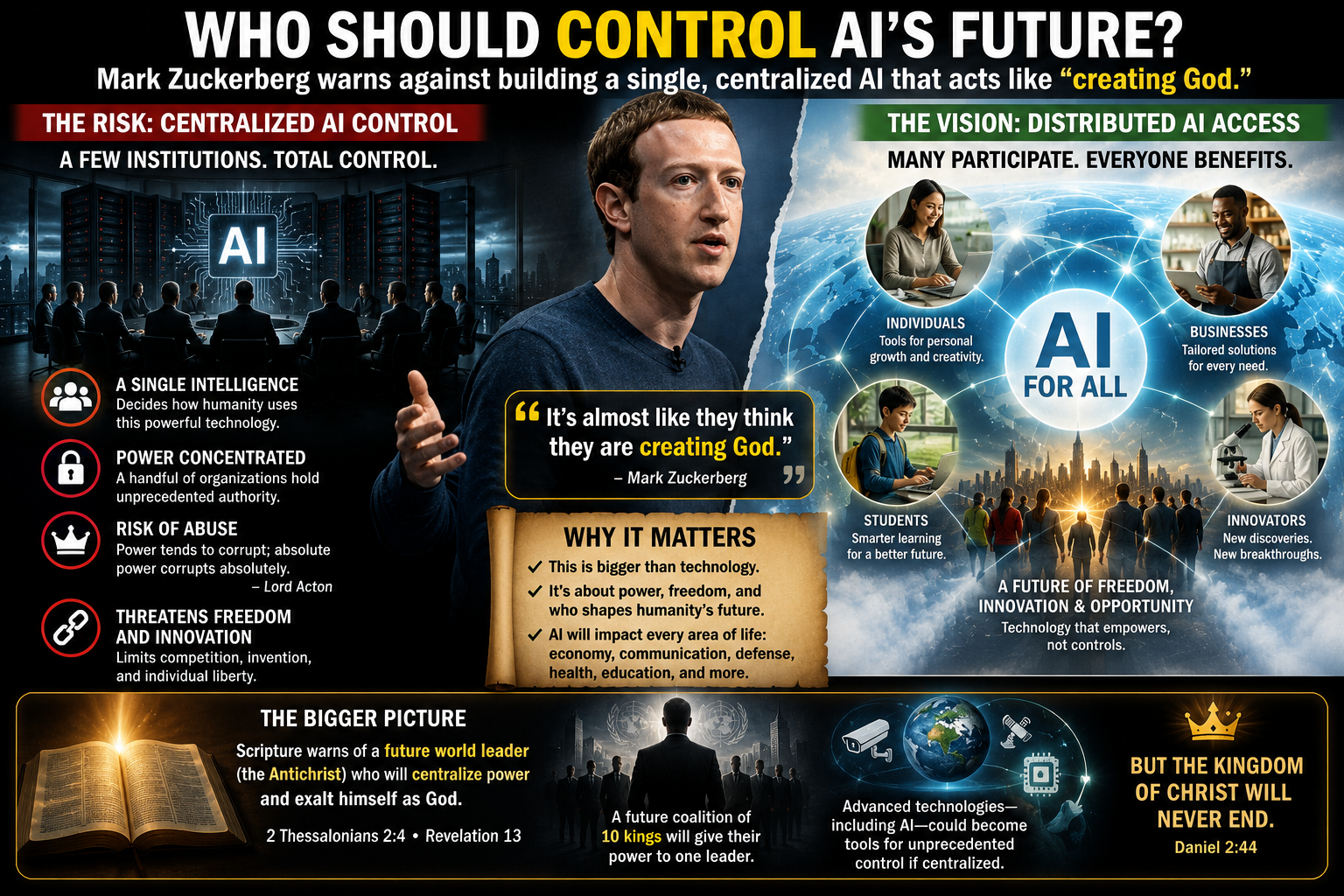
In interviews and public writings released this week, Zuckerberg warned against allowing artificial intelligence to become concentrated in the hands of a small number of organizations.
While discussing the future of AI, Zuckerberg criticized what he views as an emerging philosophy among some competitors that appears to treat the development of a single, tightly controlled superintelligence as though they were “creating God.”
He argued that no small group of executives or institutions should possess that level of influence over humanity’s technological future.
Whether one agrees with Zuckerberg’s broader vision for artificial intelligence is almost beside the point.
His observation unexpectedly touches one of the oldest themes in Scripture.
What Happened?
Artificial intelligence has rapidly become one of the defining technological and geopolitical competitions of the twenty-first century. Governments, universities, and technology companies are investing hundreds of billions of dollars into developing increasingly sophisticated AI systems capable of transforming medicine, finance, manufacturing, defense, communications, and scientific research.
At the center of the current debate is a fundamental disagreement over who should guide (or control) that future.
Some AI developers argue that increasingly powerful systems should remain under the careful oversight of a relatively small group of organizations that can ensure safety, alignment, and responsible deployment. Zuckerberg has publicly challenged that approach.
In recent interviews, including one with The New York Times, along with an opinion essay published in The Wall Street Journal, Zuckerberg argued that
artificial intelligence should not become the exclusive domain of a handful of institutions.
He warned against what he characterized as an effort to build a single, centralized intelligence that effectively determines how humanity will use one of history’s most powerful technologies.
In earlier remarks that have resurfaced during the current debate, Zuckerberg criticized the concept of “one true AI,” suggesting that some within the industry speak as though they are “creating God.” Instead, he advocated for a distributed model (i.e., NOT controlled by a mere handful of powerful people or groups) in which individuals and businesses have access to AI systems tailored to their own needs rather than relying upon one centralized authority.
His concerns extend beyond technology. They involve freedom, innovation, competition, and ultimately who should possess the authority to shape humanity’s future.
Why This Matters
The discussion surrounding artificial intelligence is no longer confined to Silicon Valley.
AI increasingly influences financial markets, national defense, cybersecurity, healthcare, transportation, education, and communication. It is quickly becoming foundational infrastructure for modern civilization, touching nearly every aspect of our daily lives.
With so much influence concentrated within digital systems, an equally important question naturally follows.
Who controls those systems?
History demonstrates that technological breakthroughs often reshape civilizations. But history also demonstrates that whenever extraordinary power becomes centralized, opportunities for abuse tend to increase alongside it. As John Emerich Edward Dalberg-Acton once said:
“Power tends to corrupt, and absolute power corrupts absolutely.”
That is one reason Zuckerberg’s warning has attracted such widespread attention. His concern is not merely whether artificial intelligence becomes more powerful.
His greater concern is whether that power becomes concentrated within the hands of a few people or institutions capable of directing its development for the entire world.
For Christians, that broader question resonates far beyond the technology sector.
Prophetic Perspective
It is important to begin with an important distinction.
Artificial intelligence itself is not the fulfillment of Bible prophecy.
The Bible never predicts AI, machine learning, or computer algorithms.
Likewise, Zuckerberg’s comments should not be viewed as a prophetic fulfillment.
Yet they do illuminate a biblical principle that has existed since the opening chapters of Genesis.
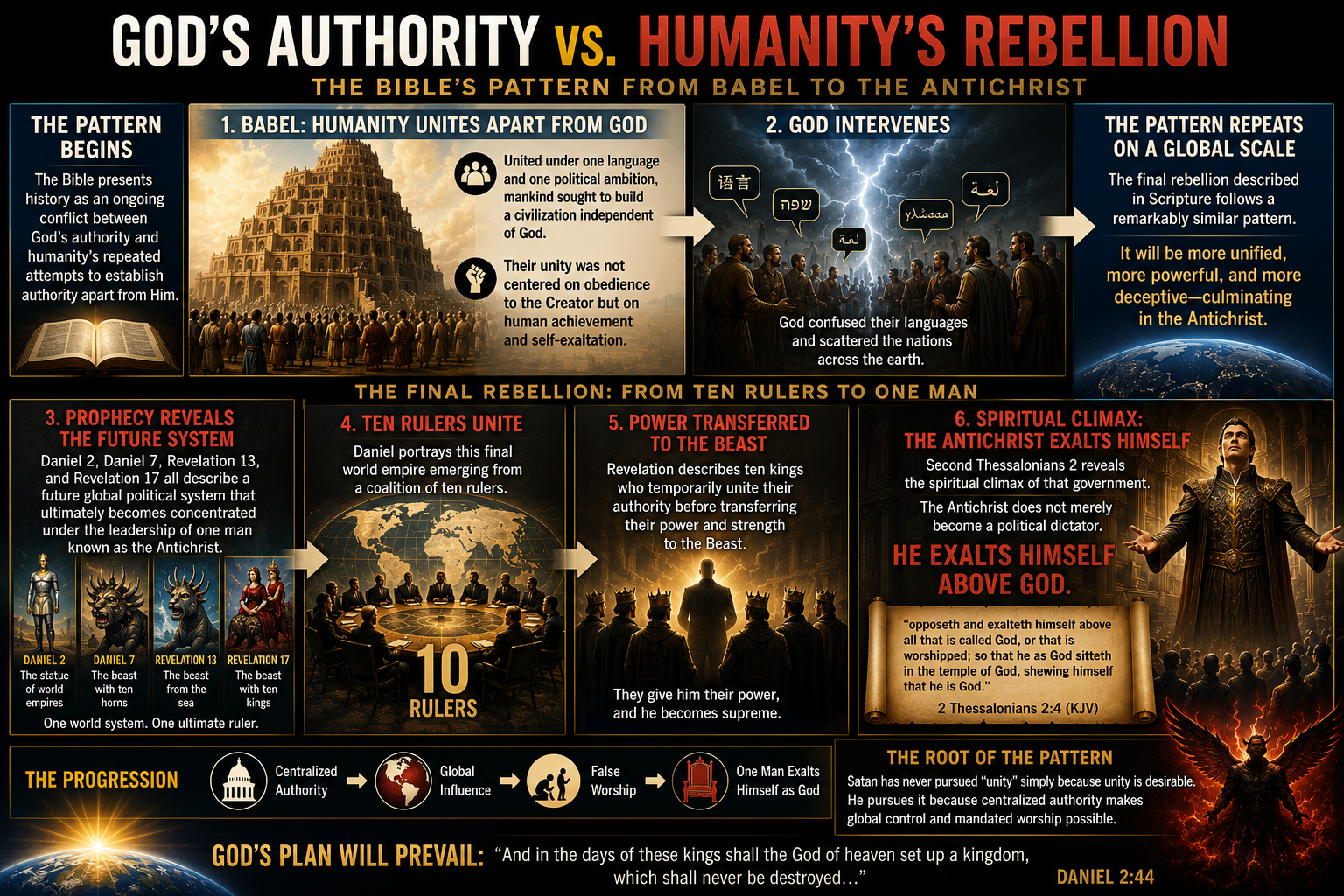
The Bible presents history as an ongoing conflict between God’s authority and humanity’s repeated attempts to establish authority apart from Him.
That conflict reached its first great expression at the Tower of Babel.
United under one language and one political ambition, mankind sought to build a civilization independent of God. Their unity was not centered upon obedience to the Creator but upon human achievement and self-exaltation.
Scripture records that God intervened, confusing their languages and scattering the nations across the earth.
The final rebellion described in Scripture follows a remarkably similar pattern.
Daniel 2, Daniel 7, Revelation 13, and Revelation 17 all describe a future global political system that ultimately becomes concentrated under the leadership of one man commonly known as the Antichrist.
Daniel portrays this final world empire emerging from a coalition of ten rulers. Revelation expands the picture by describing ten kings who temporarily unite their authority before transferring their power to the Beast.
Second Thessalonians 2 reveals the spiritual climax of that government.
The Antichrist does not merely become a political dictator.
He exalts himself above God.
Paul writes that he
“opposeth and exalteth himself above all that is called God, or that is worshipped; so that he as God sitteth in the temple of God, shewing himself that he is God” (2 Thessalonians 2:4).
Notice the progression.
Centralized authority.
Global influence.
False worship.
That pattern has characterized Satan’s ambitions from the beginning.
He has never pursued “unity” (i.e., centralized authority) simply because unity is desirable.
He has pursed “unity” because centralized authority makes global control and mandated worship possible.
This is what makes Zuckerberg’s warning so intriguing.
When one of the world’s leading technology executives cautions against concentrating artificial intelligence into what he describes as a godlike centralized authority, Christians should at least recognize the broader biblical principle at stake.
Scripture does not say artificial intelligence will power the coming world government.
It does not identify AI as the mechanism through which the Antichrist exercises authority.
However, it is not difficult to imagine how increasingly centralized digital systems could dramatically expand the reach of any future government possessing global ambitions.
The Bible reveals that an unprecedented political system is coming.
Today’s technologies could someday become tools within such a system if placed under centralized control.
That possibility should not produce fear.
It should produce discernment.
What Bible Prophecy Students Should Watch
Rather than searching for sensational headlines, believers should pay attention to broader trends.
Watch for continued efforts to centralize digital infrastructure across national boundaries.
Watch for increasing cooperation between governments, international organizations, and major technology companies regarding artificial intelligence standards and governance.
Watch developments within Europe, where Scripture identifies a future coalition of ten rulers that ultimately forms the political foundation from which the Antichrist arises.
Most importantly, remember that technology itself is morally neutral.
The question is never merely what technology can do.
The greater question is who controls it and toward what purpose it is ultimately directed.
Final Thought
The greatest danger facing humanity is not that artificial intelligence becomes intelligent enough to replace mankind.
The greater danger is that mankind becomes arrogant enough to believe it can replace God.
History’s first rebellion began with a created being who desired God’s throne.
History’s final rebellion will culminate with a man who claims to occupy it.
Between those two events, humanity continues building increasingly powerful systems capable of reshaping civilization. Whether those systems become instruments of blessing or instruments of control will depend largely upon those who wield them.
The good news is that Scripture does not end with the triumph of human ambition.
Daniel declared
“in the days of these kings [the 10 toes of Dan. 2 / 10 horns of Dan. 7 / and 10 kings of Dan. 7 and Rev. 13 – which all represent the same 10 end-time rulers] shall the God of heaven set up a kingdom, which shall never be destroyed” (Daniel 2:44).
Every empire will pass away.
Every false kingdom will fall.
Every counterfeit god will be exposed.
And Jesus Christ alone will reign forever.
The most important thing is, to be READY when Jesus returns.
To ensure you are ready to meet Him ==> Click Here
Original Article: https://www.nytimes.com/2026/07/28/technology/mark-zuckerberg-meta-ai.html
About the Author
 Bryan Smith serves as Content & Teaching Pastor at Endtime Ministries and has been part of the Endtime family for more than 25 years. He has been engaged in pastoral ministry for two decades, served as Academic Dean, Registrar, and Professor for Valor University, and is a frequent teacher of the Understanding the End Time class. Bryan holds a Bachelor of Arts (B.A.) in Theology, a Master of Arts (M.A.) in Leadership, has completed advanced studies in the history of prophecy through HarvardX’s certificate program with Harvard University, and is pursuing a Doctor of Ministry (D.Min.) in Biblical Studies. In addition to hosting The Bible Prophecy Show podcast, Bryan is a regular contributor to Endtime magazine and writes on the intersection of Bible prophecy, theology, and global current events.

Latest Articles