
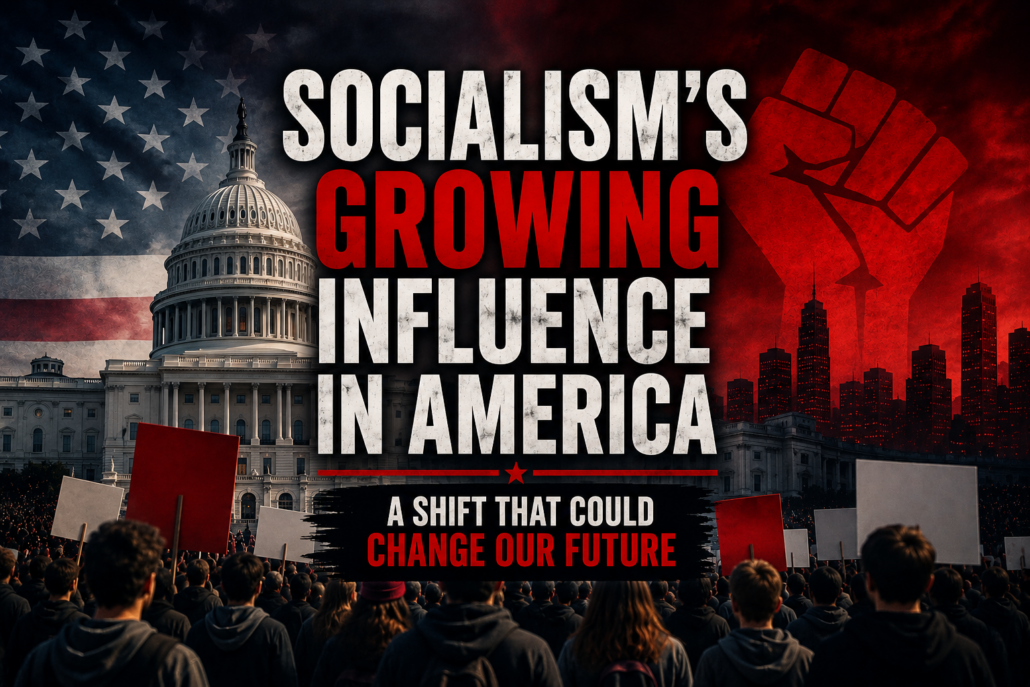
Champagne Socialism Comes to America? Why a Growing Political Trend Matters
A growing embrace of socialist ideas among America’s educated and affluent classes is reshaping political discourse and raising important questions about the future of freedom, government, and global governance.
By Bryan Smith
Champagne Socialism
For decades, socialism in America was largely viewed as a fringe political ideology. Today, however, socialist and democratic socialist ideas have moved increasingly into the mainstream, particularly among younger voters, university-educated professionals, and influential cultural institutions.
A recent commentary in The American Spectator argued that socialism’s modern appeal is no longer driven primarily by working-class movements but by affluent intellectual and professional elites. The article describes this phenomenon as “champagne socialism,” a term often used to describe wealthy or privileged individuals who advocate socialist economic policies while enjoying the benefits of free-market prosperity.
While debates over socialism are not new, the growing acceptance of government-centered economic solutions has become a significant force in American politics and public policy. As economic uncertainty, wealth inequality, housing affordability, and inflation continue to affect millions of Americans, calls for greater government intervention are gaining traction.
American voters are divided, with the conservative-leaning voters longing more for American national sovereignty (i.e., the UN not dictated to the US what it can and cannot do) and personal freedoms (especially of religion, speech, and the right to bear arms), while left-leaning voters seem to welcome the loss of certain freedoms in exchange for promised provisions.
The question for Christians is not merely political. It is whether these trends reveal larger developments that could ultimately contribute to the prophetic system described in Scripture (Rev. 13).
What Happened?
The recent discussion centers around the growing popularity of socialist and collectivist policies within American political culture.
According to The American Spectator, support for socialism is increasingly found among highly educated professionals, affluent urban voters, and younger generations who have become dissatisfied with traditional economic institutions. The article argues that many of these supporters have embraced policies that would expand government control over housing, wages, healthcare, and other sectors of society.
Supporters contend that stronger government involvement is necessary to address economic inequality, rising costs of living, and perceived failures of market-driven systems.
Critics argue that such policies historically reduce economic freedom, weaken private enterprise, and increase dependence upon centralized government authority.
Regardless of one’s political viewpoint, there is little question that the national conversation is shifting. Ideas once considered politically impossible are now openly debated at the highest levels of government, academia, media, and business.
This ideological shift comes during a period of growing distrust in institutions, increasing political polarization, and heightened concerns about economic stability.
Why This Matters
The implications extend far beyond domestic politics. Here are just a few:
Economic Implications
Expanding government involvement in economic affairs inevitably increases centralized control over resources, regulations, and financial systems.
Advocates believe such measures can create greater fairness and economic security.
Opponents warn that excessive centralization often leads to inefficiency, reduced innovation, and limitations on personal economic freedom.
The broader debate concerns how much authority governments should possess over economic activity and individual decision-making.
Political Implications
Historically, crises often create public demand for stronger governmental solutions.
Periods of economic instability, social unrest, and political uncertainty frequently produce support for expanded government authority.
Whether in socialist, nationalist, or technocratic forms, the trend toward centralized power has repeatedly appeared throughout modern history.
Global Implications
Many of the policy discussions occurring in America mirror conversations taking place internationally.
Governments around the world increasingly collaborate through multinational institutions, global economic agreements, and international regulatory frameworks.
For students of Bible prophecy, this broader movement toward international governance deserves careful observation.
Prophetic Perspective
The rise of socialist ideas in America is not itself a direct fulfillment of Bible prophecy.
No biblical prophecy predicts the election of a socialist candidate, the adoption of a particular economic policy, or the success of any specific political movement. However, these developments may contribute to larger trends that Bible prophecy does address.
Scripture foretells the emergence of a global governing system in the years immediately preceding the Second Coming of Jesus Christ. The Harlot Church (Rev. 17) sits atop a scarlet (i.e., Red) colored beast (one world government); the very color associated with socialism (and communism).
So he carried me away in the spirit into the wilderness: and I saw a woman sit upon a scarlet coloured beast, full of names of blasphemy, having seven heads and ten horns.
Revelation 13 describes a final world government that exercises unprecedented authority over political, economic, and religious life. The world is moving toward increasing (red/socialistic) global integration and centralized governance.
After the fall of the Berlin Wall (1989) subsequent geopolitical developments accelerated the movement toward greater international governance and the New World Order.
The United States has dominated the world since that time (i.e., 1989); however, Scripture indicates a shift toward Europe being the primary power of global governance is coming (Dan. 2), picturing the U.S. in a more isolated setting while still protecting and backing the nation of Israel until Christ’s return (cf. Dan. 7; Rev. 12:14).
The key prophetic issue is not whether a society chooses capitalism or socialism (the black horse or the red horse).
See Endtime’s – The Four Horsemen of The Apocalypse – Video (for more info)
The key issue is whether power becomes increasingly concentrated into the hands of governments and international institutions in ways that could eventually support the prophesied end-time One World Government and financial system (i.e., 666 – Mark of the Beast) of the soon-coming Antichrist, called, the Mark of the Beast (Rev. 13).
Since the prophecies of Scripture always come to pass, the question is not “if” these things are coming to a majority of the globe, but “when.”
It appears from Scripture, that ultimately, at least the U.S., Israel, and Jordan may escape out of the hand and One World Government of the coming Antichrist (cf. Dan. 7; Rev. 12-13, Dan. 11:41).
History demonstrates that centralized authority often expands during times of crisis. Whether those expansions occur through economic programs, emergency powers, technological systems, or international agreements, Bible prophecy students should pay attention whenever governmental control becomes more comprehensive.
Scripture calls believers to remain discerning, balanced, and grounded in biblical truth rather than political fear.
2 Timothy 1:7 (King James Version)
For God hath not given us the spirit of fear; but of power, and of love, and of a sound mind.
What Bible Prophecy Students Should Watch
Several developments warrant continued observation:
- Increasing calls for global economic coordination.
- Expansion of international regulatory institutions.
- Growth of digital financial systems and centralized economic oversight.
- Public willingness to exchange personal freedoms for promises of security and stability.
- Continued movement toward international political integration.
None of these developments alone fulfill prophecy.
However, together they may contribute to conditions that could eventually support the system described in Revelation 13.
Students of prophecy should focus less on partisan politics and more on the broader trajectory of world events.
Final Thought
Political movements come and go.
Economic systems rise and fall.
Yet Scripture reminds us that God’s plan remains firmly in place.
Psalm 119:89 (KJV)
For ever, O Lord, thy word is settled in heaven.
While Christians should remain informed about current events, our confidence is not in governments, political parties, or economic theories. Our confidence rests in Jesus Christ and His coming Kingdom.
As the world continues to change, believers are called to remain spiritually prepared, biblically informed, and committed to sharing the gospel.
Rather than responding with fear, we should respond with faith, knowing that every development ultimately unfolds within God’s sovereign plan.
About the Author
 Bryan Smith serves as Content & Teaching Pastor at Endtime Ministries and has been part of the Endtime family for more than 25 years. He has been engaged in pastoral ministry for two decades, served as Academic Dean, Registrar, and Professor for Valor University, and is a frequent teacher of the Understanding the End Time class. Bryan holds a Bachelor of Arts (B.A.) in Theology, a Master of Arts (M.A.) in Leadership, has completed advanced studies in the history of prophecy through HarvardX’s certificate program with Harvard University, and is pursuing a Doctor of Ministry (D.Min.) in Biblical Studies. In addition to hosting The Bible Prophecy Show podcast, Bryan is a regular contributor to Endtime magazine and writes on the intersection of Bible prophecy, theology, and global current events.