

Daniel 8: The Vision That Shook a Prophet—and Foretells Our Future
A Ram, a Goat, and the Rise of Global Power—Decoded Through Scripture
 by Dave Robbins
In the third year of King Belshazzar’s reign, the prophet Daniel received a vision so astonishing, so spiritually weighty, that it left him physically ill for days. This wasn’t just another dream—it was a divine revelation hidden for over 2,500 years, preserved in the Word of God to be understood in our time.
What did Daniel see? Empires rising and falling. A ram. A goat. Four kingdoms. And a “little horn” with global influence and unholy power. But this wasn’t just history in advance—it was prophecy about your future. In this blog, we unpack Daniel chapter 8—one of the most powerful prophetic chapters in all of Scripture.
Daniel: A Prophet for the End Time
At Endtime Ministries, we teach that the book of Daniel is foundational to understanding all of Bible prophecy. While Revelation is certainly vital, it cannot be fully understood without Daniel’s visions. That’s why we begin with Daniel in this series.
Importantly, the book isn’t written in chronological order. For clarity, chapters 1–4 come first, followed by 7 and 8, and then 5, 6, 9, 11, 12, and finally 10. Following this order helps us correctly trace the timeline of kings and events.
Unveiling the Vision
Daniel 8 begins in Shushan (modern-day Susa, Iran), where Daniel is by the River Ulai. There he sees a ram with two horns—one higher than the other—charging west, north, and south. No beast can stand against it. This ram represents the empire of the Medes and the Persians (Daniel 8:20).
Then a goat appears from the west, moving swiftly. It has one prominent horn and violently clashes with the ram, defeating it. The goat, we’re told, is Greece. Its horn is the first king—none other than Alexander the Great (Daniel 8:21).
After the great horn is broken, four horns rise in its place, symbolizing the four generals—Lysimachus, Cassander, Seleucus, and Ptolemy—who divided the Grecian Empire after Alexander’s death. And from one of these comes a “little horn,” a figure of immense prophetic significance.
Prophetic Symbols and Spiritual Warfare
The “little horn” waxes great toward the south, east, and the “pleasant land” (Israel), casting down stars and exalting itself even to the “Prince of the Host.” It removes the daily sacrifice and casts truth to the ground. This is no ordinary military conquest—it’s spiritual warfare.
This passage points us to the Abomination of Desolation, which Jesus Himself referenced in Matthew 24:15. It’s a future event—one we believe lies just ahead on God’s prophetic timeline.
The 2,300 Days: A Mystery Unfolding
Daniel then hears an angelic question: “How long shall be the vision concerning the daily sacrifice and the transgression of desolation?” The answer: 2,300 days—until the sanctuary is cleansed (Daniel 8:13–14).
Some translations render this as “2,300 evenings and mornings,” potentially referring to 1,150 literal days. While we don’t yet claim a conclusive answer, this number is a divine clue, one we believe will become clearer as prophecy continues to unfold.
Gabriel’s Interpretation: Prophecy for the End Time
God sends Gabriel to explain the vision—clear proof of its importance. The angel declares that the vision pertains to “the time of the end” (Daniel 8:17). While the events begin with ancient Persia and Greece, the prophecy stretches forward 2,500 years, culminating in our day.
It’s vital to note that while many commentaries try to align Daniel 7 with Daniel 2, the symbols don’t always match. Daniel 8 clarifies this. The Bible itself identifies the ram as Medo-Persia and the goat as Greece—leaving no room for guesswork.
At Endtime Ministries, we urge believers to trust the Word over tradition. If the Bible clearly defines a symbol, we must accept its interpretation rather than forcing extra-biblical overlays.
Why This Matters Today
Daniel’s vision is not ancient history—it’s a prophetic framework that continues to shape our world today. The rise and fall of empires, the spiritual conflict in the heavens, and the actions of the “little horn” all point to events we are beginning to witness now.
Bible prophecy isn’t about fear—it’s about faith. Jesus said, “I tell you these things before they come to pass, that when they do, you might believe” (John 13:19). Prophecy is God’s way of proving His Word and preparing His people.
Prophecy Validates Scripture—and Builds Faith
Archaeology continues to affirm Daniel’s accuracy—such as the 1850s discovery of an inscription confirming Belshazzar’s co-regency with Nabonidus, long dismissed by critics. Once again, the Bible proves itself more reliable than secular history.
God’s Word stands vindicated, and Daniel’s visions are coming to life before our eyes.
Are You Ready?
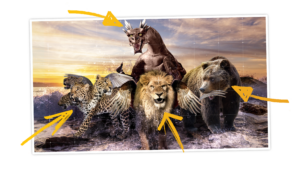
Understanding Daniel prepares us for Revelation. The beasts of Daniel 7 appear again in Revelation 13. The ten kings, the abomination, the war on truth—these aren’t distant concepts. They’re signs on the road ahead.
Join us as we continue through this Daniel series. We’ll unpack the rise of the Antichrist, the timeline of the Second Coming, and your role in the final days.
Until then, may the Spirit of God give you understanding, boldness, and peace as we watch prophecy unfold—together.
→ Want to dive deeper?
📺 Watch the full episode of “The Endtime Show” on endtime.com/show
📅 Attend a Prophecy Conference near you: endtime.com/events
📞 Call 800-ENDTIME to connect with our ministry team.