
Daniel’s Confirmation of the Covenant Explained
By Bryan Smith
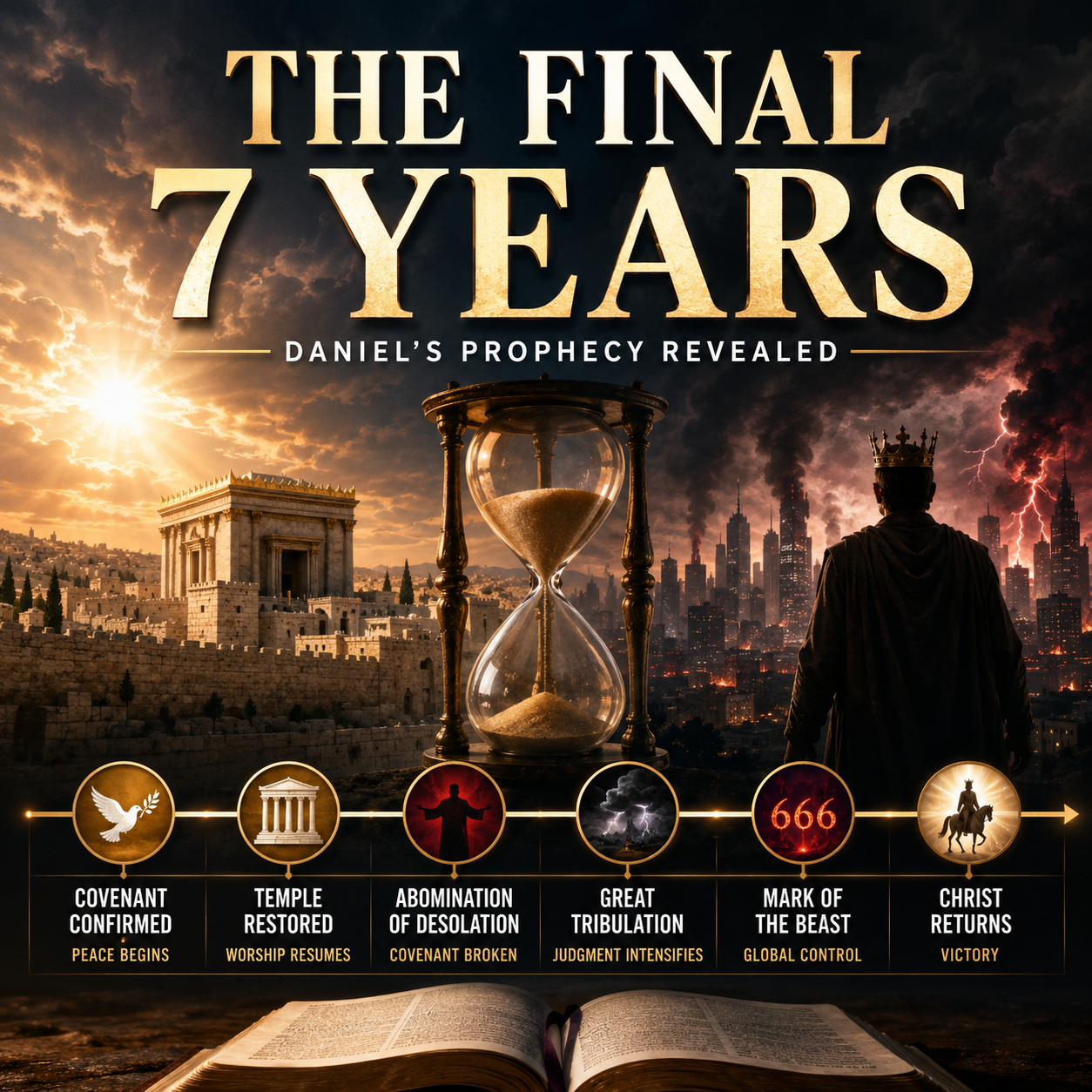
What is the biblically prophesied Final 7-Year Covenant (i.e., the Confirmation of the Covenant) noted in Daniel 9:27? Discover what the Bible teaches about the coming peace agreement, the Antichrist, the Third Temple, and the prophetic events leading to the Second Coming of Jesus Christ.
The Final 7-Year Covenant Explained
The Short Answer
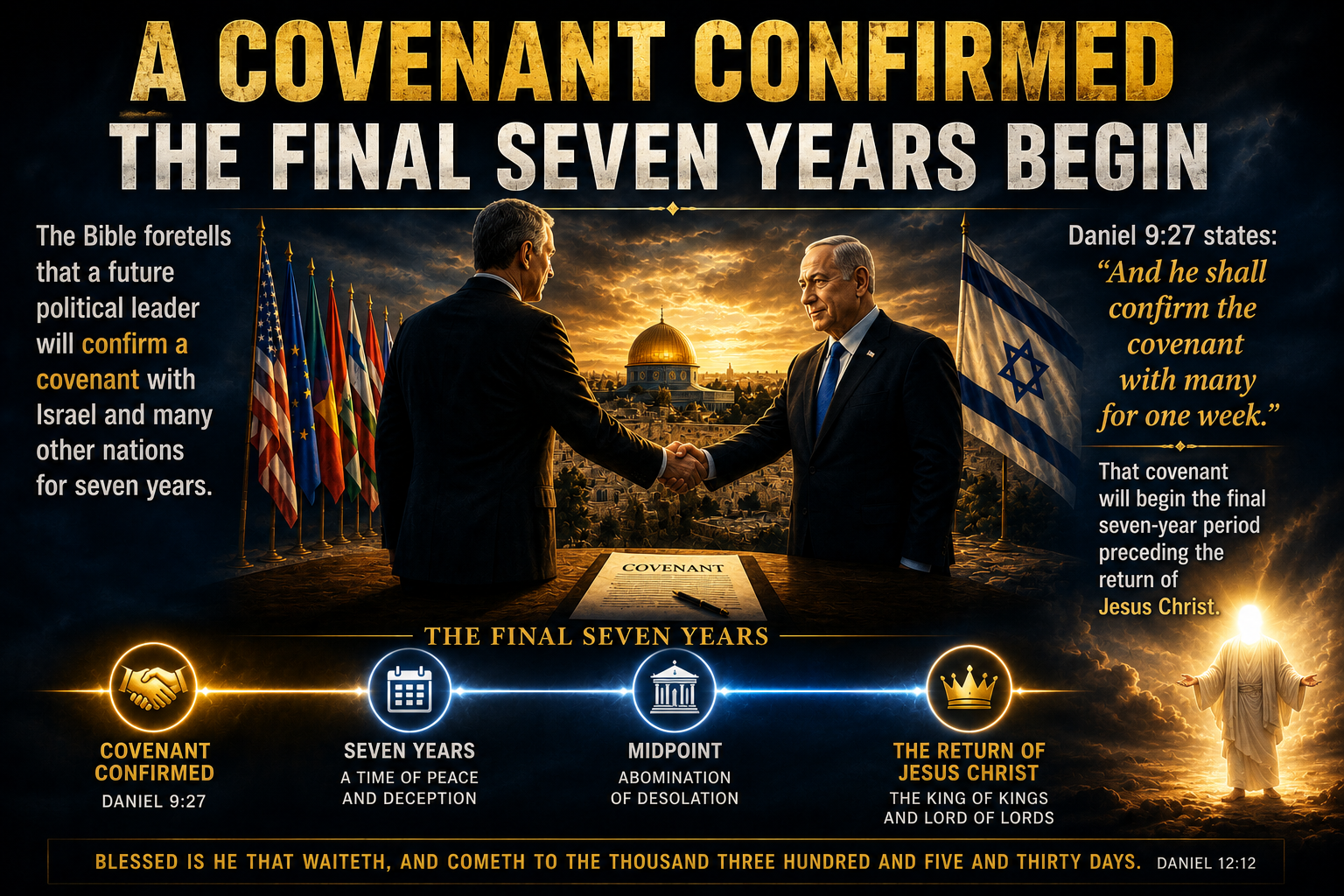
The Final 7-Year Covenant described in Daniel 9:27 is one of the Bible’s most significant end-time prophecies. According to the interpretation presented in this article, it refers to a future international agreement involving Israel and many nations that will mark the beginning of the final seven years before the Battle of Armageddon and the Second Coming of Jesus Christ. Halfway through those seven years, the agreement will be broken, Jewish sacrifices will cease, the Antichrist will be revealed and commit the Abomination of Desolation, and the Great Tribulation will begin.
This prophecy serves as God’s prophetic countdown to the climax of human history. Unlike most biblical prophecies that describe future events without assigning a measurable duration, Daniel 9 provides a specific timeline. Once this covenant is confirmed, Scripture indicates that seven prophetic years remain until Christ returns to establish His Kingdom on earth.
Understanding this prophecy is important because it provides the chronological framework that connects many other end-time passages throughout the Bible, including Jesus’ Olivet Discourse (Matthew 24), Paul’s teaching regarding the “man of sin” (2 Thessalonians 2), John’s visions in Revelation, and Old Testament prophecies concerning Israel, Jerusalem, and the nations.
Yet Daniel’s prophecy has also become one of the most debated passages in Scripture. Faithful Christians have reached different conclusions regarding the identity of the one who confirms the covenant, the nature of the covenant itself, and whether the seventieth week has already been fulfilled or remains future. Before examining our conclusion, it is important to understand the prophecy in its original setting.
Why Daniel 9 Matters
Few passages in all of Scripture have generated more theological discussion than Daniel’s prophecy of the Seventy Weeks (Daniel 9:24-27).
Entire books have been written attempting to explain these four verses. They have been interpreted through preterist, historicist, amillennial, covenantal, and futurist frameworks. While these approaches differ significantly, nearly all agree on one point: Daniel 9 is one of the most remarkable prophetic passages in the Bible because it presents God’s redemptive plan according to a carefully structured timetable. (Bible Gateway)
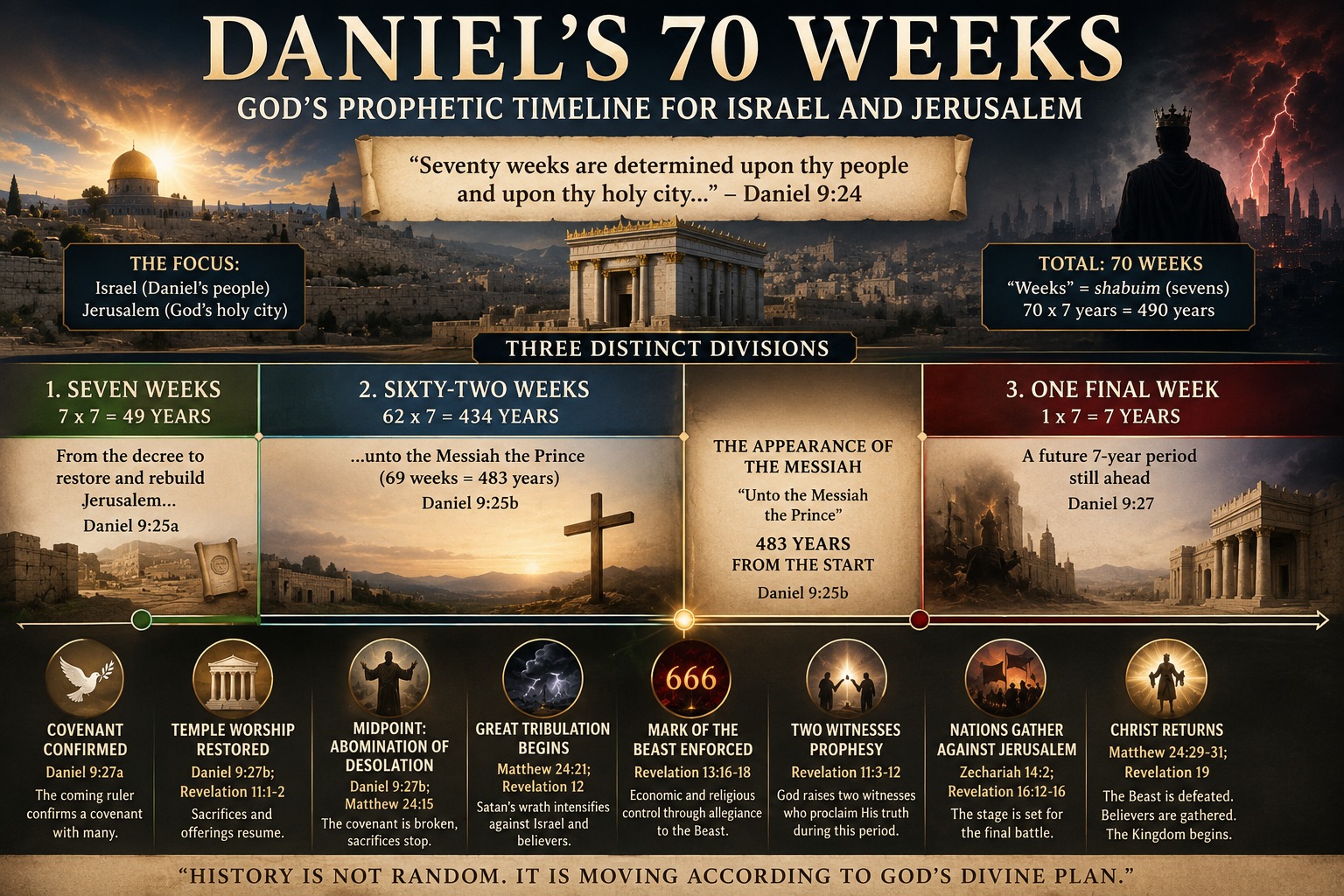
Unlike symbolic visions that simply describe future kingdoms or coming judgments, Daniel receives a chronological revelation. The angel Gabriel informs him that “Seventy weeks are determined upon thy people and upon thy holy city” (Daniel 9:24).
The Hebrew word translated “weeks” is shabuim, meaning “sevens.” The context demonstrates these are not weeks of days but groups of seven years. Thus, seventy “sevens” equal 490 prophetic years. Some suggest that “weeks” are referring to literal 7-day weeks; however, other Old Testament biblical passages prove the terminology of a “week” to mean 7 years (cf. Genesis 29; see specially verse 27).
These 490 years concern two specific subjects:
- Daniel’s people, Israel
- Daniel’s holy city, Jerusalem (which belongs to God)
That distinction is important. Daniel is not receiving a general prophecy about world history. Instead, God is revealing His future program concerning Israel and Jerusalem, culminating in the establishment of His everlasting Kingdom. Literally, God is using the history and future of Israel as a time-clock (a prophetic timeline, as it were) to reveal His ultimate plan for humanity.
The prophecy unfolds in three distinct divisions:
- Seven weeks (49 years)
- Sixty-two weeks (434 years)
- One final week (7 years)
Together, the first sixty-nine weeks total 483 years, leading to the appearance of Messiah. The final week stands apart as the culmination of God’s prophetic program for Israel.
Understanding why that final week remains future requires us to examine the historical setting in which Daniel received this remarkable revelation.
The Historical Background: Why Daniel Received the Prophecy
To understand the Final Seven Years, we must first understand the circumstances surrounding Daniel’s prayer in chapter nine.
Prophecies do not often appear in Scripture without context. God revealed future events in response to specific historical situations. Daniel 9 is no exception.
Daniel was living as an exile in Babylon. Decades earlier, Nebuchadnezzar had conquered Jerusalem, destroyed Solomon’s Temple in 586 B.C., and carried thousands of Jews into captivity (2 Kings 25:1-21). The city that God had chosen for His name lay in ruins. The Temple had been burned. The Davidic monarchy had collapsed. To many observers, it may have appeared that God’s promises to Israel had failed.
But God had not forgotten His covenant.
Daniel Discovers Jeremiah’s Prophecy
As Daniel studied the writings of the prophet Jeremiah, he discovered something remarkable.
Jeremiah had foretold that Judah’s captivity would last seventy years.
“After seventy years be accomplished at Babylon I will visit you, and perform my good word toward you, in causing you to return to this place.” (Jeremiah 29:10)
Daniel realized those seventy years were nearly complete.
He understood that God’s appointed time for Israel’s restoration was fast approaching.
Rather than assuming the prophecy would automatically fulfill itself, Daniel responded the way faithful believers always should when they understand God’s promises.
He prayed.
Daniel 9:3 says,
“And I set my face unto the Lord God, to seek by prayer and supplications, with fasting, and sackcloth, and ashes.”
His response teaches an important principle. Biblical prophecy should never produce passivity. Instead, it should inspire prayer, repentance, and renewed dependence upon God.
Daniel’s Prayer Focused on National Repentance
One of the remarkable features of Daniel 9 is that Daniel never distances himself from Israel’s sins.
Although Scripture records Daniel as one of the Bible’s most faithful men, he repeatedly confessed Israel’s rebellion as though it were his own.
He prayed,
“We have sinned, and have committed iniquity, and have done wickedly…” (Daniel 9:5)
Notice the repeated use of the word “we.”
Daniel did not blame previous generations.
He did not point fingers at political leaders.
He humbled himself before God and identified with his nation.
Throughout the prayer he acknowledged that Israel’s exile was not an accident of history but the direct fulfillment of God’s covenant warnings found centuries earlier in the Law of Moses (Deuteronomy 28).
God had promised blessings for obedience and judgment for rebellion.
Israel had experienced both.
Gabriel Arrives with an Even Greater Prophecy
Before Daniel could finish praying, God responded.
Daniel writes,
“Yea, whiles I was speaking in prayer… the man [angelic being] Gabriel… touched me about the time of the evening oblation.” (Daniel 9:20-21)
Gabriel informed Daniel that he had been sent because Daniel was “greatly beloved” (Daniel 9:23).
But instead of simply answering Daniel’s question about the seventy-year captivity, Gabriel revealed something much larger.
Daniel had been thinking about 70 years.
God answered by revealing 490 years.
Daniel was asking about Israel’s immediate restoration.
God answered by revealing His complete prophetic timetable leading to the coming of the Messiah, Israel’s ultimate restoration, and the establishment of God’s everlasting Kingdom.
This pattern appears throughout Scripture.
Often, God answers our immediate questions by revealing His much greater purposes.
Seventy “Weeks” Are Determined
Gabriel began,
“Seventy weeks are determined upon thy people and upon thy holy city…” (Daniel 9:24)
This statement establishes the scope of the prophecy.
Notice what Gabriel does not say.
He does not say these seventy weeks concern all humanity.
He does not say they concern the Church.
Nor does he describe them as a symbolic representation of an undefined period.
Instead, he identifies two specific subjects.
- Daniel’s people (Israel)
- Daniel’s holy city (Jerusalem)
These remain the central focus throughout the prophecy.
This observation becomes especially important because many interpretations shift the emphasis away from Israel and apply the entire prophecy primarily to the Church. While the Church certainly benefits from Christ’s redemptive work accomplished during the period described, Gabriel explicitly identifies Israel and Jerusalem as the prophetic locale and focus of the seventy weeks.
What Does “Weeks” Mean?
The Hebrew word translated “weeks” is shabuim (שָׁבֻעִים), literally meaning “sevens.”
The text itself does not specify days.
The context determines the unit.
Several factors indicate Gabriel is speaking about years rather than ordinary seven-day weeks.
First, Daniel had been reading Jeremiah’s prophecy concerning seventy years of captivity (Jeremiah 25:11-12; 29:10). The conversation is already centered on years.
Second, the accomplishments described in Daniel 9:24 could never occur within 490 literal days.
Third, the Old Testament already uses groups of seven years in several places. Most notably, Israel observed sabbatical years every seventh year (Leviticus 25:1-7), followed by the Year of Jubilee after seven cycles of seven years (Leviticus 25:8-12). The concept of counting time in sevens of years was therefore familiar within Jewish thought.
Many English translations reflect this understanding. The New International Version renders the expression as “seventy sevens,” while other translations note that the period represents 490 years.
Thus, Gabriel is announcing a prophetic period consisting of 490 years that God has specifically appointed for Israel and Jerusalem.
Six Divine Purposes of the Seventy Weeks
Before explaining the timeline itself, Gabriel first reveals God’s ultimate objectives.
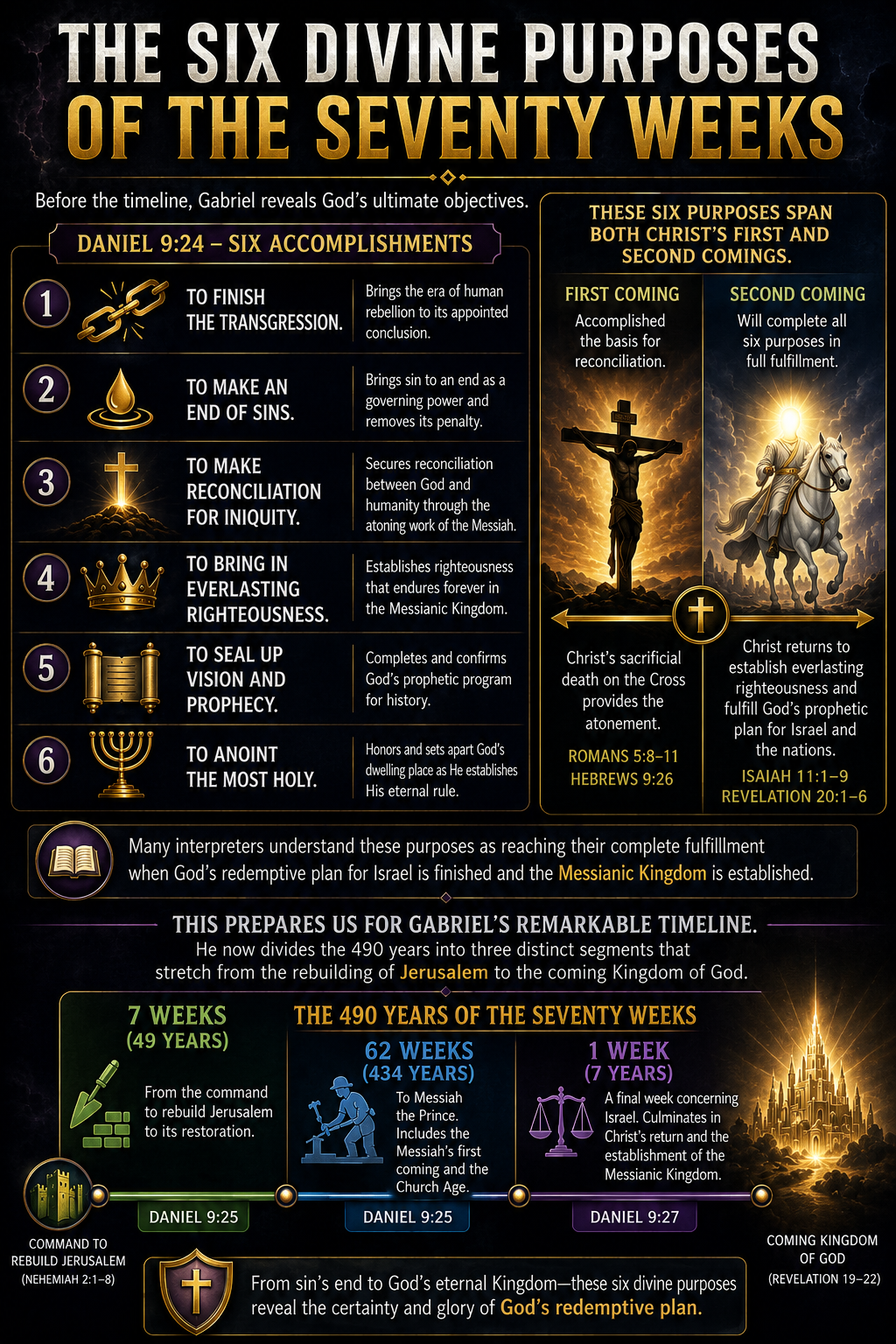
Daniel 9:24 lists six accomplishments that will ultimately be fulfilled:
- To finish the transgression.
- To make an end of sins.
- To make reconciliation for iniquity.
- To bring in everlasting righteousness.
- To seal up vision and prophecy.
- To anoint the Most Holy.
These six purposes span both Christ’s first and second comings.
Jesus accomplished the basis for reconciliation through His sacrificial death on the Cross (Romans 5:8-11; Hebrews 9:26). Yet several elements await their complete fulfillment, including the full establishment of everlasting righteousness and the consummation of God’s prophetic program when Christ returns to reign over the earth (Isaiah 11:1-9; Revelation 20:1-6).
For this reason, many interpreters understand these purposes as reaching their complete fulfillment only when God’s redemptive plan for Israel is finished and the Messianic Kingdom is established.
This prepares us for Gabriel’s remarkable timeline.
He now divides the 490 years into three distinct segments that stretch from the rebuilding of Jerusalem to the coming Kingdom of God.
The Sixty-Nine Weeks: The Countdown to the Messiah
Having established the purpose of the prophecy, Gabriel next revealed one of the most astonishing timelines in all of Scripture. Rather than speaking in broad, symbolic language, he divided the 490 years into three distinct segments, each serving a unique role in God’s redemptive plan.
Daniel 9:25-27 separates the prophecy into:
- Seven weeks (49 years)
- Sixty-two weeks (434 years)
- One final week (7 years)
Together, the first two periods total sixty-nine weeks, or 483 years, leaving 1 final week (or 7 years) remaining. According to Gabriel, these years would stretch from the decree to rebuild Jerusalem until the coming of the Messiah.
The Decree to Restore Jerusalem
Gabriel instructed Daniel:
“Know therefore and understand, that from the going forth of the commandment to restore and to build Jerusalem unto the Messiah the Prince shall be seven weeks, and threescore and two weeks…” (Daniel 9:25)
This prophecy begins with a royal decree authorizing Jerusalem’s restoration after the Babylonian captivity.
Following Babylon’s fall to the Medo-Persian Empire, King Cyrus issued a decree allowing the Jewish exiles to return to their homeland and rebuild the Temple (Ezra 1:1-4). Later Persian kings reaffirmed and expanded those restoration efforts (Ezra 6; Nehemiah 2). Together these decrees enabled the rebuilding of Jerusalem, its walls, and its civil infrastructure after decades of desolation.
Daniel was living during the Babylonian exile, so this prophecy would have given tremendous hope. The city that had been destroyed because of Israel’s sin would one day be rebuilt according to God’s promise.
Yet Gabriel’s prophecy looked far beyond Jerusalem’s physical restoration. It pointed toward the arrival of Israel’s long-awaited Messiah.
Why Seven Weeks and Sixty-Two Weeks?
One question often arises.
Why didn’t Gabriel simply say sixty-nine weeks?
Why divide the period into seven weeks and sixty-two weeks?
Scripture does not explicitly answer this question, so humility is appropriate. However, many scholars understand the initial seven weeks, or forty-nine years, to describe the rebuilding period itself. Jerusalem would indeed be rebuilt, but Daniel was told it would happen “even in troublous times” (Daniel 9:25).
The books of Ezra and Nehemiah confirm this. The returning exiles faced political opposition, military threats, economic hardship, and repeated attempts by surrounding nations to halt the work (Nehemiah 4). Even after the walls were completed, Jerusalem remained a relatively small and vulnerable city within the Persian Empire.
Whether the first forty-nine years mark the rebuilding process specifically or serve another chronological purpose, the larger point remains unchanged: after the combined sixty-nine weeks, the Messiah would appear.
The Messiah Arrives
Gabriel’s prophecy pointed unmistakably toward Jesus Christ.
Daniel states that after the sixty-nine weeks, “Messiah the Prince” would come (Daniel 9:25).
The Hebrew word Mashiach means “Anointed One.” Throughout the Old Testament, prophets, priests, and kings were anointed with oil as a symbol of God’s calling upon their lives. Ultimately, however, the title points to the promised Deliverer whom God would send to redeem His people.
The New Testament repeatedly identifies Jesus as that promised Messiah.
Andrew told his brother Simon,
“We have found the Messias, which is, being interpreted, the Christ.” (John 1:41)
The Samaritan woman declared,
“I know that Messias cometh.”
Jesus answered,
“I that speak unto thee am he.” (John 4:25-26)
The Greek title Christ carries the same meaning as the Hebrew Messiah: “the Anointed One.”
Long before Bethlehem, Gabriel announced exactly when Israel’s Messiah would appear.
Click Here ==> To Explore More Prophecies about the true Messiah (Jesus Christ).
Messiah Would Be “Cut Off”
Perhaps the most remarkable statement comes in Daniel 9:26.
“And after threescore and two weeks shall Messiah be cut off, but not for himself…”
The phrase “cut off” refers to a violent death.
Rather than conquering Israel’s enemies immediately, the Messiah would suffer.
He would die.
Yet Daniel adds an important qualification.
He would be cut off “but not for himself.”
In other words, His death would not result from His own guilt, nor was His death performed for His own benefit.
Isaiah had foretold the same truth centuries earlier:
“He was wounded for our transgressions, he was bruised for our iniquities…” (Isaiah 53:5)
Jesus died as the substitutionary sacrifice for sinners.
Remarkably, Daniel received this prophecy nearly five centuries before the birth of Jesus Christ.
His crucifixion fulfilled God’s redemptive plan while providing reconciliation for all who place their faith in Him (Romans 5:8; 2 Corinthians 5:21), and obey His Gospel (Rom. 10:16, 2 Thes. 1:8).
Click Here ==> To Explore How to Obey the Gospel
Jerusalem Would Be Destroyed Again
Gabriel’s prophecy did not stop with the Messiah’s death.
He immediately added another prediction.
“…and the people [the Romans] of the prince that shall come shall destroy the city and the sanctuary…” (Daniel 9:26)
History records the fulfillment with striking accuracy.
In A.D. 70, following a Jewish revolt against Rome, the Roman general Titus led his armies against Jerusalem. After months of siege, the city fell. The Second Temple was burned, and much of Jerusalem was destroyed. The Jewish historian Josephus records the devastation in sobering detail, describing widespread famine, enormous loss of life, and the destruction of the Temple that had stood for nearly six centuries.
Jesus Himself foretold this judgment during the final week before His crucifixion.
As He overlooked Jerusalem, He declared:
“There shall not be left here one stone upon another, that shall not be thrown down.” (Matthew 24:2)
Within a generation, His words came to pass.
Who Are “the People of the Prince That Shall Come”?
Daniel’s wording is precise.
Notice what the text says.
It does not say the coming prince destroys Jerusalem.
Instead, it says “the people of the prince that shall come” destroy the city.
This distinction has generated considerable discussion among Bible prophecy scholars.
Historically, the people who destroyed Jerusalem were the Roman armies under Titus in A.D. 70.
The coming prince himself is introduced but not yet identified.
This distinction becomes important in verse 27, where the pronoun “he” appears.
Many interpreters conclude that “he” refers back to “the prince that shall come” because he is the nearest singular antecedent in the passage. Others believe the pronoun refers to the Messiah instead. We will examine both interpretations carefully momentarily.
For now, notice that Daniel deliberately distinguishes between the people and their futuristic coming prince.
That distinction lays the groundwork for the prophecy’s final seven years.
The Gap Between the Sixty-Ninth and Seventieth Weeks
One of the most frequently discussed aspects of Daniel’s prophecy is something many readers overlook.
Daniel 9:26 begins with the word “after.”
“After threescore and two weeks shall Messiah be cut off…”
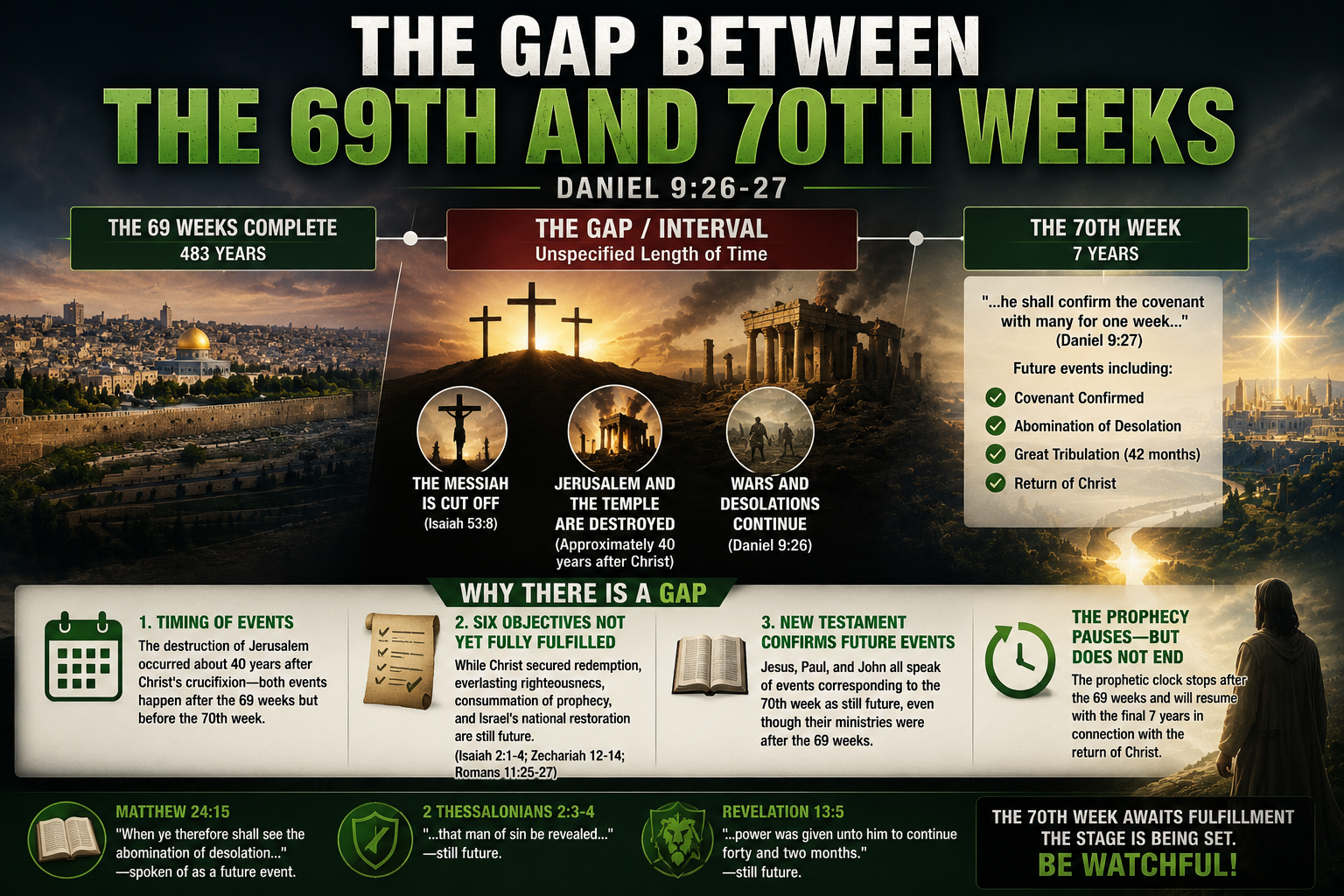
Notice what happens after the sixty-nine weeks:
- The Messiah is cut off (out of the land of the living / or killed / see Isaiah 53:8).
- Jerusalem and the Temple are destroyed.
- Wars and desolations continue.
Yet none of these events are described as occurring during the seventieth week itself.
This observation has led many Bible scholars to recognize an interval between the sixty-ninth and seventieth weeks.
Some interpreters reject the idea of such a gap, arguing that the seventy weeks must unfold consecutively without interruption. Others contend that the events of verse 26 demonstrate that the prophetic clock pauses after the sixty-ninth week before resuming with the final seven years.
Several observations support the latter understanding.
First, the destruction of Jerusalem occurred approximately forty years after Christ’s crucifixion. Both events are said to occur after the sixty-nine weeks but before the activities described in verse 27.
Second, the six objectives listed in Daniel 9:24 have not yet reached their complete fulfillment. While Christ secured redemption through His death and resurrection, everlasting righteousness has not yet filled the earth, prophecy has not yet reached its consummation, and Israel still awaits the national restoration described throughout the Old Testament (Isaiah 2:1-4; Zechariah 12-14; Romans 11:25-27).
Third, the New Testament repeatedly anticipates future events that correspond to Daniel’s final week.
Jesus spoke of the Abomination of Desolation as a future event (Matthew 24:15), even though His ministry occurred after the sixty-nine weeks.
Likewise, Paul described the revelation of the “man of sin” as still future (2 Thessalonians 2:3-4), and John later wrote of a coming Beast who would exercise authority for forty-two months (Revelation 13:5).
Taken together, these passages suggest that Daniel’s final week extends beyond the first century and awaits fulfillment in connection with the return of Christ.
The Times of the Gentiles
Why would there be such a lengthy interval in God’s prophetic timetable?
The Apostle Paul provides important insight.
Speaking of Israel, he wrote:
“Blindness in part is happened to Israel, until the fulness of the Gentiles be come in.” (Romans 11:25)
Following Israel’s national rejection of the Messiah, the Gospel was proclaimed throughout the nations. During this present age, God is calling people from every tribe, tongue, and nation into His family through faith in Jesus Christ (Ephesians 2:11-22).
This does not mean God has abandoned His promises to Israel.
Rather, Paul emphasizes that Israel’s present blindness is partial and temporary.
God’s covenant promises remain intact.
When His purposes among the nations reach their appointed completion, His prophetic program concerning Israel will resume exactly as foretold.
This understanding explains why the final seven years focus once again on Israel, Jerusalem, the Temple, and the nations surrounding the Holy Land.
The stage is now set for Daniel’s final and most debated verse.
Everything hinges on one question:
Who is the “he” of Daniel 9:27?
That single pronoun determines how one understands the Final Seven Years and the prophetic events leading to the Second Coming of Jesus Christ.
Daniel 9:27 Explained
Everything in Daniel’s prophecy culminates in one extraordinary verse.
Daniel 9:27 has been called one of the most debated verses in all of Scripture because nearly every major end-time doctrine intersects here. The identity of one small pronoun, “he,” determines whether the covenant is viewed as Christ’s New Covenant, a past historical event, or a future agreement involving the Antichrist.
The verse reads:
“And he shall confirm the covenant with many for one week [7 years]: and in the midst of the week he shall cause the sacrifice and the oblation to cease, and for the overspreading of abominations he shall make it desolate, even until the consummation, and that determined shall be poured upon the desolate.” (Daniel 9:27)
To understand this prophecy, we must examine it one phrase at a time.
Who Is the “He”?
The first question is obvious.
Who is the person Daniel identifies simply as “he”?
Two primary interpretations have been offered throughout church history.
View One: “He” Refers to Jesus Christ
Many Christians understand the pronoun to refer to the Messiah mentioned in verse 26.
According to this interpretation:
- Christ confirms God’s covenant through His death and resurrection.
- His earthly ministry lasts approximately three and one-half years.
- His sacrificial death causes the Old Testament sacrificial system to become spiritually obsolete because He fulfilled its purpose (Hebrews 10:1-18).
- The seventieth week is therefore completed during Christ’s first coming.
This interpretation has been held by certain scholars throughout church history and deserves careful consideration. Those who hold this view rightly emphasize the centrality of Christ’s atoning work and the fulfillment of God’s promises through the New Covenant.
However, several features of the text lead to a different conclusion.
View Two: “He” Refers to the Coming Prince
The interpretation presented in this article understands the pronoun to refer to “the prince that shall come” mentioned in Daniel 9:26.
There are several reasons for this conclusion.
The Immediate Grammar
The nearest singular antecedent before verse 27 is “the prince that shall come.”
While Hebrew grammar does not always require a pronoun to refer to the nearest antecedent, that remains the normal reading unless the context clearly indicates otherwise.
If Daniel intended the reader to return to the Messiah after introducing another prince, we would expect some textual indicator.
Instead, the narrative flows naturally from the introduction of the coming prince into his future actions.
The Actions Fit the Coming World Ruler
Daniel says this individual performs three major actions.
He confirms a covenant.
He stops sacrifices.
He commits the Abomination of Desolation.
When these actions are compared with Daniel’s later prophecies, they consistently describe the same end-time ruler.
Daniel 11 expands upon this coming king in remarkable detail.
Daniel 11:21 introduces him as a contemptible or vile person who gains power through political intrigue.
Daniel 11:22 refers to him as “the prince of the covenant.”
Later, Daniel writes:
“And arms shall stand on his part, and they shall pollute the sanctuary of strength, and shall take away the daily sacrifice, and they shall place the abomination that maketh desolate.” (Daniel 11:31)
Notice the remarkable parallels.
In Daniel 9:27:
- covenant
- sacrifices cease
- Abomination of Desolation
In Daniel 11:
- prince of the covenant
- sacrifices cease
- Abomination of Desolation
Rather than describing two different individuals performing identical actions, the simplest explanation is that Daniel is describing the same future ruler from different perspectives.
Does Jesus Stop the Sacrifices?
One of the strongest arguments for the Messiah interpretation is that Christ’s death rendered animal sacrifices unnecessary.
Spiritually, that is absolutely true.
Hebrews declares that Christ offered Himself “once for all” (Hebrews 10:10). His sacrifice fulfilled everything the Old Testament sacrificial system anticipated.
Yet Daniel 9:27 appears to describe something different.
The text does not merely say sacrifices lose their spiritual significance.
It says someone causes them to cease.
Daniel uses language describing the interruption of ongoing temple worship.
Daniel 11:31 uses nearly identical wording when describing the daily sacrifices being forcibly removed.
This suggests governmental or political intervention rather than theological fulfillment.
The distinction is significant.
Jesus Christ fulfilled the sacrificial system through redemption.
The coming world ruler abolishes sacrifices through authority.
These are two very different actions.
Does Jesus Place the Abomination of Desolation… or Warn About It?
Perhaps the clearest evidence comes from Jesus Himself.
During the Olivet Discourse, Jesus declared:
“When ye therefore shall see the abomination of desolation, spoken of by Daniel the prophet, stand in the holy place…” (Matthew 24:15)
Notice the timing.
Jesus was standing on the Mount of Olives, and was speaking near the end of His earthly ministry.
If Daniel’s seventieth week had already been fulfilled through Christ’s ministry, why would Jesus speak of the Abomination of Desolation as a future event?
He did not describe it as something already accomplished.
He warned His disciples to watch for it.
He connected it directly to the coming Great Tribulation.
Immediately afterward Jesus said,
“For then shall be great tribulation, such as was not since the beginning of the world…” (Matthew 24:21)
This is extremely important.
NOTE:
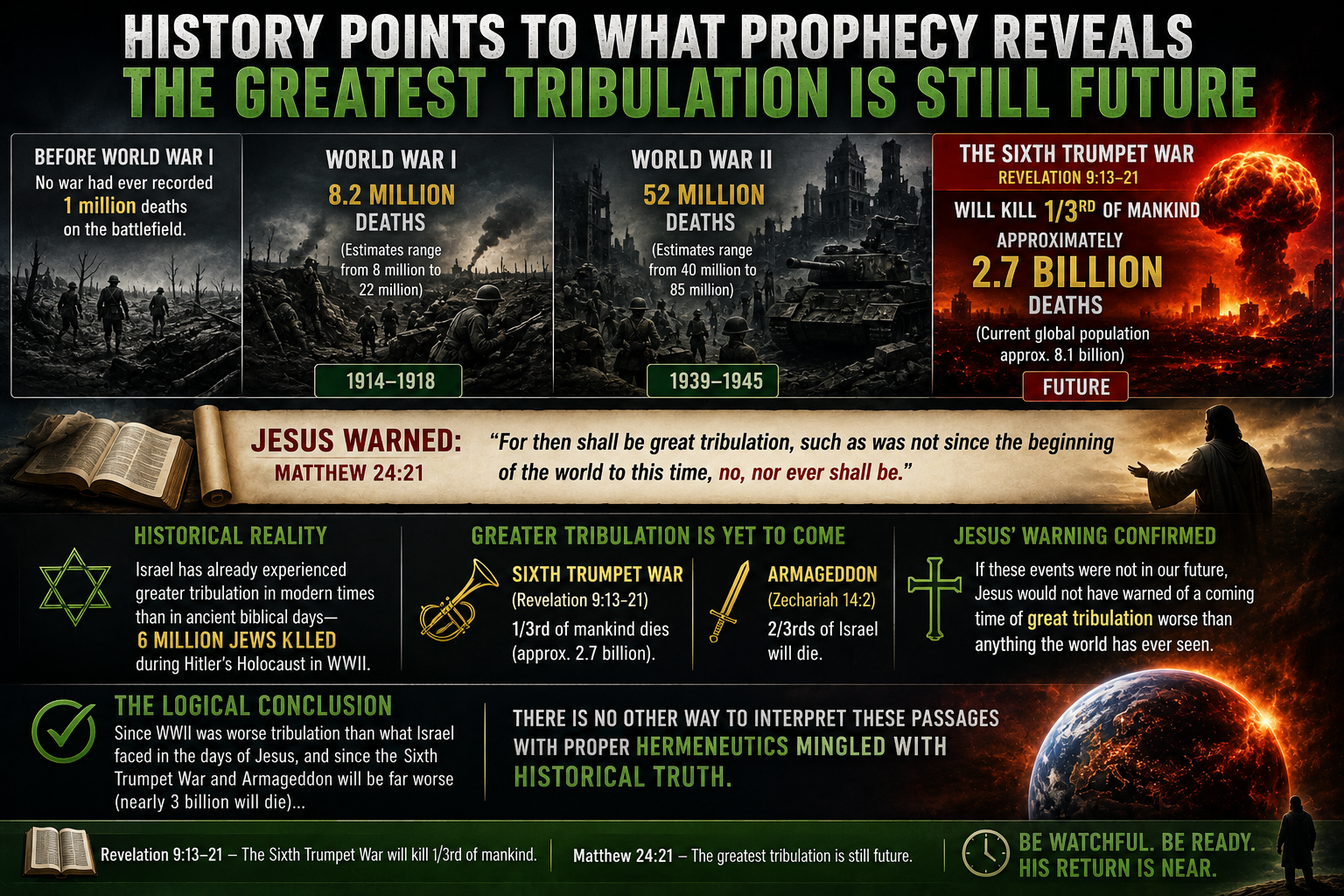
Before World War I, no war had ever recorded 1 million deaths on the battle field. World War I occurred and the death toll reports today range from 8 million to 22 million. World War II occurred and estimates vary from 40 million deaths to 85 million (to be conservative, we have cited 8.2 million for WWI and 52 million for WWII).
Revelation 9:13-21 prophesies of the coming Sixth Trumpet War, stating it will kill 1/3rd of mankind (approximately 2.7 billion by current global population). Consider, Jesus taught in Matthew 24:21, that at the tine of the Abomination of Desolation there will be great tribulation on earth, such as was not since the beginning of the world to this time, no, nor ever shall be.
Therefore, this event known as “the Abomination of Desolation” and the subsequent greatest time of tribulation on earth, has not yet come to pass. Certainly the nation of Israel has experienced greater tribulation in modern times (e.g., 6 million Jews killed during Hilter’s Holocaust of WWII) than they ever did in ancient biblical days. Additionally, we know greater tribulation than WWII is yet to come (e.g., Sixth Trumpet War where 1/3rd of mankind die, and Armageddon where 2/3rds of Israel will die). If these terrible events were not in our future, Jesus would not have warned about a coming time of great tribulation that will be worse than anything that has occurred since since the beginning of the world, to the days of Jesus, no, nor ever shall be.
Since WWII was worse tribulation than what Israel faced in the days of Jesus, and since the Sixth Trumpet War, the subsequent great tribulation, and Armageddon will be worse than WWII (as nearly 3 billion will die); then there is no other way to interpret these passages with proper hermeneutics mingled with historical truth.
Jesus Places It in the Future
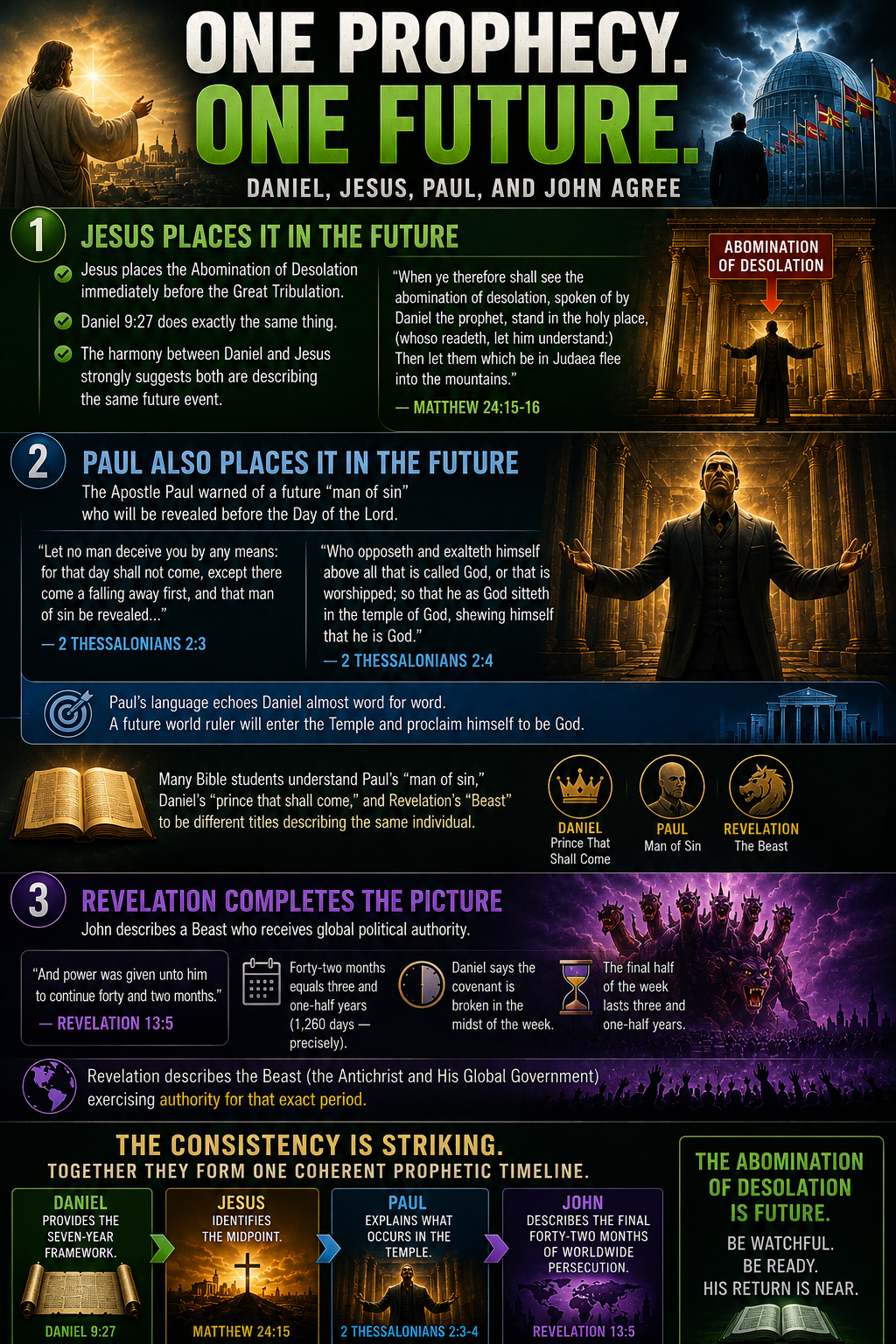
Jesus places the Abomination of Desolation immediately before the Great Tribulation.
Daniel 9:27 does exactly the same thing.
The harmony between Daniel and Jesus strongly suggests both are describing the same future event.
Paul Also Places It in the Future
The Apostle Paul likewise points to a future fulfillment.
Writing decades after Christ’s resurrection, Paul warned believers not to think the Day of the Lord had already arrived.
He explained:
“Let no man deceive you by any means: for that day shall not come, except there come a falling away first, and that man of sin be revealed…” (2 Thessalonians 2:3)
Paul then describes what this man will do.
“Who opposeth and exalteth himself above all that is called God, or that is worshipped; so that he as God sitteth in the temple of God, shewing himself that he is God.” (2 Thessalonians 2:4)
Paul’s language echoes Daniel almost word for word.
Daniel describes an abomination.
Jesus warns of an abomination.
Paul explains what that abomination involves.
A future world ruler will enter the Temple and proclaim himself to be God.
This is why many Bible students understand Paul’s “man of sin,” Daniel’s “prince that shall come,” and Revelation’s “Beast” to be different titles describing the same individual.
Revelation Completes the Picture
The book of Revelation supplies the final pieces.
John describes a Beast who receives global political authority.
“And power was given unto him to continue forty and two months.” (Revelation 13:5)
Forty-two months equals three and one-half years (i.e., 1,260 days – precisely).
Daniel says the covenant is broken in the midst of the week.
The final half of the week lasts three and one-half years.
Revelation describes the Beast (i.e., the Antichrist, and His Global Government) exercising authority for that exact period.
The consistency is striking.
Daniel provides the seven-year framework.
Jesus identifies the midpoint.
Paul explains what occurs in the Temple.
John describes the final forty-two months of worldwide persecution.
Together they form one coherent prophetic timeline.
What Does “Confirm the Covenant” Mean?
The Hebrew verb translated “confirm” (higbîr) means to make strong, strengthen, enforce, or cause to prevail.
This is an important distinction.
Daniel does not necessarily say the coming ruler creates an entirely new covenant.
Rather, he strengthens or confirms an existing covenant with many.
This wording has prompted considerable discussion among Bible scholars.
Some believe the covenant refers to God’s redemptive covenant fulfilled in Christ.
Others understand it as a future international agreement involving Israel and many nations.
The interpretation presented in this article follows the latter view for several reasons.
First, the covenant immediately introduces a seven-year period that culminates in the stopping of sacrifices and the Abomination of Desolation.
Second, Daniel’s entire prophecy concerns Daniel’s people and Daniel’s holy city, namely Israel and Jerusalem.
Third, the broader prophetic context consistently points toward a future period centered on Israel, the Temple, Jerusalem, and the surrounding nations.
Rather than describing the New Covenant inaugurated by Christ’s blood, Daniel appears to foresee a geopolitical agreement that temporarily resolves longstanding disputes involving Israel before collapsing halfway through its seven-year term.
But this raises another important question.
What covenant is being confirmed?
Is Daniel referring to a brand-new peace treaty, or is he referring to a much older covenant that reaches all the way back to Abraham himself?
That question will lead us into one of the most fascinating aspects of this prophecy and reveal why the Final Seven Years begin with what Scripture calls the confirmation of the covenant rather than simply the signing of a political agreement.
What Is “the Covenant” in Daniel 9:27?
Many readers naturally assume Daniel is speaking of a future peace treaty. Others conclude he is referring to the New Covenant established through Christ’s blood. Still others argue the passage is too ambiguous to identify the covenant with certainty.
The wording Daniel uses, however, invites us to look much farther back in Scripture.
Before we ask what the coming ruler confirms, we should first ask:
What covenant concerning Israel already existed?
The First Great Covenant Concerning the Land
The Bible introduces the foundational covenant concerning Israel in Genesis.
After calling Abram out of Ur, God made a series of promises that would shape the rest of biblical history.
Genesis 12 records the initial promise:
“Now the LORD had said unto Abram… I will make of thee a great nation… and in thee shall all families of the earth be blessed.” (Genesis 12:1-3)
Several chapters later, God expanded that promise by establishing a formal covenant.
Genesis 15 says:
“In the same day the LORD made a covenant with Abram, saying, Unto thy seed have I given this land, from the river of Egypt unto the great river, the river Euphrates.” (Genesis 15:18)
This covenant is commonly called the Abrahamic Covenant.
It contains several foundational promises.
God pledged:
- Abraham would become a great nation.
- His descendants would inherit the Promised Land.
- The covenant would ultimately bless all nations through the coming Messiah.
- The promises would continue through Abraham’s descendants.
Unlike many ancient treaties, this covenant was initiated by God Himself.
Genesis 15 describes God alone passing between the covenant pieces, signifying that the fulfillment ultimately depended upon His faithfulness rather than Abraham’s perfection. God is forever faithful.
Throughout the Old Testament, God repeatedly reaffirmed these promises to Isaac (Genesis 26:3-5), Jacob (Genesis 28:13-15), and the nation of Israel.
Even when Israel experienced judgment because of disobedience, God never revoked His covenant promises.
Has God Replaced Israel?
This question naturally arises.
If Israel rejected her Messiah, did God permanently replace Israel with the Church?
Some theological systems answer yes.
Others answer no.
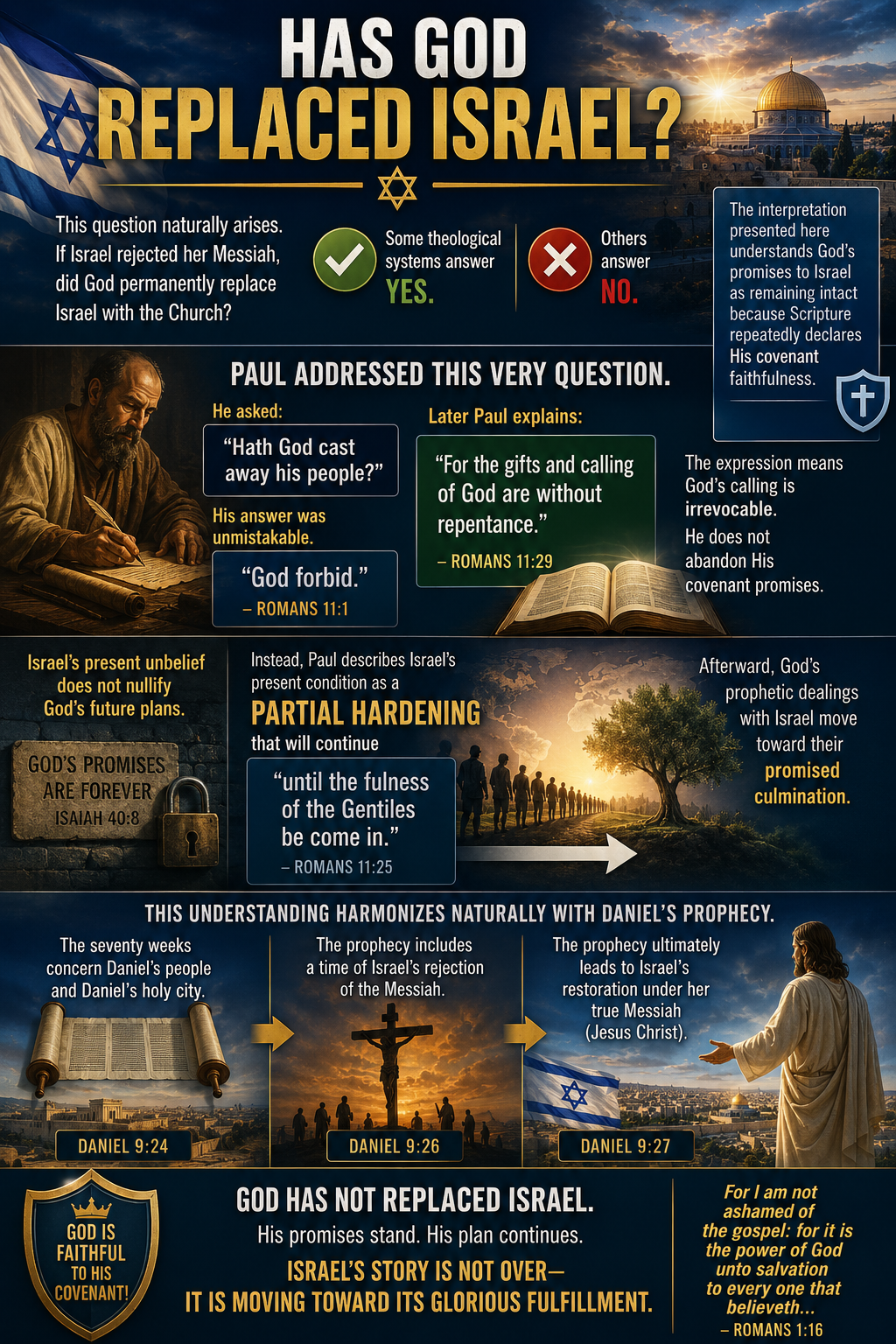
The interpretation presented in this article understands God’s promises to Israel as remaining intact because Scripture repeatedly declares His covenant faithfulness.
The Apostle Paul addressed this very question.
He asked:
“Hath God cast away his people?”
His answer was unmistakable.
“God forbid.” (Romans 11:1)
Later Paul explains:
“For the gifts and calling of God are without repentance.” (Romans 11:29)
The expression means God’s calling is irrevocable.
He does not abandon His covenant promises.
Israel’s present unbelief does not nullify God’s future plans.
Instead, Paul describes Israel’s present condition as a partial hardening that will continue “until the fulness of the Gentiles be come in” (Romans 11:25).
Afterward, God’s prophetic dealings with Israel move toward their promised culmination.
This understanding harmonizes naturally with Daniel’s prophecy.
The seventy weeks concern Daniel’s people and Daniel’s holy city.
The prophecy ultimately leads to Israel’s restoration under her true Messiah (Jesus Christ).
Why Daniel Uses the Word “Confirm”
Daniel does not say the coming ruler creates a covenant.
He says he confirms one.
The Hebrew verb translated “confirm” (higbîr) carries the idea of strengthening, enforcing, causing to prevail, or making firm.
That wording is significant.
Rather than inventing Israel’s right to exist, the coming ruler recognizes or strengthens an already existing claim.
The distinction is subtle – but important.
Israel’s claim to the land does not originate with international diplomacy.
According to Scripture, it originates with Almighty God.
Long before there was a United Nations…
Long before modern political negotiations…
Long before the modern State of Israel was established in 1948 (May 14th)…
God had already declared:
“Unto thy seed have I given this land…” (Genesis 15:18)
From this perspective, the future agreement does not create Israel’s biblical right to exist.
It acknowledges it.
More Than a Political Agreement
This helps explain why Daniel’s prophecy carries such profound significance.
The agreement is certainly political.
It involves many nations.
It affects borders.
It concerns Jerusalem.
It has enormous geopolitical consequences.
But underneath the political negotiations lies something much deeper.
The debate over Israel has never been merely about geography.
It is about God’s promises.
Throughout history, the central question has remained remarkably consistent:
Who has the God-given right to the land?
The future agreement temporarily settles that question, at least on the international stage.
For the first time, Israel’s right to exist within agreed-upon boundaries will receive broad international recognition.
Yet Daniel also makes clear that this agreement is temporary.
It’s not an indefinite agreement, it is confirmed for precisely “one week” (i.e., specifically 7 years).
Halfway through that period (3 and 1/2 years later), everything changes.
Why “With Many”?
Daniel writes that the covenant is confirmed “with many.”
Notice he does not say it is confirmed with only Israel.
Nor does he say it is confirmed solely with one neighboring nation.
The wording suggests a broader international dimension.
This fits the larger prophetic picture found throughout Scripture.
By the time of the final seven years, a powerful international leader has emerged.
His influence extends far beyond the Middle East.
The agreement involves multiple parties and carries global implications.
This observation also aligns with the modern reality that virtually every major peace initiative involving Israel has included international participation. Israel and the Palestinians alone, cannot seem to get the job done. Because of this, international cooperation will arise, and many will participate in the confirmation of the Abrahamic Covenant.
Over the past several decades, efforts have involved the United States, the European Union, the United Nations, Russia, Arab nations, and numerous international mediators. From the Camp David negotiations to the Oslo Accords, the Quartet’s Road Map for Peace, and subsequent diplomatic initiatives, the conflict has increasingly become an international concern rather than merely a regional dispute.
Daniel does not identify the specific nations involved.
He simply says “many.”
The emphasis is on the breadth of the agreement rather than the identity of every participant.
Is This Simply Another Peace Treaty?
Scripture never uses the phrase “peace treaty.”
That expression is often used as shorthand because the agreement clearly involves Israel and temporarily brings stability to one of the world’s longest-running conflicts.
However, Daniel’s language is broader.
The covenant appears to encompass political recognition, territorial arrangements, and provisions that make possible several prophetic developments described elsewhere in Scripture.
Among them are:
- Israel’s continued presence in the land.
- A functioning Third Jewish Temple in Jerusalem.
- The resumption of animal sacrifices (i.e., the daily sacrifice).
- An agreement that remains in effect for seven years, although it is broken halfway through.
These elements suggest something much more comprehensive than a ceasefire or diplomatic accord.
It becomes the prophetic framework upon which the remaining events of Daniel’s seventieth week unfold.
The Beginning of God’s Prophetic Countdown
One of the remarkable features of Daniel’s prophecy is that God ties the final seven years of human government to a single identifiable event.
Unlike many biblical prophecies that unfold gradually over centuries, this prophecy begins with a specific action.
“And he shall confirm the covenant with many for one week…”
When that confirmation occurs, God’s prophetic clock begins its final countdown.
For nearly two thousand years, believers have watched world events without knowing exactly when the final seven years would commence.
But Daniel indicates there will be no uncertainty once this covenant is confirmed.
The world may celebrate it as the greatest diplomatic achievement of modern history.
Many will believe humanity has finally solved the Middle East conflict.
Yet Scripture reveals that this agreement is not the destination.
It is the beginning.
It marks the opening chapter of the final seven years before the visible return of Jesus Christ to Earth.
The first half of those seven years will witness developments unlike anything the world has seen in nearly two millennia. One of those developments, perhaps the most astonishing of all, is the rebuilding of a Jewish Temple in Jerusalem.
To many people, that idea sounds impossible.
Yet the Bible repeatedly points to its necessity, and several prophetic passages become difficult to explain apart from the existence of a future Temple.
That is where Daniel’s prophecy now leads us next.
If the covenant is confirmed and sacrifices are later stopped, one obvious question arises:
How can sacrifices be stopped if there isn’t first a Temple in which to offer them?
Let’s answer that thoroughly.
Why the Third Temple Must Be Rebuilt
One of the most remarkable implications of Daniel’s prophecy is something many people overlook.
Daniel says the coming ruler will stop the daily sacrifices halfway through the seven-year covenant (Daniel 9:27).
That raises an obvious question.
How can sacrifices be stopped unless they have first begun?
The answer leads directly to one of the Bible’s most fascinating prophetic subjects: the rebuilding of a (Third) Jewish Temple in Jerusalem.
To many people, the idea sounds improbable, if not impossible. The Temple Mount is currently occupied by two of Islam’s most revered structures, the Dome of the Rock and the Al-Aqsa Mosque. The political, religious, and diplomatic challenges surrounding the site are immense.
Yet when the prophetic passages are considered together, they consistently point to the existence of a functioning Jewish Temple during the Final Seven Years.
Rather than relying on one isolated verse, this conclusion emerges from the combined testimony of Daniel, Jesus, Paul, and John.
Daniel Foretells the End of Temple Sacrifices
The first indication comes from Daniel himself.
Daniel 9:27 declares:
“And in the midst of the week he shall cause the sacrifice and the oblation to cease…”
The wording assumes something important.
Sacrifices are already taking place.
Daniel is not describing the introduction of sacrifices.
He is describing their interruption.
Likewise, Daniel 11 expands upon the same event:
“And arms shall stand on his part, and they shall pollute the sanctuary of strength, and shall take away the daily sacrifice…” (Daniel 11:31)
Again, the daily sacrifices are already being offered before they are forcibly stopped.
This is significant because the Mosaic Law required these sacrifices to be presented at the sanctuary God had designated for worship (Deuteronomy 12:5-14). Throughout Israel’s history, the regular morning and evening sacrifices were inseparably connected to the Temple.
If daily sacrifices are functioning again during the seventieth week, there must necessarily be a sanctuary in which they are being offered.
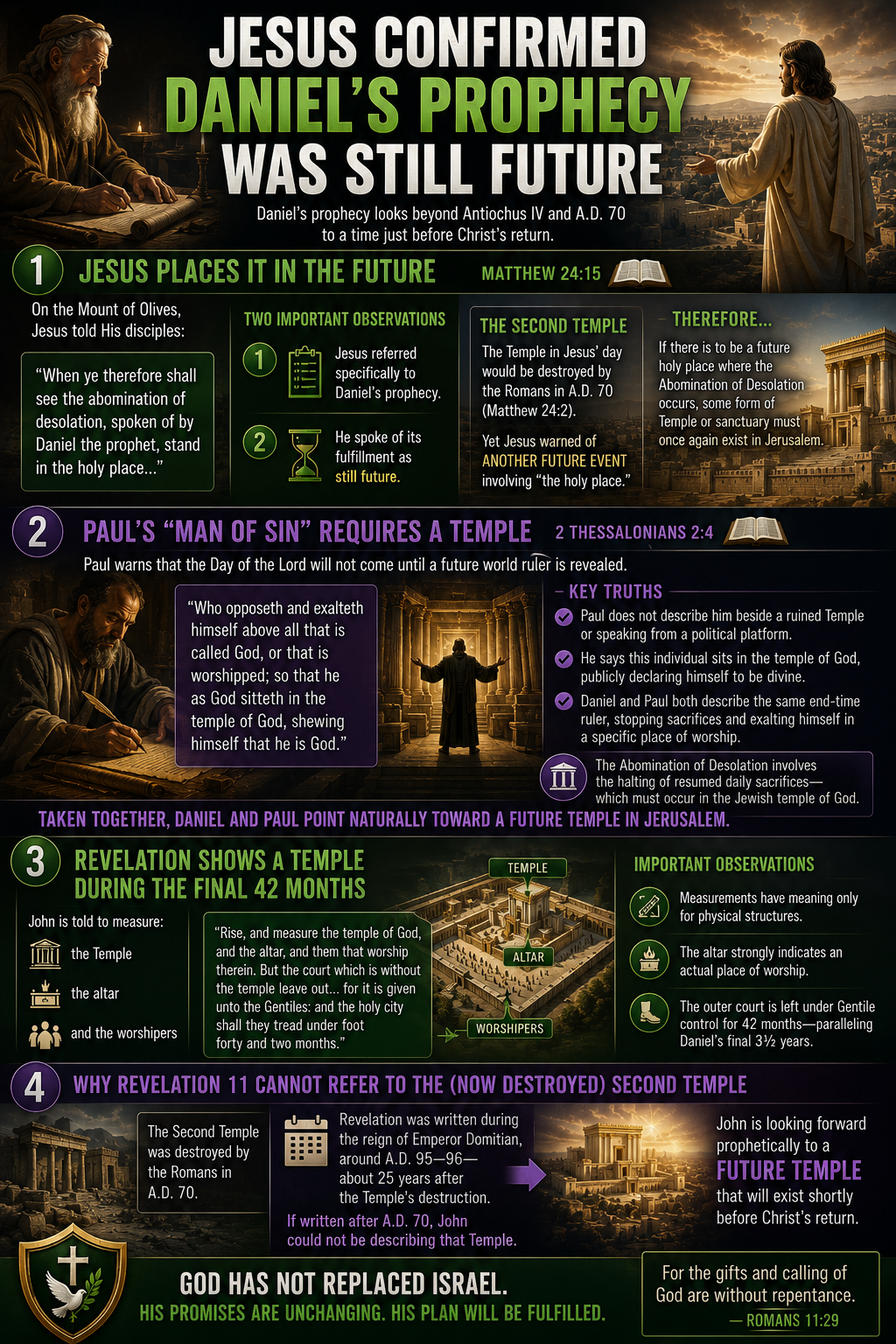
Jesus Confirmed Daniel’s Prophecy Was Still Future
Some have suggested Daniel’s prophecy was fulfilled in the events surrounding Antiochus IV Epiphanes during the second century B.C. Others point to the Roman destruction of Jerusalem in A.D. 70.
While those events certainly foreshadow later fulfillment, Jesus’ own words indicate that Daniel’s prophecy ultimately points beyond both.
Speaking to His disciples on the Mount of Olives, Jesus said:
“When ye therefore shall see the abomination of desolation, spoken of by Daniel the prophet, stand in the holy place…” (Matthew 24:15)
Notice two important observations.
First, Jesus referred specifically to Daniel’s prophecy.
Second, He spoke of its fulfillment as still future.
The Temple standing in Jesus’ day was the Second Temple built after the Babylonian captivity. Within a few decades, that Temple would be destroyed by the Romans in A.D. 70, exactly as Jesus foretold (Matthew 24:2).
Yet Jesus also warned of another future event involving “the holy place.”
If there is to be a future holy place where the Abomination of Desolation occurs, some form of Temple or sanctuary must once again exist in Jerusalem.
Paul’s “Man of Sin” Requires a Temple
The Apostle Paul provides another crucial piece of the prophetic puzzle.
Writing to the believers in Thessalonica, Paul warned that the Day of the Lord would not come until a future world ruler is revealed.
He writes:
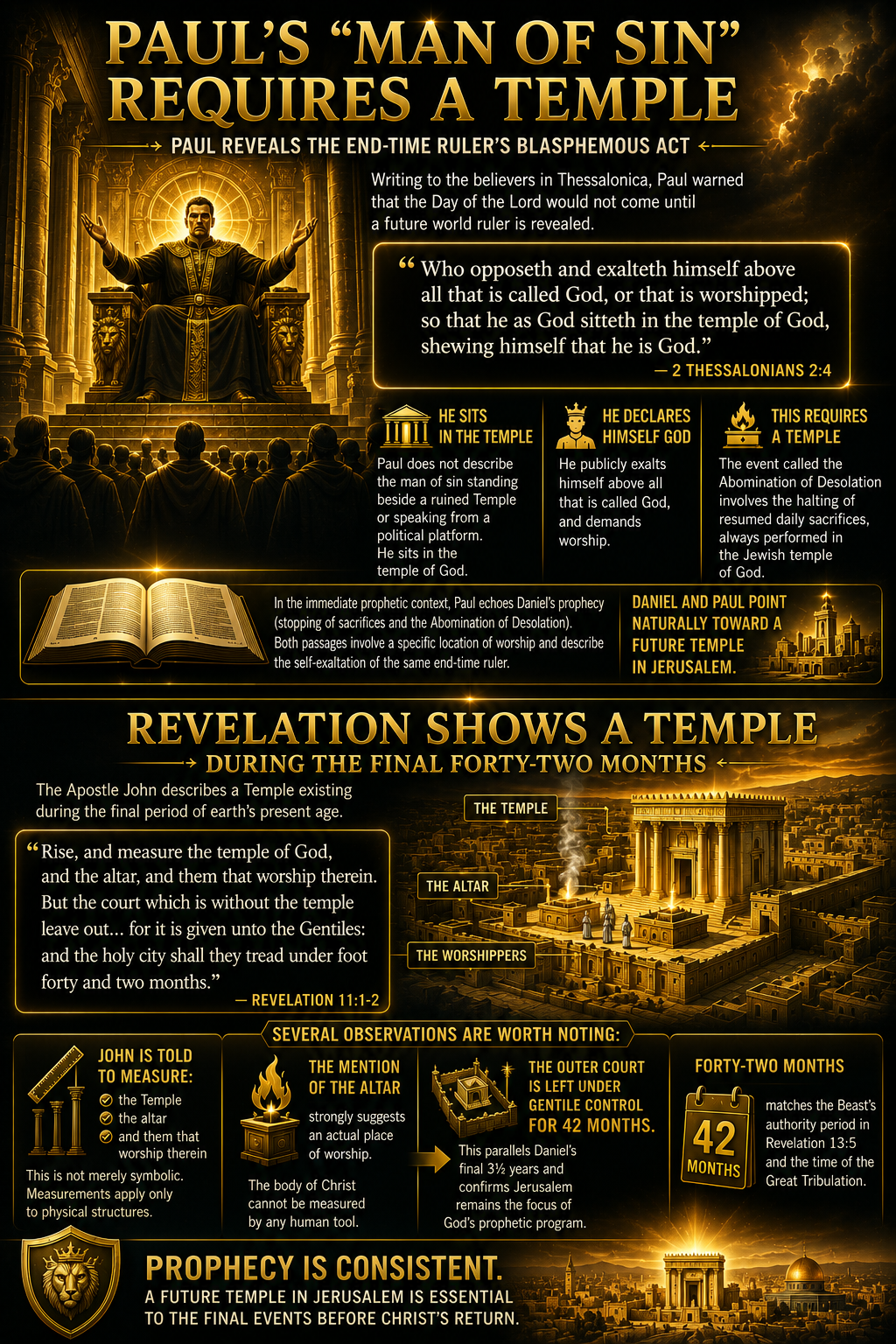
“Who opposeth and exalteth himself above all that is called God, or that is worshipped; so that he as God sitteth in the temple of God, shewing himself that he is God.” (2 Thessalonians 2:4)
Paul does not describe the man of sin standing beside a ruined Temple.
He does not describe him speaking from a political platform.
He says this individual sits in the temple of God, publicly declaring himself to be divine.
Some interpreters understand Paul’s language symbolically, suggesting the “temple” represents the Church. However, in the immediate prophetic context, Paul appears to echo Daniel’s prophecy concerning the stopping of sacrifices and the Abomination of Desolation. Both passages involve a specific location associated with worship, and both describe the self-exaltation of the same end-time ruler. Further, the event called “the Abomination of Desolation” involves the halting of resumed daily sacrifices, always performed in the Jewish temple of God.
Taken together, Daniel and Paul point naturally toward a future Temple in Jerusalem.
Revelation Shows a Temple During the Final Forty-Two Months
The Apostle John likewise describes a Temple existing during the final period of earth’s present age.
In Revelation 11:1-2 he writes:
“Rise, and measure the temple of God, and the altar, and them that worship therein. But the court which is without the temple leave out… for it is given unto the Gentiles: and the holy city shall they tread under foot forty and two months.”
Several observations are worth noting.
John is told to measure:
- the Temple,
- the altar,
- and the worshipers.
This is not merely a symbolic reference to believers.
The mention of the altar strongly suggests an actual place of worship. Measurements have no meaning or purpose for anything other than physical structures. The body of Christ globally cannot be measured by any human measuring tool.
Furthermore, John distinguishes between the Temple itself and the outer court, which is left under Gentile control for forty-two months.
That detail closely parallels Daniel’s final three and one-half years and indicates that Jerusalem remains the focal point of God’s prophetic program.
Why Revelation 11 Cannot Refer to the (now destroyed) Second Temple
Some readers ask whether John might simply be describing the Second Temple that stood during the first century.
The chronology makes that difficult.
Most scholars date the writing of Revelation during the reign of Emperor Domitian, around A.D. 95 or 96, approximately twenty-five years after the Romans destroyed the Second Temple. While some scholars argue for an earlier date, the later date has long been the majority position among evangelical historians and commentators.
If Revelation was written after A.D. 70, the Temple John measured could not have been the one destroyed by Titus.
Instead, John is looking forward prophetically to a future Temple that will exist shortly before Christ’s return.
Does the Bible Require Animal Sacrifices to Return?
For many Christians, this is one of the most difficult questions.
Why would God allow animal sacrifices to resume after Christ offered the perfect sacrifice for sin?
The New Testament is unequivocal.
Jesus’ sacrifice is complete.
Hebrews declares:
“For by one offering he hath perfected for ever them that are sanctified.” (Hebrews 10:14)
No future sacrifice could ever add to Christ’s finished work.
The return of sacrifices would therefore not represent the Christian’s need to return to the Old Covenant as a means of salvation.
Rather, Daniel simply states that sacrifices will exist and later be stopped.
The prophecy describes what will happen.
It does not necessarily endorse why people resume the practice. We know that currently, many Jews do not accept Jesus as the Messiah, and therefore they do not look to His sacrifice (i.e., Calvary) as supreme. In fact, thy had Him nailed to the cross.
Throughout history, people have often engaged in religious activity without fully understanding God’s redemptive purposes. The existence of future sacrifices should therefore be understood descriptively rather than prescriptively. Scripture nowhere teaches that believers are to return to the sacrificial system for forgiveness of sins.
Jesus Christ (and His sacrifice) is more than enough.
Preparations Already Underway
Although no Third Temple currently stands in Jerusalem, it is noteworthy that significant preparations have been taking place for decades.
Several organizations in Israel have devoted extensive effort toward researching and preparing for a future Temple. Educational exhibits, priestly garments, sacred vessels, and studies concerning Temple worship have all received considerable attention.
The Temple Institute, for example, has produced replicas of many Temple furnishings described in Scripture and has invested years in studying the biblical requirements for Temple service.
These developments should not be viewed as proof that the Final Seven Years have begun.
Neither should every headline be interpreted as the fulfillment of prophecy.
However, they do demonstrate that the rebuilding of a Temple is no longer merely a theoretical discussion. There are individuals and organizations actively preparing for the possibility, even though profound political and religious obstacles remain.
Christians should approach such developments with discernment. Our confidence rests not in newspaper headlines but in the reliability of God’s Word.
The Temple Is Not the Center of God’s Plan
As fascinating as the subject is, the rebuilt Temple is not the centerpiece of biblical prophecy.
Jesus Christ is.
The Temple matters because of what happens there.
It becomes the stage upon which one of history’s greatest acts of deception unfolds.
Halfway through the seven-year covenant, the man who helped broker peace reveals his true character. He enters the Temple, stops the sacrifices, exalts himself above every object of worship, and demands the allegiance of the world.
That event, known as the Abomination of Desolation, marks the dividing line of Daniel’s seventieth week (the final 7 years).
It transforms a period of apparent peace into the darkest time of persecution the world has ever known.
Jesus said that when this event occurs, those in Judea should flee immediately, “For then shall be great tribulation, such as was not since the beginning of the world to this time, no, nor ever shall be” (Matthew 24:21).
Understanding what happens at that midpoint is essential because it unlocks nearly every major prophetic passage concerning the end of the age.
The Bible does not leave us guessing.
Daniel, Jesus, Paul, and John all point to the same pivotal event, each adding another piece to the prophetic picture that God has graciously revealed in advance.
The First Three and One-Half Years: A World Hopeful for Peace
When people think about the Final Seven Years, they often picture only chaos, persecution, and global upheaval. While those events certainly characterize the latter half of the period, the Bible presents a very different picture at the beginning.
The opening years of Daniel’s seventieth week appear to be marked by remarkable diplomatic success.
The long-running conflict surrounding Israel reaches a temporary resolution.
A charismatic world leader rises to prominence.
Religious tensions ease.
Hope for lasting peace spreads throughout the international community.
From a human perspective, it may seem that the world has finally solved one of its oldest and most volatile conflicts.
Yet Scripture warns that beneath this appearance of peace lies a deception that will ultimately culminate in history’s greatest rebellion against God.
A Leader Rises Through Diplomacy, Not Conquest
Popular culture often portrays the Antichrist as a military dictator who immediately seizes control through violence.
The biblical picture is more nuanced.
Daniel first introduces him as a remarkably gifted political leader.
Daniel 8 describes him as a king of “fierce countenance” who understands “dark sentences” (Daniel 8:23). The language suggests unusual intelligence, political insight, and strategic ability.
Later, Daniel writes:
“And in his estate shall stand up a vile person… but he shall come in peaceably, and obtain the kingdom by flatteries.” (Daniel 11:21)
The Hebrew idea behind “flatteries” conveys diplomacy, intrigue, persuasive speech, and political maneuvering rather than overwhelming military force.
This does not mean he never wages war.
Daniel later depicts him as a formidable military leader (Daniel 11:40-45).
However, his initial rise is accomplished through diplomacy, negotiation, and extraordinary political skill.
This helps explain why he becomes the individual capable of confirming the covenant with many.
A World Longing for Peace
To appreciate the significance of the coming agreement, we must understand the historical backdrop.
For generations, the conflict surrounding Israel has remained one of the world’s most persistent geopolitical challenges. Successive peace initiatives have sought to resolve disputes over borders, security, refugees, settlements, and the status of Jerusalem. Although individual agreements have produced periods of cooperation, none has permanently resolved the conflict.
The Scriptures indicate that one day an agreement will emerge that appears to succeed where so many others have failed.
For the first time, a broad international consensus will recognize a framework that temporarily stabilizes the region.
It is not difficult to imagine the world’s response.
Political leaders will celebrate.
Financial markets may respond positively to increased regional stability.
News organizations will speak of historic breakthroughs.
Diplomats will praise unprecedented cooperation.
Many will believe humanity has entered a new era.
The Apostle Paul anticipated this atmosphere when he wrote:
“For when they shall say, Peace and safety; then sudden destruction cometh upon them…” (1 Thessalonians 5:3)
Paul does not necessarily identify this statement as the formal announcement of Daniel’s covenant (in fact, it’s more connected with the Second Coming of Jesus – 7 years after the Confirmation of the Covenant), but the principle is striking. Scripture repeatedly warns that humanity’s confidence in political peace can create a false sense of security just before dramatic prophetic events unfold.
Israel Continues to Dwell in the Land
One of the immediate effects of the covenant is that Israel remains securely established in the land promised by God.
This does not mean every dispute disappears. Nor does it imply universal acceptance.
Rather, the agreement provides a framework under which Israel continues to exist while broader political arrangements are implemented.
For the Jewish people, this represents something profoundly significant.
For centuries, they have longed not only for security but also for the restoration of worship centered on Jerusalem.
The covenant appears to provide the conditions necessary for that hope to move toward reality.
Nevertheless, the issue of who will ultimately control Jerusalem will not be completely solved via the covenant.
Preparations Give Way to Construction
If Daniel, Paul, and John all describe a functioning Temple during the midpoint of the seven years, then the Temple must be completed during the first half of the covenant.
The Bible does not tell us exactly how long construction takes.
Neither does it describe the architectural design or the sequence of construction.
It simply reveals the result. Yet, there are passages in Daniel that indict that it could take around 7 months to construct (perhaps 220 – 223 1/2 days). How that conclusion is reached is too lengthy of a matter to disclose here and now, but revolves around the timing Daniel noted as 2,300 days.
By the midpoint of the Final 7 Years:
- a Temple exists,
- worship is taking place,
- sacrifices are being offered,
- and a future world ruler enters that Temple.
How every detail of those developments unfold is not fully revealed.
What matters prophetically is that they do.
This reminds us of an important principle when studying prophecy.
The Bible often tells us what will happen without answering every question about how it will happen.
Where Scripture is specific, we should be confident.
Where Scripture is silent, we should exercise humility.
However, it is fun to speculate and no Scripture forbids it.
In fact, Jesus did instruct us to watch and pray, and it is nearly impossible to speculate without watching.
Daily Sacrifices Resume
Daniel twice refers to the daily sacrifices.
These offerings formed the heart of Israel’s Temple worship under the Mosaic Law.
Every morning and every evening, sacrifices were presented before the Lord according to the instructions given through Moses (Exodus 29:38-42; Numbers 28:3-8).
The resumption of these sacrifices would represent an event of enormous religious significance for many within Judaism.
For nearly two thousand years, the absence of a Temple has prevented the restoration of the sacrificial system as prescribed in the Torah.
The existence of a functioning Temple would therefore mark one of the most dramatic developments in Jewish religious history since A.D. 70.
For Christians, however, it is important to distinguish between prophetic expectation and saving faith.
The New Testament teaches that forgiveness of sins comes only through the once-for-all sacrifice of Jesus Christ (Hebrews 9:11-15; Hebrews 10:10-14) upon obedience to His Gospel. No future animal sacrifice can add to His finished work on the cross.
The return of Temple sacrifices should therefore be understood as a prophetic event foretold in Scripture, not as a restoration of God’s means of redemption.
The Growing Influence of the Coming World Leader
During these opening years, the leader who confirmed the covenant continues to gain influence.
Daniel’s visions portray a ruler whose authority steadily expands.
John likewise describes the Beast eventually exercising authority over “all kindreds, and tongues, and nations” (Revelation 13:7).
This authority does not appear instantaneously.
Rather, the biblical narrative suggests a progression.
A successful diplomat becomes an internationally respected statesman.
A respected statesman becomes an indispensable global leader.
An indispensable global leader ultimately demands absolute allegiance.
This gradual progression explains why so many initially embrace him.
Rarely does history surrender itself to tyranny overnight.
Power is more often accumulated step by step, each success increasing public confidence until opposition becomes increasingly difficult.
A False Peace
Although these first three and one-half years may appear peaceful on the surface, Scripture consistently warns that the peace is temporary.
The covenant is never intended to last indefinitely.
Daniel specifically says it is confirmed “for one week” (7 years).
Even before the agreement reaches its midpoint, God already knows what is coming.
The ruler who appeared to unite nations will ultimately divide them.
The man celebrated as a peacemaker will reveal himself as a blasphemer.
The diplomat admired by the world will become its greatest persecutor.
This dramatic reversal occurs at the exact midpoint of the seven-year covenant.
Everything changes in a single prophetic moment.
Jesus identified that moment with one phrase:
“The Abomination of Desolation.”
From that point forward, the final forty-two months begin, and what once appeared to be humanity’s greatest diplomatic triumph becomes the darkest period the world has ever experienced.
The Midpoint of the Seven Years: The Abomination of Desolation
If the confirmation of the covenant begins God’s prophetic countdown (i.e., the final 7 years to the Second Coming of Jesus Christ to earth), the Abomination of Desolation marks its dramatic turning point.
Everything changes at this moment.
The first half of Daniel’s seventieth week is characterized by diplomatic progress, religious restoration, and growing international optimism. But at the midpoint, the man who helped broker peace reveals his true identity.
The mask comes off.
The peacemaker becomes a persecutor.
The statesman becomes a tyrant.
The world leader becomes the self-proclaimed object of worship.
Jesus identified this event as the unmistakable sign that the Great Tribulation had begun.
For that reason, no event in Bible prophecy is more important to understand than the Abomination of Desolation.
What Does “Abomination of Desolation” Mean?
The expression may sound strange to modern readers, but its meaning becomes clearer when the two words are examined separately.
In Scripture, an abomination refers to something detestable in God’s sight. The Hebrew word often describes acts of idolatry, false worship, moral corruption, or anything that profanes what God has declared holy.
The word desolation speaks of devastation, ruin, or abandonment. It conveys the idea of something being left spiritually and physically defiled because of God’s judgment.
Together, the phrase describes an act of profound sacrilege that desecrates a holy place and results in devastating consequences.
Daniel uses the expression several times (Daniel 8:13; 9:27; 11:31; 12:11), each time connecting it with the interruption of Temple worship and the defilement of God’s sanctuary.
But Daniel does not fully explain what the act involves.
For that explanation, we turn to Jesus and the New Testament.
Jesus Pointed His Disciples Back to Daniel
When the disciples asked Jesus about the signs of His coming and the end of the age, He did not begin with world politics.
He began with spiritual deception.
Then, after describing various preliminary signs, He pointed directly back to Daniel’s prophecy.
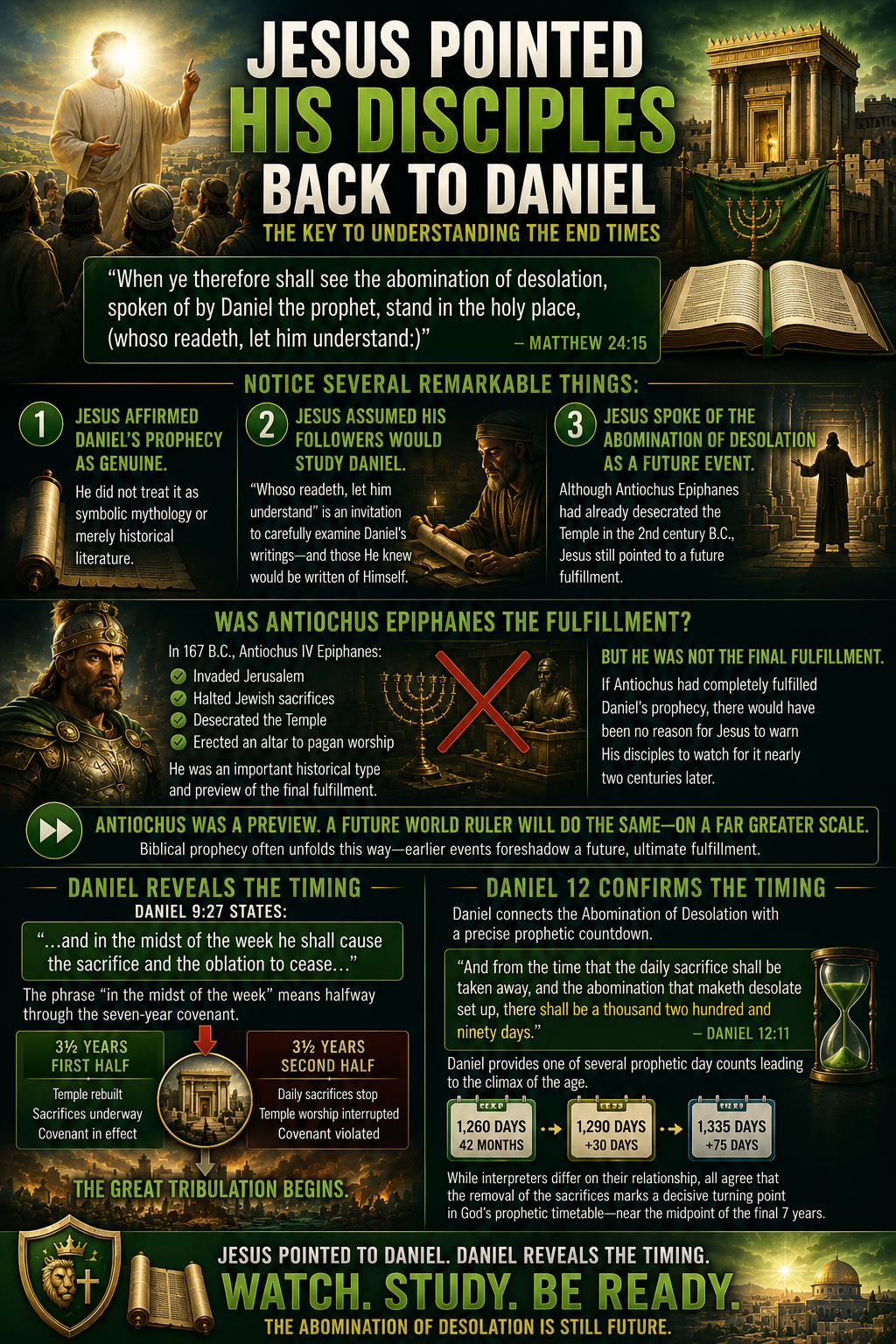
“When ye therefore shall see the abomination of desolation, spoken of by Daniel the prophet, stand in the holy place, (whoso readeth, let him understand:)” (Matthew 24:15)
Notice several remarkable things.
First, Jesus affirmed Daniel’s prophecy as genuine.
He did not treat it as symbolic mythology or merely historical literature.
Second, He assumed His followers would study Daniel.
His parenthetical statement, “whoso readeth, let him understand,” is an invitation to carefully examine Daniel’s writings, and those He knew would be written of Himself (i.e., Matthew 24, and more).
Third, Jesus spoke of the Abomination of Desolation as a future event.
Although Daniel had written centuries earlier, and although Antiochus IV Epiphanes had already desecrated the Temple in the second century B.C., Jesus still pointed His disciples toward a future fulfillment.
That observation is critically important.
Was Antiochus Epiphanes the Fulfillment?
Many Bible scholars recognize Antiochus IV Epiphanes as a historical foreshadowing of the Abomination of Desolation.
In 167 B.C., Antiochus invaded Jerusalem, halted Jewish sacrifices, desecrated the Temple, and erected an altar associated with pagan worship. These events became the catalyst for the Maccabean Revolt and left a lasting impression upon Jewish history.
There is little doubt that Antiochus serves as an important historical type.
However, Jesus’ words indicate he was not the final fulfillment.
If Antiochus had completely fulfilled Daniel’s prophecy, there would have been no reason for Jesus to warn His disciples to watch for it nearly two centuries later.
Instead, Antiochus becomes a preview.
His actions foreshadow what a future world ruler will do on an even greater scale.
Biblical prophecy often unfolds this way.
An earlier historical event provides a pattern that reaches its ultimate fulfillment in the future.
Daniel Reveals the Timing
Daniel tells us exactly when the Abomination occurs.
Daniel 9:27 states:
“…and in the midst of the week he shall cause the sacrifice and the oblation to cease…”
The phrase “in the midst of the week” means halfway through the seven-year covenant.
Three and one-half years have passed.
The Temple has been rebuilt.
Sacrifices are underway.
Then everything changes.
The daily sacrifices stop.
Temple worship is interrupted.
The covenant is violated.
The Great Tribulation begins.
Daniel 12 confirms the importance of this moment by connecting the Abomination of Desolation with a precise prophetic countdown.
“And from the time that the daily sacrifice shall be taken away, and the abomination that maketh desolate set up, there shall be a thousand two hundred and ninety days.” (Daniel 12:11)
Daniel provides one of several prophetic day counts associated with the closing events of the age. While interpreters differ regarding the relationship between the 1,260, 1,290, and 1,335 day periods described in Daniel 12 and Revelation, all agree that the removal of the sacrifices marks a decisive turning point in God’s prophetic timetable, near the midpoint of the final 7 years.
Paul Explains What Daniel Only Hinted At
Daniel tells us when the event occurs.
Paul explains what actually happens.
Writing to the Thessalonian believers, Paul warns:
“Let no man deceive you by any means: for that day shall not come, except there come a falling away first, and that man of sin be revealed…” (2 Thessalonians 2:3)
Paul then continues:
“Who opposeth and exalteth himself above all that is called God, or that is worshipped; so that he as God sitteth in the temple of God, shewing himself that he is God.” (2 Thessalonians 2:4)
Here the mystery is unveiled.
The Abomination of Desolation is not merely the stopping of sacrifices.
Nor is it simply an act of political aggression.
It is the moment when the Antichrist publicly claims divine authority.
Standing in God’s Temple, he demands worship that belongs to God alone.
This explains why Jesus treated the event with such urgency.
The issue is no longer merely political.
It is theological.
The Creator’s rightful place is being usurped by a created man.
The Ultimate Counterfeit of Christ
Throughout Scripture, Satan seeks to imitate God’s work.
Satan does not merely oppose truth.
He counterfeits it.
Jesus is the true Messiah.
The Antichrist presents himself as the world’s savior.
Jesus performs miracles.
The False Prophet performs deceptive signs (Revelation 13:13-14).
The Father glorifies the Son.
The False Prophet glorifies the Beast.
Christ receives worship because He is God.
The Beast demands worship though he is merely a man empowered by Satan.
This is why the midpoint of the seven years represents far more than a political betrayal.
It is when war in the heavens begin.
It is Satan’s greatest attempt to replace God with himself.
The serpent who said in the Garden, “ye shall be as gods” (Genesis 3:5), now seeks worship through the man Scripture calls the Beast.
Why Jesus Said to Flee Immediately
Jesus’ instructions following the Abomination are remarkably urgent.
“Then let them which be in Judaea flee into the mountains…” (Matthew 24:16)
He continues:
“Let him which is on the housetop not come down to take any thing out of his house.”
“Neither let him which is in the field return back to take his clothes.” (Matthew 24:17-18)
These commands reveal several important truths.
First, the danger is immediate.
There is no time to gather possessions.
No time to make elaborate plans.
No time to delay.
Second, Jesus specifically addresses those in Judea.
This geographic reference reinforces Daniel’s focus on Israel and Jerusalem during the seventieth week.
Third, the event triggers unprecedented persecution.
Jesus explains why.
“For then shall be great tribulation, such as was not since the beginning of the world to this time, no, nor ever shall be.” (Matthew 24:21)
Notice the sequence.
Not before the Abomination.
Not sometime during the seven years.
Then.
Immediately following the Abomination of Desolation.
Jesus Himself identifies the midpoint as the beginning of the Great Tribulation.
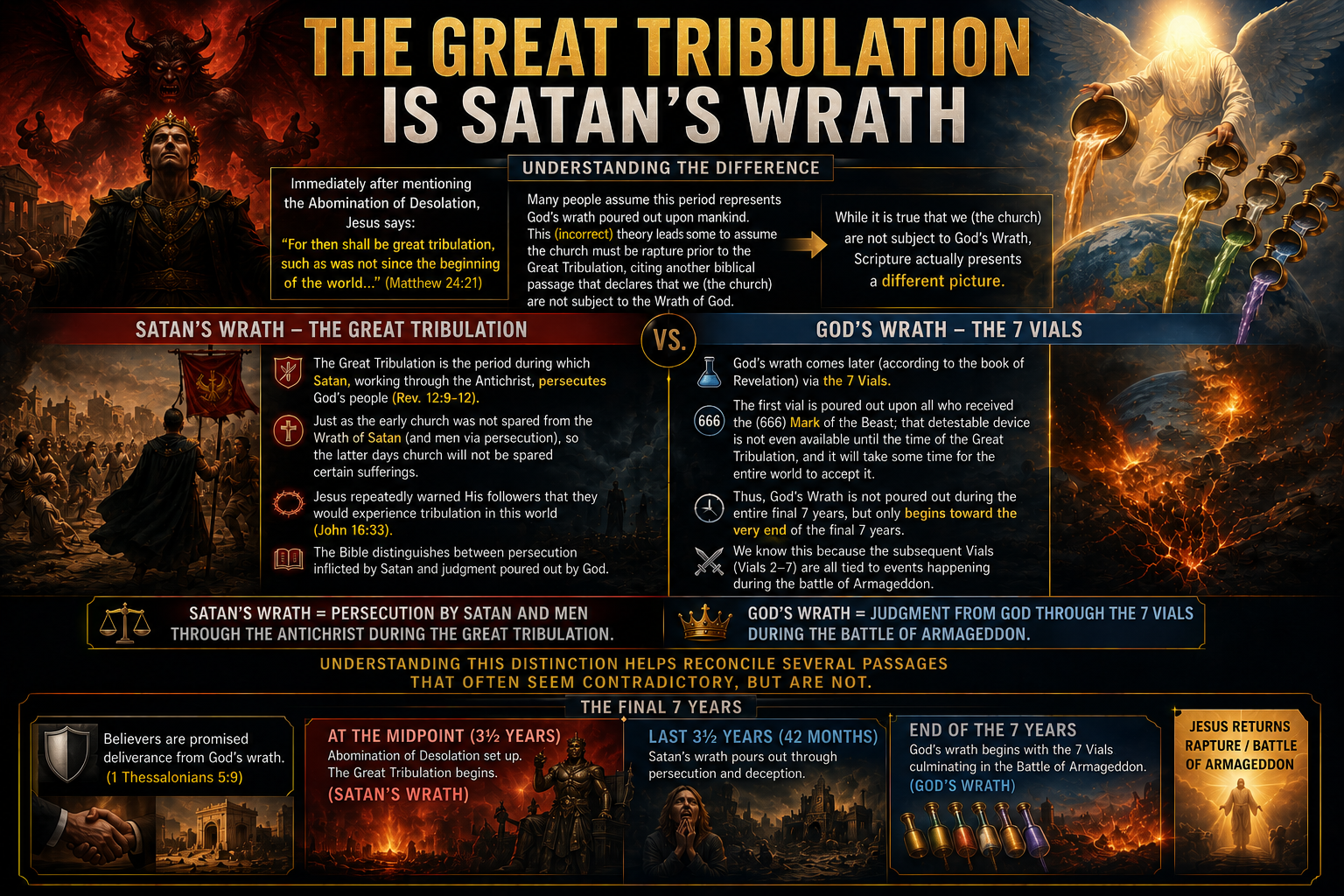
Satan’s Wrath, Not God’s
This distinction is often overlooked but is essential for understanding the prophetic timeline.
Many people refer to the entire seven-year period as “the Tribulation.”
While that terminology has become common, Jesus specifically locates the Great Tribulation after the Abomination of Desolation.
Furthermore, Revelation explains why this period is so severe.
Following Satan’s expulsion from heaven, John writes:
“Woe to the inhabiters of the earth and of the sea! for the devil is come down unto you, having great wrath, because he knoweth that he hath but a short time.” (Revelation 12:12)
Notice whose wrath is emphasized.
It is Satan’s wrath. The Great Tribulation is not God’s wrath, it is Satan’s. God’s wrath is not poured out until the end of the final 7 years via God’s vials (i.e., bowls of wrath). Upon careful study of the Vials of God’s wrath, we discover that only unbelievers are affected them, keeping true with Scripture that saved individuals are not subject to the wrath of God.
The dragon persecutes the woman, symbolic of Israel (Revelation 12:13-17), and wages war against those “which keep the commandments of God, and have the testimony of Jesus Christ.”
This understanding helps distinguish the Great Tribulation from the outpouring of God’s wrath later depicted in Revelation’s bowl judgments. During the Great Tribulation, God’s people experience intense persecution from Satan through the Antichrist’s global system. Later, God Himself judges the rebellious world in preparation for Christ’s return.
Keeping those two expressions distinct brings remarkable harmony to the prophetic timeline.
Revelation Shows the Global Consequences
John expands the picture even further.
After the midpoint, the Beast receives worldwide authority.
“And all that dwell upon the earth shall worship him, whose names are not written in the book of life…” (Revelation 13:8)
The False Prophet then compels humanity to worship the Beast, performs deceptive miracles (e.g., pulling fire down from heaven in the sight of men), erects an image associated with the Beast, and eventually enforces the Mark of the Beast (666) as the means of participating in the global economy (Revelation 13:11-18).
What began as the desecration of one Temple in Jerusalem rapidly becomes a worldwide system demanding universal allegiance.
The Abomination of Desolation is therefore much more than a local religious event.
It becomes the catalyst for the final global rebellion against the authority of God.
The Defining Moment of the End of the Age
It is difficult to overstate the importance of this event.
Daniel builds toward it.
Jesus warns about it.
Paul explains it.
John expands upon its worldwide consequences.
Every major prophetic passage concerning the end of the age intersects at this point.
This is why Jesus did not tell His followers to watch merely for wars, earthquakes, political unrest, or economic turmoil.
He told them to also (and primarily) watch for this.
When the Abomination of Desolation occurs, the final (3 and 1/2 year) countdown to the visible return of Jesus Christ enters its last and most intense phase.
The world will never be the same again.
From that moment forward, the conflict is no longer between nations alone.
It is between the kingdoms of this world and the Kingdom of God Himself.
The Final Three and One-Half Years: The Rise of the Beast’s Global Kingdom
With the Abomination of Desolation, the world enters an entirely new phase of history.
The diplomatic optimism of the first three and one-half years disappears almost overnight.
The leader once celebrated as history’s greatest peacemaker now demands something no righteous leader has ever required.
Worship.
This marks the beginning of the period Jesus called the Great Tribulation (Matthew 24:21), a time of unparalleled deception, persecution, and global upheaval.
The Bible presents these final forty-two months as the climax of humanity’s rebellion against God and the final attempt by Satan to establish his counterfeit kingdom before the return of Jesus Christ.
From Political Leader to Self-Proclaimed God
Throughout history, ambitious rulers have sought wealth, military power, or political dominance.
The Antichrist seeks something far greater.
He desires worship.
Paul describes him as one who
“opposeth and exalteth himself above all that is called God, or that is worshipped…” (2 Thessalonians 2:4)
Daniel likewise portrays him speaking “great words against the most High” (Daniel 7:25).
John records that the Beast opens
“his mouth in blasphemy against God, to blaspheme his name, and his tabernacle…” (Revelation 13:6).
Taken together, these passages reveal that the Antichrist’s ultimate objective is not merely political supremacy.
It is spiritual supremacy.
He does not simply want to govern humanity.
He wants humanity to worship him as though he were God Himself.
This is the ultimate expression of Satan’s rebellion, first seen in Isaiah 14, where Lucifer declared,
“I will ascend above the heights of the clouds; I will be like the most High.” (Isaiah 14:14)
The Antichrist becomes the earthly instrument through whom Satan pursues that ancient ambition.
The Beast Receives Global Authority
Following the Abomination of Desolation, Revelation shifts its attention to the worldwide influence of the Beast.
John writes,
“And power was given him over all kindreds, and tongues, and nations.” (Revelation 13:7)
This does not necessarily mean every nation willingly embraces his rule.
Nor does it require that every government disappears instantly.
Rather, the prophecy depicts unprecedented international authority exercised by one global leader.
Daniel foresaw this same development centuries earlier.
His vision of the fourth beast culminates in a kingdom unlike any before it.
Daniel writes,
“The fourth beast shall be the fourth kingdom upon earth, which shall be diverse from all kingdoms…” (Daniel 7:23)
Unlike previous empires that primarily dominated particular regions, this final kingdom exerts influence on a truly global scale, and uniquely.
Revelation simply expands what Daniel first introduced.
The False Prophet: The Religious Partner of the Beast
Political power alone cannot satisfy Satan’s objectives.
If the Beast desires worship, someone must persuade the world to give it.
This is where Revelation introduces the second Beast.
John writes,
“And I beheld another beast coming up out of the earth… and he had two horns like a lamb, and he spake as a dragon.” (Revelation 13:11)
Later, this individual is identified as the False Prophet (Revelation 19:20).
He performs miracles in the sight of men, but also in the presence of the (i.e., the Antichrist / global dictator), for Revelation 19:20 notes that
“…the false prophet… wrought miracles before [GK: (enopion) in the face of, or in the presence (sight) of] him.“
Thus, both the Antichrist and False Prophet are on the political world scene together.
His appearance is significant.
He looks “like a lamb.”
The imagery suggests gentleness, spirituality, religious credibility, and even Christlike (as Jesus Christ is the known as “the Lamb which taketh away the sin of the world).
Yet he speaks “as a dragon” (or Satan / Rev. 12:9)
His message ultimately originates from Satan.
The contrast is intentional.
His appearance inspires trust.
His words promote deception.
Jesus warned repeatedly about false prophets who would arise in the last days (Matthew 24:11, 24). The False Prophet becomes the ultimate fulfillment of that warning, using religion not to point people toward God, but to direct worship toward the Beast.
Will You Spot the False Prophet When He Arrives?
One critical “miracle” (i.e., lying wonder) he will perform is pulling down fire from heaven in the sight of men (Rev. 13:13). No doubt some will be deceived into believing that this evil religious false prophet is the return of the prophet Elijah (as He was noted in Scripture as pulling down fire from heaven in the sight of men). However, Jesus noted that John the Baptist fulfilled the prophecy of Elijah returning before the Messiah appeared (cf. Luke 1:12-17 / Matthew 11:13-14 / Matthew 17:12-13).
Today, we are not looking for Elijah to return before the coming of the Messiah, as John the Baptist fulfilled that prophecy. There will be a religious leader working alongside the Antichrist pulling down fire from heaven (like Elijah did), but he will be an imposter, and point people to worship the Antichrist (who is not God, nor the Messiah).
The very fact that all these things shall come to pass, should be enough proof and evidence that God’s Word (i.e., the Bible) is true, and that Jesus Christ is the true Messiah and the only Almighty God (John 4:26-26, Acts 9:22, Rev. 1:8, John 14:29).
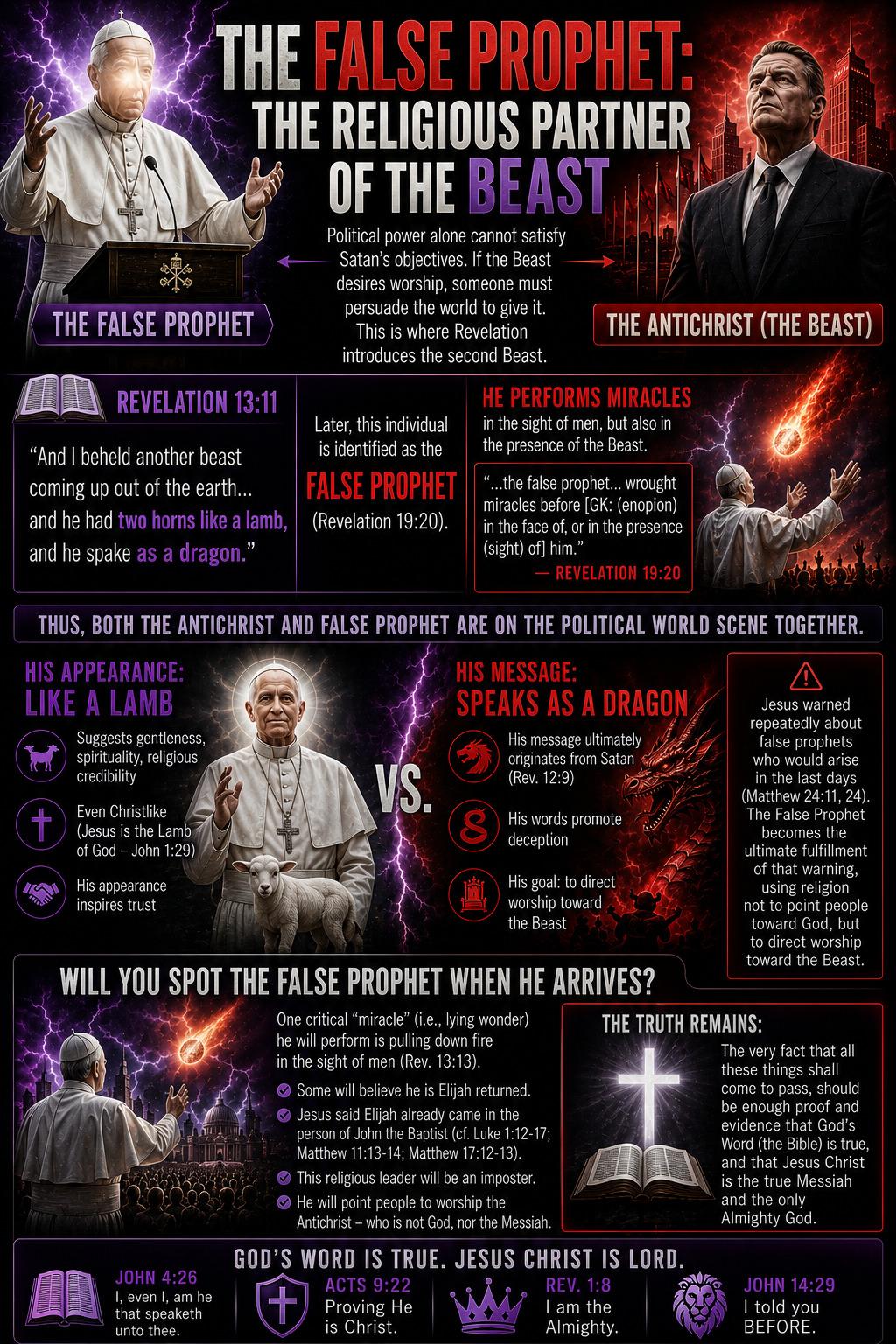
A Counterfeit Diety (God)
One of the striking features of Revelation is Satan’s attempt to imitate God’s own work.
Throughout Scripture, Satan is not merely an opposer. He is a counterfeiter.
Notice the parallels.
The Father sends the Son.
The dragon empowers the Beast.
The Holy Spirit glorifies Christ.
The False Prophet glorifies the Beast.
Jesus performs genuine miracles.
The False Prophet performs deceptive signs.
Christ receives worship because He alone is worthy.
The Beast demands worship through coercion, deception, and intimidation.
This illustrates Satan’s long-standing strategy. Rather than inventing something entirely new, he seeks to imitate God’s work while corrupting its purpose.
Deceptive Miracles
One reason so many people follow the Beast is that the False Prophet performs astonishing signs.
John records,
“And he doeth great wonders, so that he maketh fire come down from heaven on the earth in the sight of men.” (Revelation 13:13)
These miracles are not presented as harmless spectacles.
They serve a purpose.
John continues,
“And deceiveth them that dwell on the earth by the means of those miracles…” (Revelation 13:14)
This reminds believers that miraculous signs, by themselves, are never the ultimate test of truth.
Throughout Scripture, God’s people are instructed to evaluate every teaching juxtaposed to God’s Word (i.e., the Bible / cf. Deuteronomy 13:1-5; Acts 17:11; 1 John 4:1).
Truth is determined by faithfulness to God, not merely by supernatural displays.
The Image of the Beast
The False Prophet then commands the inhabitants of the earth to construct an image honoring the Beast.
John writes,
“…that they should make an image to the beast…” (Revelation 13:14)
The imagery recalls Nebuchadnezzar’s golden image in Daniel 3.
There, faithful believers faced a simple choice.
Bow before the image.
Or remain faithful to God.
The same issue confronts humanity during the final three and one-half years.
The central question is no longer political allegiance.
It is worship.
Who alone deserves ultimate loyalty?
The Creator?
Or the Beast who exalts himself as God?
Every person will eventually answer that question.
The Mark of the Beast
The final stage of this global system is economic enforcement.
John writes,
“And he causeth all, both small and great, rich and poor, free and bond, to receive a mark…” (Revelation 13:16)
He continues,
“And that no man might buy or sell, save he that had the mark…” (Revelation 13:17)
Much speculation has surrounded the identity of the Mark of the Beast.
Christians have suggested countless possibilities throughout history, from paper currency to barcodes, credit cards, implanted microchips, and various emerging technologies.
While technology may eventually play a role, Scripture places its primary emphasis elsewhere.
The mark is not merely a technological innovation.
It is an act of allegiance.
Those who receive it identify themselves with the Beast and participate in his system of worship and authority.
Revelation consistently connects the mark with worship.
People worship the Beast.
People receive his mark.
The two actions are inseparably linked (Revelation 14:9-11).
This perspective helps believers avoid the mistake of viewing the mark as an accidental medical procedure or an unknowingly accepted technological device.
Rather, the biblical emphasis falls upon conscious loyalty to the Beast’s kingdom in opposition to the Kingdom of God.

Persecution Intensifies
Those who refuse the Beast’s authority face severe consequences.
Economic exclusion becomes only the beginning.
Revelation describes widespread persecution of those who remain faithful to Jesus.
John writes,
“It was given unto him to make war with the saints, and to overcome them…” (Revelation 13:7)
Jesus anticipated this persecution.
“Then shall they deliver you up to be afflicted, and shall kill you: and ye shall be hated of all nations for my name’s sake.” (Matthew 24:9)
Daniel likewise foresaw the same period.
“…he shall wear out the saints of the most High…” (Daniel 7:25)
Three writers.
Three centuries apart.
One consistent picture.
The final three and one-half years become the greatest persecution of God’s people in human history.
God Never Loses Control
At this point in the narrative, some readers may wonder whether evil has finally gained the upper hand.
Revelation answers with a resounding no.
Repeatedly, John reminds us that authority is “given” to the Beast (Revelation 13:5, 7).
He does not seize unlimited power.
He receives limited authority under God’s sovereign control.
Even Satan cannot exceed the boundaries God permits.
Daniel had already revealed the same truth.
The Beast’s dominion is temporary.
His kingdom is measured.
His days are numbered.
The God who revealed the future to Daniel also determined its conclusion before it ever began.
That truth provides tremendous comfort.
The darkest chapter of human history unfolds only because God, in His wisdom and sovereignty, allows it for a season before bringing it to its appointed end.
Israel’s Preservation During the Great Tribulation
While the Beast extends his authority across the nations, God does not abandon His covenant people.
Revelation 12 introduces one of the most remarkable promises in all of prophecy.
As Satan intensifies his persecution following the Abomination of Desolation, Israel is provided a place of protection in the wilderness.
This event not only demonstrates God’s faithfulness to His covenant promises but also fulfills Jesus’ urgent command for those in Judea to flee without delay.
Understanding how Revelation 12, Matthew 24, and the Old Testament prophets fit together will help explain one of the most hope-filled aspects of the Great Tribulation.
It reminds us that even in history’s darkest hour, God remains faithful to every promise He has ever made.
God’s Preservation of Israel During the Great Tribulation
Although the Great Tribulation represents the darkest period in human history, it is also one of the greatest demonstrations of God’s covenant faithfulness.
From Genesis to Revelation, God repeatedly promises that He will preserve a remnant of Israel. Kingdoms rise and fall. Empires come and go. Nations attempt to destroy the Jewish people. Yet God’s covenant remains.
The Great Tribulation is no exception.
While Satan unleashes unprecedented persecution against Israel and Christians (almost) globally, God provides supernatural protection for the very people through whom He has promised to fulfill His covenant purposes.
This remarkable balance between persecution and preservation runs throughout biblical prophecy.
Remember, we shall not all sleep (i.e., be killed). There will be Christians on earth who survive throughout the Great Tribulation and remain alive unto the Second Coming of Jesus (1 Corinthians 15:51).
Jesus’ Urgent Warning to Judea
Immediately after describing the Abomination of Desolation, Jesus issued one of the most urgent commands recorded in the Gospels.
“Then let them which be in Judaea flee into the mountains.” (Matthew 24:16)
His instructions continue with remarkable urgency.
“Let him which is on the housetop not come down to take any thing out of his house.”
“Neither let him which is in the field return back to take his clothes.” (Matthew 24:17-18)
The language is unmistakable.
There is no time to pack.
No time to gather possessions.
No time to hesitate.
Flight must be immediate.
Why?
Because the event that has just occurred, the Abomination of Desolation, marks the beginning of history’s most intense persecution.
Jesus continues:
“For then shall be great tribulation, such as was not since the beginning of the world to this time, no, nor ever shall be.” (Matthew 24:21)
Notice again the sequence.
The Abomination occurs.
Israel flees.
Then the Great Tribulation begins.
The chronology is precise.
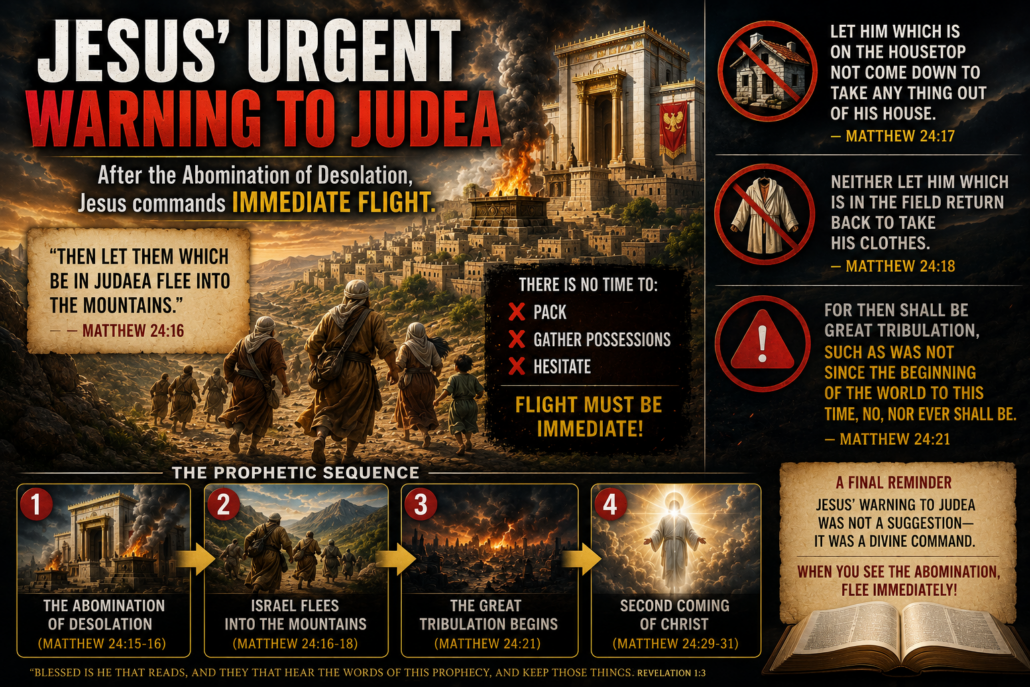
Why Does Jesus Mention Judea?
Some readers have wondered why Jesus specifically mentions Judea rather than speaking generally about believers throughout the world.
The answer lies in the context.
Daniel’s seventieth week centers upon Israel.
Daniel himself was told the prophecy concerned:
“…thy people and thy holy city…” (Daniel 9:24)
The covenant involves Israel.
The Temple is in Jerusalem.
The Abomination occurs on the Temple Mount.
Naturally, those living in Judea become the first targets of the Antichrist’s persecution.
Jesus’ warning fits perfectly within Daniel’s prophetic framework.
Revelation Reveals What Happens Next
John expands upon Jesus’ warning in Revelation 12.
He describes a symbolic woman who gives birth to a male child destined to rule all nations with a rod of iron (Revelation 12:5).
The identity of the child is unmistakable.
It is Jesus Christ.
The woman, therefore, represents the nation through whom the Messiah came.
Throughout the Old Testament, Israel is repeatedly pictured as a woman or bride in covenant relationship with God (Isaiah 54:5-6; Jeremiah 3:14; Hosea 2:19-20). Also, the woman in Revelation 12 was clothed with the sun, the moon was under her feet and she had a crown of 12 stars above her head.
Scripture itself is often the best interpreter of Scripture. Many times, the Bible elsewhere will fill in the blanks and give meaning to other biblical texts, as God is truly the author of the entire Bible (he merely changed secretaries from time to time).
The only other place in Scripture noting a sun, moon, and 12 stars, is the story of Joseph and his 11 brothers (i.e., the 12 stars are the 12 tribes of Israel) and Joseph’s father and mother represented the sun and moon (Genesis 37:9-10). With this biblical backing, we know for sure that the “woman” of Revelation 12 represents the nation of Israel, which indeed brought the Messiah (Jesus Christ) into the world.
Following Satan’s expulsion from heaven, John writes:
“And when the dragon saw that he was cast unto the earth, he persecuted the woman which brought forth the man child.” (Revelation 12:13)
The dragon is explicitly identified as Satan (Revelation 12:9).
Unable to overthrow Christ Himself, he turns his fury toward Israel.
This corresponds perfectly with Jesus’ warning in Matthew 24.
The Two Wings of a Great Eagle
One of the most fascinating statements in Revelation follows immediately.
John writes:
“And to the woman [Israel] were given two wings of a great eagle, that she might fly into the wilderness, into her place…” (Revelation 12:14)
This imagery has generated considerable discussion.
Some understand the passage symbolically, emphasizing God’s supernatural protection.
Others have proposed various historical or political fulfillments.
The passage to describes God’s providential deliverance of Israel during the Great Tribulation. The imagery of eagle’s wings reminds us of God’s earlier deliverance of Israel from Egypt, where He declared:
“Ye have seen what I did unto the Egyptians, and how I bare you on eagles’ wings, and brought you unto myself.” (Exodus 19:4)
In Scripture, eagle’s wings often symbolize God’s power to deliver, protect, and sustain His people.
Additionally, Daniel 7 presents another intriguing image.
The first beast is described as a lion with eagle’s wings (Daniel 7:4). Later in the vision, the wings are plucked from the lion and the beast is caused to stand separately.
It appears from Scripture that the eagle’s wings symbolize the United States emerging from Great Britain, while Revelation 12 employs the same imagery to describe Israel’s end-time deliverance.
Perhaps the purest understanding of this passage (Rev. 12:14) is a mixture of two ideas together; God directly intervenes, but He does so using human instruments (i.e., the United States of America).
Regardless of how God does it, God preserves Israel (according to the Bible).
A Prepared Place
John continues:
“…into her place, where she is nourished for a time, and times, and half a time…” (Revelation 12:14)
Several details deserve careful attention.
First, God has already prepared the place.
John calls it “her place.”
This is not a random hiding location discovered at the last moment.
God has made provision in advance, and it’s within Israel’s national biblical boarders.
Second, Israel is nourished there.
The emphasis is not merely survival.
God sustains His people throughout the period.
Third, the duration exactly matches Daniel’s prophecy.
“A time, and times, and half a time.”
This expression appears repeatedly throughout Scripture.
- Daniel 7:25
- Daniel 12:7
- Revelation 12:14
It equals three and one-half years, the same forty-two months described elsewhere in Revelation (11:2; 13:5) and the same 1,260 days mentioned in Revelation 11:3 and 12:6.
The consistency of these time references strongly suggests they all describe the same final half of Daniel’s seventieth week.
Satan’s Frustration
Unable to destroy Israel directly, Satan attempts another strategy.
John writes:
“And the serpent cast out of his mouth water as a flood after the woman…” (Revelation 12:15)
Whether this flood represents a literal military assault, overwhelming persecution, weather event (Job 1:18-19), or symbolic imagery describing a massive attempt to destroy Israel, the result is the same.
God intervenes.
“And the earth helped the woman…” (Revelation 12:16)
Once again, God demonstrates that His covenant cannot be overturned by human or demonic opposition.
The same God who parted the Red Sea…
The same God who fed Israel in the wilderness…
The same God who preserved His people through exile…
continues to preserve them during history’s final crisis.
The Dragon Turns Against the Saints
Unable to destroy Israel, Satan redirects his fury.
John concludes:
“And the dragon was wroth with the woman, and went to make war with the remnant of her seed, which keep the commandments of God, and have the testimony of Jesus Christ.” (Revelation 12:17)
This verse beautifully connects Revelation 12 with Revelation 13.
The persecution of believers described under the Beast’s global government is not a separate event.
It flows directly out of Satan’s failed attempt to destroy Israel.
Unable to eliminate God’s covenant people…
Unable to prevent God’s prophetic plan…
Unable to overturn God’s promises…
the dragon wages war against all who remain faithful to Jesus Christ.
This explains why the Great Tribulation becomes global in scope.
The persecution begins in connection with Israel but ultimately extends to believers throughout the world. Since no Scripture exists separating “rapture saints” from “tribulation saints,” we must assume the church is still present on earth during the Great Tribulation.
After all, God’s presence is everywhere at all times, and cannot be removed from earth, as some suppose happens just before the final 7 years.
Essentially, either we are a “saint” or an “ain’t.”
It’s not good grammar, but it is a powerful truth.
God’s Covenant Never Fails
One of the great themes running through Scripture is God’s faithfulness despite human failure.
Israel often failed.
Kings failed.
Priests failed.
The nation experienced exile because of disobedience.
Yet God’s covenant endured.
Paul reminds us:
“For the gifts and calling of God are without repentance.” (Romans 11:29)
In other words, God does not revoke His covenant promises.
His faithfulness rests upon His own character.
This truth reaches one of its greatest demonstrations during the Great Tribulation.
At the very moment Satan believes he can finally destroy Israel, God once again proves Himself to be the Keeper of His covenant.
Why This Matters
This prophecy is about far more than Israel’s physical preservation.
It reveals something about the character of God.
If God remains faithful to His covenant with Israel after thousands of years…
If He preserves His promises through wars, exiles, persecutions, and the Great Tribulation itself…
then believers today can have complete confidence that He will remain faithful to every promise He has made through Jesus Christ.
Our assurance rests not upon our ability to hold onto God.
It rests upon His unwavering commitment to hold onto His people.
The Great Tribulation therefore becomes one of the greatest demonstrations of God’s covenant faithfulness ever revealed in Scripture.
And while God protects Israel in the wilderness, He is simultaneously raising up two extraordinary witnesses whose ministry becomes one of the most powerful prophetic testimonies the world has ever seen.
Their message confronts the Antichrist’s deception, calls the nations to repentance, and prepares the world for the soon return of Jesus Christ.
The Ministry of the Two Witnesses
While the Antichrist expands his political authority and the False Prophet strengthens the world’s religious deception, God does not leave Himself without a witness.
Throughout Scripture, whenever darkness increases, God raises up voices to proclaim His truth.
Before the Flood, Noah warned of coming judgment.
Before Israel entered exile, prophets called the nation to repentance.
John the Baptist prepared the way for the Messiah’s first coming, fulfilling the Old Testament prophecies about Elias coming before the Messiah.
Likewise, during the Final Seven Years, God appoints two extraordinary witnesses whose ministry boldly proclaims His message to a world increasingly united in rebellion.
Their appearance reminds us of an important biblical principle.
Even in humanity’s darkest hour, God’s invitation to repentance remains available.
God Always Provides a Witness
The ministry of the Two Witnesses demonstrates God’s justice and mercy.
Before judgment falls, God warns.
Before nations are held accountable, they are given opportunity to repent.
Peter reminds us that God is
“…not willing that any should perish, but that all should come to repentance.” (2 Peter 3:9)
The ministry of the Two Witnesses reflects that same divine compassion.
Even while the Beast consolidates global power, God continues calling people to Himself.
Their Ministry Lasts 1,260 Days
John writes:
“And I will give power unto my two witnesses, and they shall prophesy a thousand two hundred and threescore days, clothed in sackcloth.” (Revelation 11:3)
One thousand two hundred and sixty days equals three and one-half prophetic years.
As we’ve seen throughout this study, Scripture repeatedly describes this same period using different expressions:
- 1,260 days
- Forty-two months
- Time, times, and half a time
Each points to the same final three and one-half years of Daniel’s seventieth week (specifically the latter half).
The consistency of these time references reinforces the remarkable precision of God’s prophetic timetable.
Their Message
Although Revelation focuses primarily on their miraculous ministry, their central purpose is proclamation.
The Greek word translated “witnesses” comes from martys, from which we derive the English word martyr.
A witness is someone who testifies concerning what he has seen and knows to be true.
Throughout Scripture, God calls His people to bear witness to His truth.
The Two Witnesses fulfill that calling on an unprecedented scale during the closing years of human government.
Their message stands in direct contrast to the propaganda of the Beast.
While the Antichrist exalts himself, the Two Witnesses (who are two mighty end-time prophets) exalt God.
While the False Prophet calls the world to worship the Beast, the Two Witnesses call people to repentance, and obey the Gospel of Jesus Christ.
Their ministry reminds the world that Jesus Christ alone is King of kings and Lord of lords.
Miraculous Confirmation
God authenticates their ministry through extraordinary signs.
Revelation describes miraculous acts that recall the ministries of several Old Testament prophets.
These miracles demonstrate that the God who acted throughout biblical history continues to exercise sovereign authority over creation.
The purpose of these signs is not to entertain.
Nor are they intended merely to astonish.
As throughout Scripture, miracles confirm God’s message and call people to believe His Word.
Even during the Great Tribulation, God continues extending mercy before final judgment falls.
Opposition Intensifies
The Two Witnesses (prophets) become powerful reminders that the Beast’s authority is not absolute.
Although the Antichrist dominates much of the world’s political and religious systems, he cannot silence God’s testimony until God permits it.
When their appointed ministry reaches its conclusion, Revelation records that the Beast finally overcomes them (Revelation 11:7).
Their deaths become an international spectacle.
For the first time in history, modern communication technology makes it entirely plausible for people throughout the world to witness the same event almost simultaneously. John’s vision simply records that people from many nations see what happens and respond together (Revelation 11:9-10).
The world’s reaction is revealing.
Rather than mourning, people celebrate.
This is the hour of temptation that shall fall upon the whole earth.
Sin will be rampant as Satan throws his biggest global party of all-time: drugs, alcohol, debauchery, murder, you name it. It wouldn’t surprise me if all laws were halted and no arrests made during this time.
It’s Satan’s last hoorah, and he knows it. The shindig is up. Those who are partying and living in sin during that party, will be lost forever.
Scripture says the people of earth will exchange gifts because the Two Witnesses had tormented them with the truth they proclaimed (Revelation 11:10).
The celebration illustrates how deeply humanity has embraced the deception of the Beast’s kingdom.
Truth has become offensive.
Righteousness has become unwelcome.
God’s messengers are viewed as enemies.
And their deaths, almost seem to validate the Antichrist and False Prophet as the victors.
Almost…
God Has the Final Word
The celebration does not last.
After three and one-half days, God breathes life into His servants.
John writes:
“And they heard a great voice from heaven saying unto them, Come up hither. And they ascended up to heaven in a cloud…” (Revelation 11:12)
Is this a picture of the Rapture (and Second Coming) at the end of the Great Tribulation?
Absolutely.
Even Jesus said as much:
Matthew 24:29-31
29 Immediately after the tribulation of those days shall the sun be darkened, and the moon shall not give her light, and the stars shall fall from heaven, and the powers of the heavens shall be shaken:
30 And then shall appear the sign of the Son of man in heaven: and then shall all the tribes of the earth mourn, and they shall see the Son of man coming in the clouds of heaven with power and great glory.
31 And he shall send his angels with a great sound of a trumpet, and they shall gather together his elect from the four winds, from one end of heaven to the other.
Jesus continues the narrative of this same event (which he had just noted as occurring “immediately after” the Great Tribulation)…
Matthew 24:40-41
40 Then [after the tribulation of those days] shall two be in the field; the one shall be taken, and the other left.
41 Two women shall be grinding at the mill; the one shall be taken, and the other left.
Their resurrection serves as a dramatic reminder that the Beast’s apparent victories are temporary.
Death never has the final word where God is concerned.
The ministry of these two mighty prophets, therefore, becomes one more testimony that history is rapidly approaching its divinely appointed conclusion (the soon-coming of the Kingdom of God to the earth).
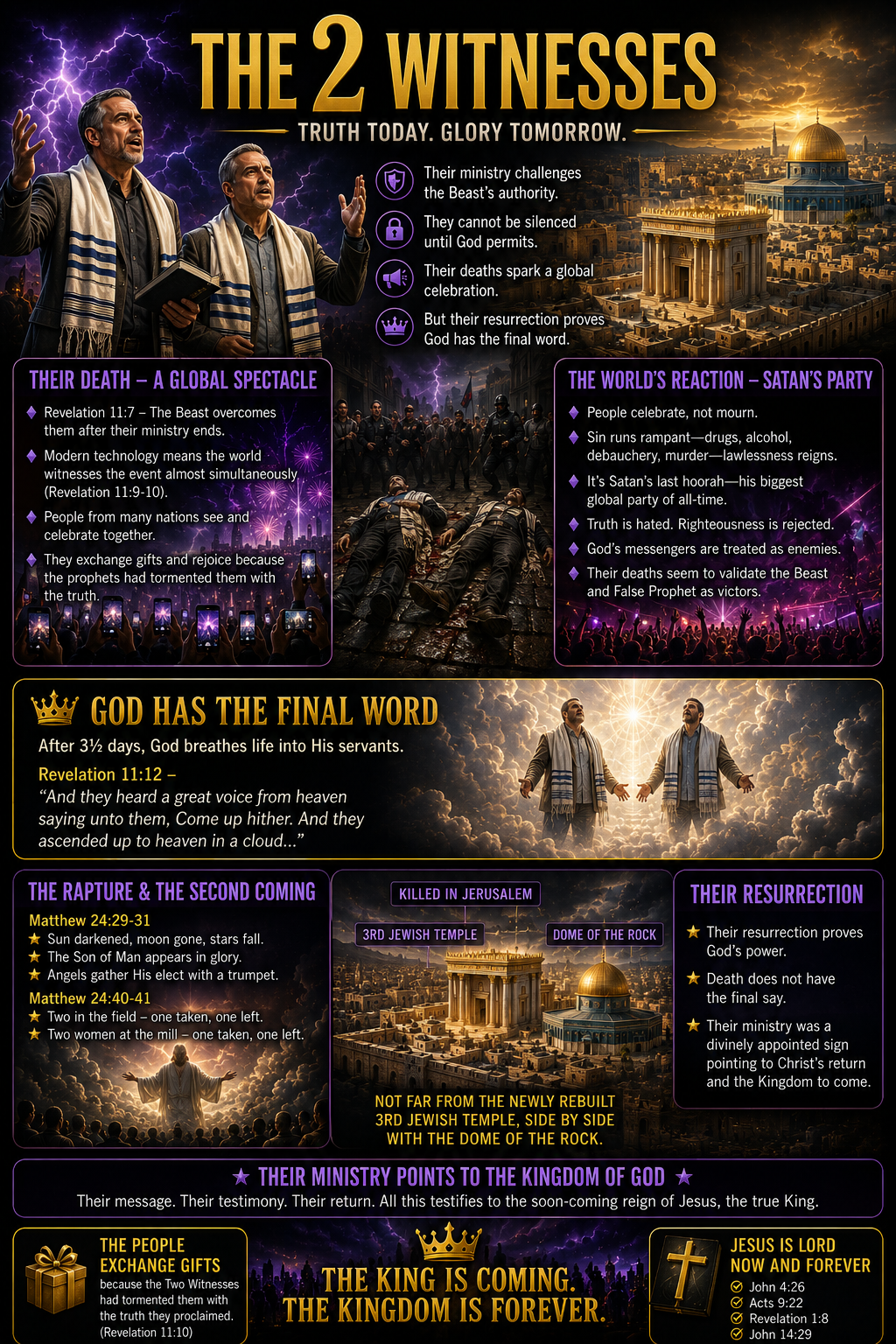
A World Racing Toward Armageddon
Mere weeks before the 2 Witnesses are killed, and nearing the conclusion of the Final Seven Years, the world has become increasingly polarized.
On one side stands the Beast’s global system, demanding allegiance through political authority, religious deception, and economic control.
On the other stands the Kingdom of God, proclaimed through faithful believers, preserved through God’s covenant promises, and powerfully affirmed by the ministry of the Two Witnesses.
The conflict is no longer merely ideological.
It is openly spiritual.
As the closing days of the age approach, Scripture reveals that the nations themselves begin moving toward one final confrontation.
Political tensions escalate.
Military alliances form.
The focus of the world increasingly centers upon one city.
Jerusalem.
The prophets consistently point toward that city because it is there that the greatest military conflict in history will culminate.
The Bible calls that conflict Armageddon.
The Nations Gather for Armageddon
From the opening chapters of Genesis, Jerusalem occupies a unique place in God’s redemptive plan.
It is the city where Abraham demonstrated his faith.
It became the location of Solomon’s Temple.
It was the center of Israel’s worship.
It witnessed the crucifixion and resurrection of Jesus Christ.
It will also become the focal point of history’s final battle.
This should not surprise us. It all began in Jerusalem; it will all end in Jerusalem.
If Jerusalem has always occupied the center of God’s covenant purposes, it is only fitting that it also becomes the place where human rebellion reaches its climax and where Jesus Christ visibly returns to establish His Kingdom.
The Gathering of the Nations
Centuries before the birth of Christ, the prophet Zechariah recorded God’s declaration:
“For I will gather all nations against Jerusalem to battle…” (Zechariah 14:2)
This remarkable prophecy envisions an unprecedented international coalition converging upon Jerusalem.
Notice that the conflict is not merely regional.
The nations of the world become involved.
Likewise, Revelation describes demonic spirits going forth to gather “the kings of the earth and of the whole world” to the battle of the great day of God Almighty (Revelation 16:13-16).
The place of assembly is called Armageddon, a name derived from the Hebrew Har Megiddo, meaning “Mount of Megiddo.”
Located in northern Israel, the Plain of Megiddo has served as the site of numerous historic battles. Yet Scripture indicates that the final conflict extends far beyond one geographical location. Armageddon represents the broader campaign that ultimately reaches Jerusalem, where the decisive events unfold.
Rapture Hint
RAPTURE HINT: If it is true that the rapture occurs “after” the great tribulation (as Jesus indicated / Matt. 24:29), then we should expect to see some hint or indicator in Rev. 16 (the passage of the battle of Armageddon) that the rapture is actually taking place at that time. Amazingly, we do. See if you can find the rapture hint in this passage concerning the gearing up of the battle of Armageddon…
Revelation 16:12-16
12 And the sixth angel poured out his vial upon the great river Euphrates; and the water thereof was dried up, that the way of the kings of the east might be prepared.
13 And I saw three unclean spirits like frogs come out of the mouth of the dragon, and out of the mouth of the beast, and out of the mouth of the false prophet.
14 For they are the spirits of devils, working miracles, which go forth unto the kings of the earth and of the whole world, to gather them to the battle of that great day of God Almighty.
15 Behold, I come as a thief. Blessed is he that watcheth, and keepeth his garments, lest he walk naked, and they see his shame.
16 And he gathered them together into a place called in the Hebrew tongue Armageddon.
Did you catch it? Verse 15 (red letter edition) notes Jesus himself declaring, “Behold, I come as a thief…”
Anytime in Scripture, Jesus “comes as a thief” it is in direct reference to the rapture (our gathering together with Jesus in the sky at the sound of the last trumpet). What in the world is Jesus doing warning his people to keep their garments clean (which only happens by the blood of the Lamb) because He is fixing to come as a thief? It appears from Scripture, that the church will be on earth all the way until the battle of Armageddon.
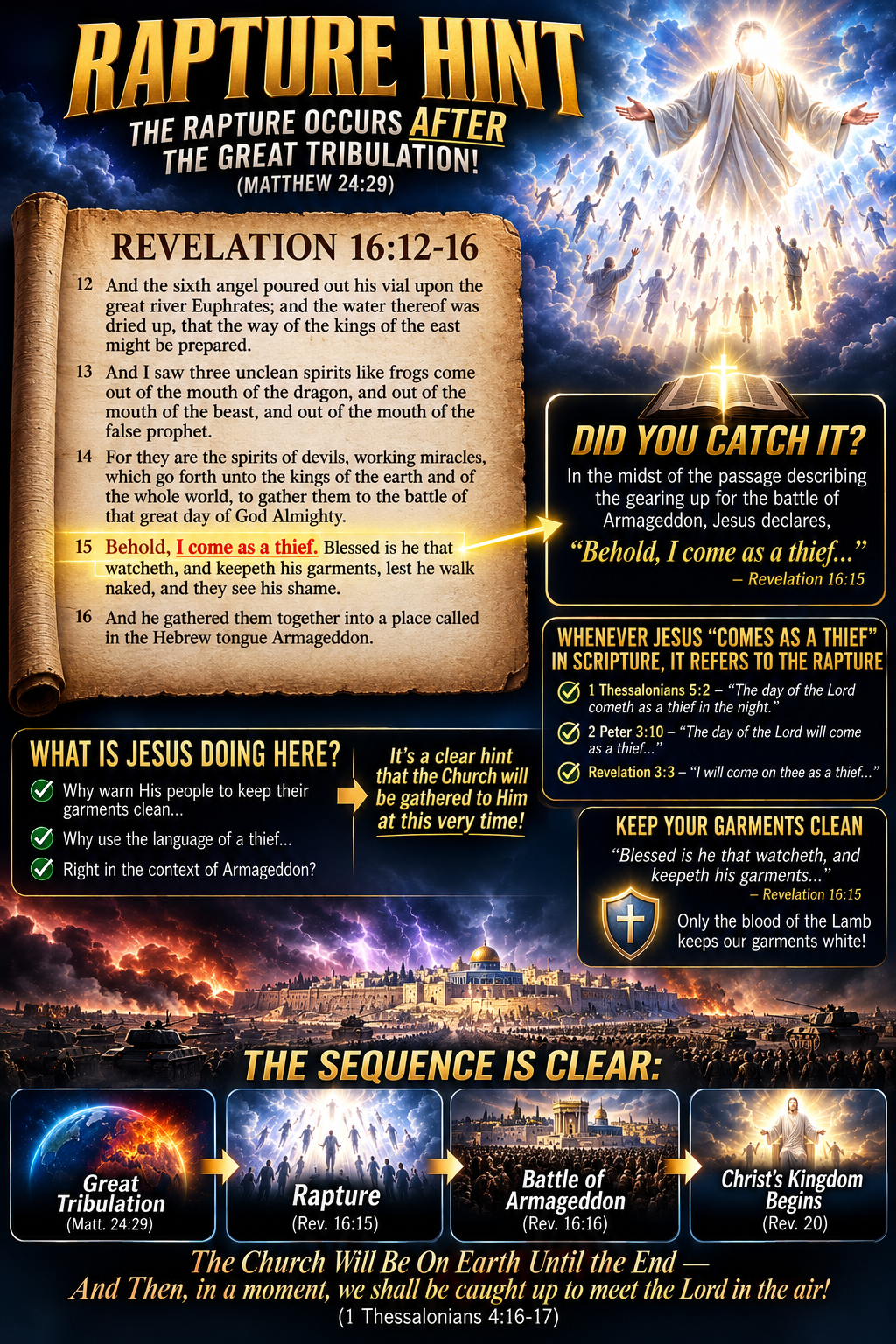
Why Jerusalem?
To the casual observer, Jerusalem appears to be a relatively small city in a relatively small nation.
Yet from God’s perspective, it stands at the center of His prophetic program.
The battle is not fundamentally about real estate.
It is about sovereignty.
Who has the right to rule?
Who is King?
The Beast has declared himself to be god.
The nations have largely accepted his authority.
Now the world stands poised to challenge the city that God Himself has chosen throughout biblical history.
What appears politically motivated is, at its deepest level, a spiritual rebellion against the rightful reign of the Lord.
The Stage Is Set
As we have followed Daniel’s seventieth week, each event has naturally led to the next.
The covenant is confirmed.
The Temple is rebuilt.
The sacrifices resume.
The Abomination of Desolation occurs.
The Great Tribulation begins.
The Beast establishes his global system.
The Mark of the Beast is enforced.
The Two Witnesses proclaim God’s truth.
The nations gather.
The entire prophetic narrative now moves toward one climactic event.
Not merely another battle.
Not another political negotiation.
Not another temporary peace agreement.
The visible return of Jesus Christ Himself.
And when He comes, everything changes forever.
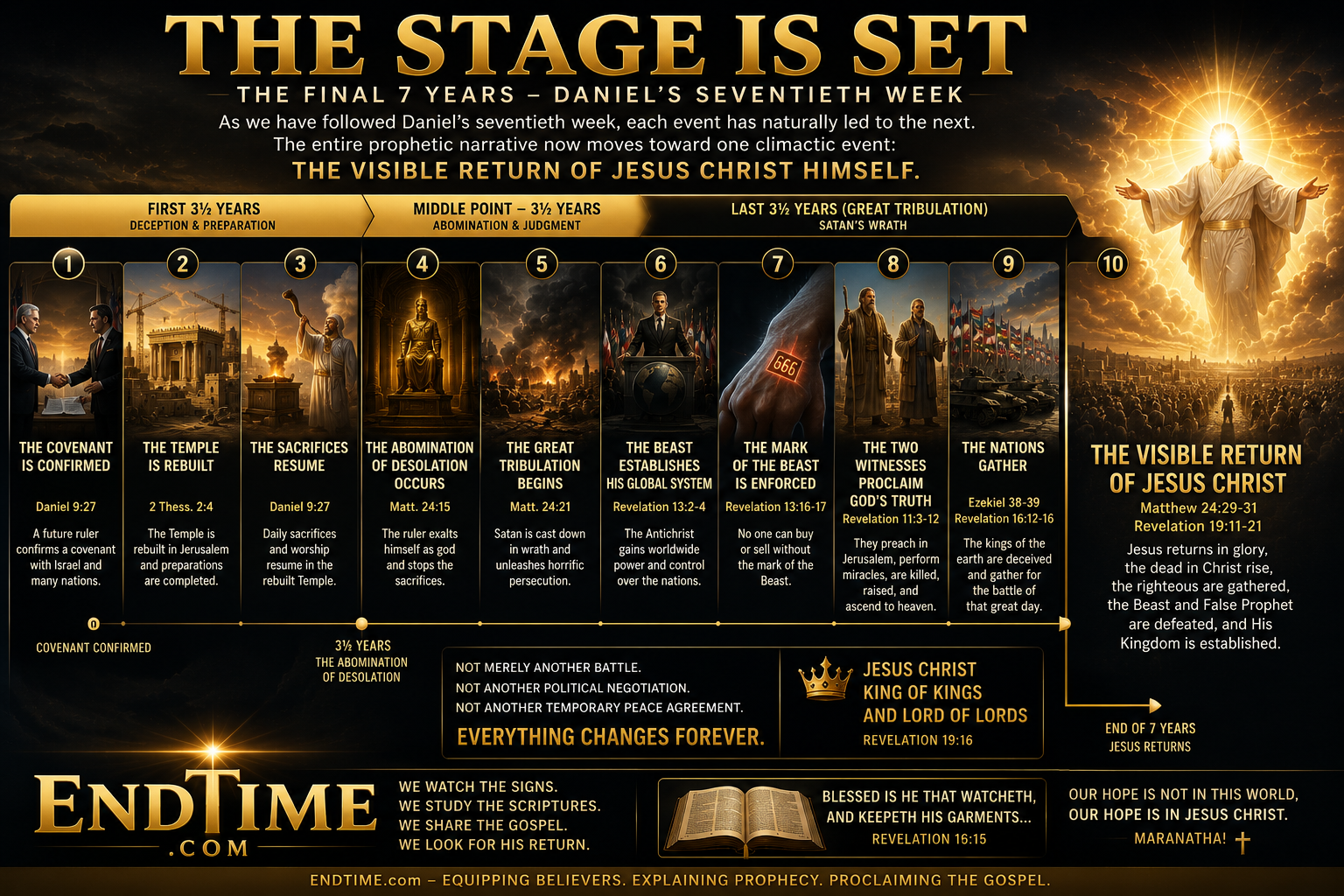
The Glorious Return of Jesus Christ
For nearly seven years, the world has watched humanity’s greatest political experiment unfold.
A charismatic leader has united nations.
A global government has emerged.
A worldwide religious system has demanded allegiance.
The Antichrist has declared himself to be god.
The Mark of the Beast (666) has divided humanity.
The saints have endured persecution.
Israel has fled into the wilderness.
The nations have gathered against Jerusalem.
From every human perspective, it appears that evil is about to prevail.
Then, at history’s darkest hour, heaven opens.
The King returns.
The Bible’s story has never ultimately been about the rise of the Antichrist.
It has always been about the return of Jesus Christ.
Every prophecy, every covenant, every promise, every kingdom, and every act of redemption points toward this magnificent moment.
The Same Jesus Who Ascended Will Return
After His resurrection, Jesus led His disciples to the Mount of Olives.
As they watched, He ascended into heaven.
Acts records:
“While they beheld, he was taken up; and a cloud received him out of their sight.” (Acts 1:9)
The disciples stood gazing upward until two angels spoke.
“Ye men of Galilee, why stand ye gazing up into heaven? this same Jesus… shall so come in like manner as ye have seen him go into heaven.” (Acts 1:11)
Notice the certainty.
Not another prophet.
Not merely a spiritual influence.
Not an invisible return.
This Same Jesus.
The One born in Bethlehem.
The One crucified outside Jerusalem.
The One who rose from the grave.
The One who ascended into heaven.
He Himself returns.
Christian hope has never rested merely in escaping difficult times.
It rests in the visible return of the risen Christ.
Every Eye Shall See Him
Unlike Christ’s first coming, which occurred quietly in Bethlehem, His Second Coming will be unmistakable.
John declares:
“Behold, he cometh with clouds; and every eye shall see him…” (Revelation 1:7)
Jesus likewise taught:
“For as the lightning cometh out of the east, and shineth even unto the west; so shall also the coming of the Son of man be.” (Matthew 24:27)
There will be no uncertainty.
No secret appearance (Matthew 24:26).
No hidden manifestation known only to a select few.
The return of Christ becomes the defining event of human history.
The King whom the world rejected now returns openly as King of kings and Lord of lords.
Immediately After the Tribulation
Jesus provides one of the clearest chronological statements in all of prophecy.
He declares:
“Immediately after the tribulation of those days…”
He then describes cosmic disturbances before continuing:
“…they shall see the Son of man coming in the clouds of heaven with power and great glory.” (Matthew 24:29-30)
The word immediately deserves careful attention.
Jesus places His visible return after the Great Tribulation.
Not before it.
Not during it.
After it.
This sequence forms one of the foundational reasons for understanding the gathering of believers to occur following the Great Tribulation.
Whatever differences sincere Christians may have regarding prophetic chronology, all believers eagerly anticipate the glorious appearing of Jesus Christ.
The discussion concerns when, not whether, He comes.
Keep in mind, the issue of when He returns is not a salvation issue, it is merely a timing issue. Thus, we should never seek to cause division in the body of Christ concerning this topic.
The Gathering of the Elect
Immediately after describing His return, Jesus continues:
“And he shall send his angels with a great sound of a trumpet, and they shall gather together his elect…” (Matthew 24:31)
Notice the sequence.
The Tribulation.
The appearing of Christ.
The trumpet.
The gathering.
Paul describes the same event.
“For the Lord himself shall descend from heaven with a shout… and with the trump of God…” (1 Thessalonians 4:16)
Again, notice the similarities.
The Lord descends.
A trumpet sounds.
Believers are gathered.
The parallels are remarkable.
Far from describing separate events, both passages portray the glorious return of Christ accompanied by the resurrection and gathering of His people.
The Resurrection of the Righteous
Paul expands upon this hope in 1 Corinthians 15.
“Christ the firstfruits; afterward they that are Christ’s at his coming [i.e., Second Coming].” (1 Corinthians 15:23)
Later he writes:
“In a moment, in the twinkling of an eye, at the last trump… the dead shall be raised incorruptible…” (1 Corinthians 15:52)
Death does not have the final word.
The resurrection promised throughout Scripture reaches its glorious fulfillment when Christ returns.
Generations of believers who trusted Him throughout history rise to meet their Savior.
Those still living are transformed.
What began with Christ’s resurrection becomes complete in the resurrection of His people.
This is not merely a doctrine.
It is the believer’s blessed hope.
One Glorious Coming
One question often arises.
Does Scripture describe one future coming of Christ or two separate returns?
Christ’s return, the resurrection of believers, and the gathering of the saints are one glorious event, occurring on one glorious day (2 Thes. 2:1-2).
Consider what occurs at Christ’s coming.
Jesus appears in glory.
The trumpet sounds.
The dead in Christ are raised.
Living believers are transformed.
The saints are gathered.
The Beast is defeated.
The kingdoms of this world become the Kingdom of our Lord.
Rather than requiring multiple future returns separated by years, these passages naturally converge upon one climactic appearing of Jesus Christ at the close of Daniel’s seventieth week.
This understanding also harmonizes with Paul’s statement that our gathering to Christ will not occur until after the man of sin is revealed (2 Thessalonians 2:1-4), as well as Jesus’ own declaration that His coming follows “immediately after the tribulation of those days” (Matthew 24:29-31).
Faithful Christians have long differed on the timing of the Rapture. Many hold a pre-tribulation view based on their understanding of passages such as 1 Thessalonians 5:9 and Revelation 3:10. Others advocate mid-tribulation or pre-wrath perspectives.
However, the clearest synthesis of Matthew 24, 1 Corinthians 15, 1 Thessalonians 4, and 2 Thessalonians 2 places the resurrection and gathering of believers at Christ’s visible return immediately following the Great Tribulation.
Regardless of where one stands in that discussion, the central truth remains unchanged.
Jesus Christ is coming again. And it is our job to be ready.
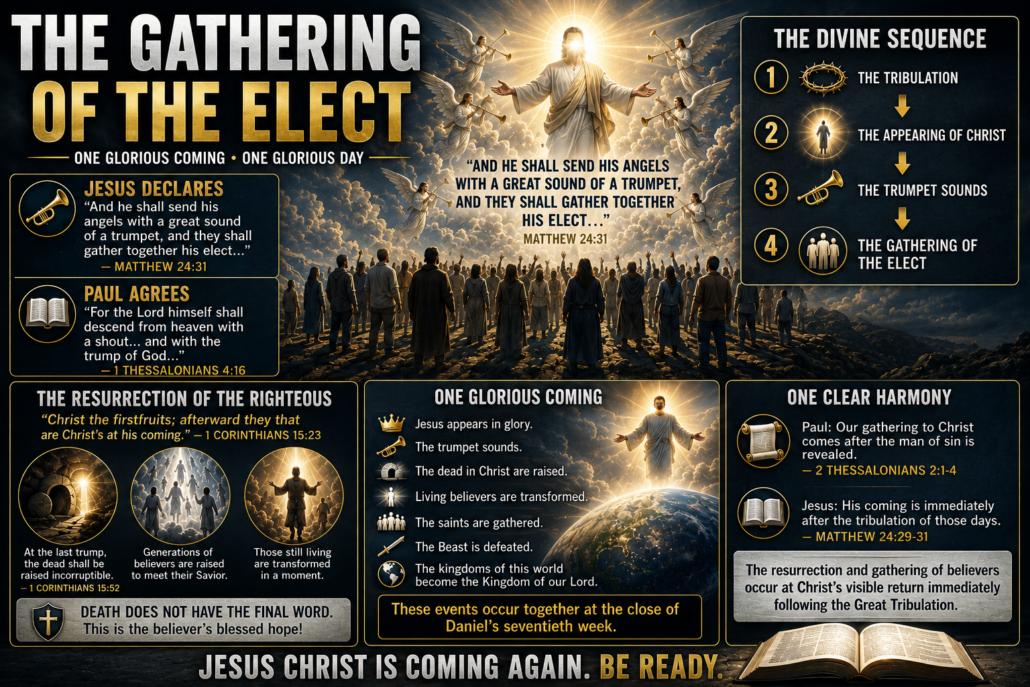
The Battle Ends Before It Truly Begins
As the nations gather against Jerusalem, the outcome appears uncertain from a human perspective.
But heaven has never questioned the result.
John writes:
“And I saw heaven opened, and behold a white horse…” (Revelation 19:11)
The Rider is called
“Faithful and True.”
Unlike the counterfeit peace established by the Beast, Christ wages righteous judgment.
The armies of heaven follow Him.
The Beast and the kings of the earth assemble to wage war against the returning King.
Yet Revelation describes no prolonged military struggle.
The Beast is seized.
The False Prophet is seized.
Their rebellion ends immediately before the authority of the returning Christ.
The King who spoke creation into existence simply speaks again.
The rebellion of the nations comes to an end.
The Stone Cut Without Hands
Daniel foresaw this very moment centuries earlier.
In Nebuchadnezzar’s dream, a great image representing successive world empires stood proudly before the king.
Then Daniel writes:
“Thou sawest till that a stone was cut out without hands, which smote the image upon his feet…” (Daniel 2:34)
The stone destroys every human kingdom.
The image collapses.
The kingdoms become like chaff carried away by the wind.
Then Daniel explains:
“The God of heaven shall set up a kingdom, which shall never be destroyed…” (Daniel 2:44)
This is not merely the defeat of one ruler.
It is the end of human government as the dominant authority over the earth.
Christ establishes His everlasting Kingdom.
Every empire.
Every dictatorship.
Every monarchy.
Every republic.
Every human government ultimately yields to the reign of the King of kings.
The Son of Man Receives His Kingdom
Daniel’s later vision reaches the same conclusion.
He writes:
“I saw… one like the Son of man came with the clouds of heaven…” (Daniel 7:13)
The Ancient of Days gives Him
“…dominion, and glory, and a kingdom, that all people, nations, and languages, should serve him…” (Daniel 7:14)
Notice the beautiful harmony.
Daniel 2.
Daniel 7.
Zechariah 14.
Matthew 24.
Acts 1.
1 Corinthians 15.
1 Thessalonians 4.
Revelation 19.
They are not competing prophecies.
They are complementary portraits of one magnificent event.
The visible return of Jesus Christ.
The King who came first as the suffering lowly Servant now returns as the conquering Cosmic King.
The Lamb becomes the Lion.
The rejected Messiah becomes the ruler of the nations.
The Carpenter from Nazareth takes His rightful place upon the throne of David.
The Blessed Hope of Every Believer
For believers, the Second Coming is not merely the conclusion of prophetic chronology.
It is the fulfillment of our deepest hope.
The One who forgave our sins…
The One who conquered death…
The One who promised, “I will come again” (John 14:3)…
keeps His word.
Every tear finds its answer.
Every prayer reaches its fulfillment.
Every promise becomes reality.
History has been moving toward this moment from the very beginning.
And when Jesus Christ returns, the age of human rebellion comes to an end.
A new era begins.
The Kingdom of God is established upon the earth, Satan is restrained, and Christ reigns in righteousness for one thousand years.
That reign, often called the Millennial Kingdom, fulfills promises stretching from Genesis to Revelation and demonstrates once again that every promise God has made will be fulfilled exactly as He declared.
The Millennial Reign of Christ: The Kingdom the Prophets Longed to See
The Final Seven Years conclude not with the destruction of the earth, but with the establishment of Christ’s Kingdom upon it.
This is one of the Bible’s most encouraging truths.
The purpose of prophecy is not simply to reveal coming judgment.
It is to reveal God’s ultimate victory.
For thousands of years, humanity has struggled under the consequences of sin.
Empires have risen and fallen.
Wars have scarred every generation.
Governments have promised lasting peace but ultimately failed.
The Millennial Reign of Jesus Christ marks the end of mankind’s unsuccessful attempts to govern the world apart from God.
The rightful King finally takes His throne.
What Is the Millennium?
The word Millennium simply means one thousand years.
It comes from the Latin words mille (thousand) and annus (year).
The term itself does not appear in most English Bible translations, but the concept comes directly from Revelation 20, where John refers to Christ’s thousand-year reign six different times (Revelation 20:1-7).
John writes:
“And they lived and reigned with Christ a thousand years.” (Revelation 20:4)
The repetition leaves little doubt about the duration John intends to communicate.
While faithful Christians differ regarding whether the thousand years should be understood literally or symbolically, the interpretation presented in this article understands Revelation 20 to describe a future, literal reign of Christ upon the earth following His Second Coming.
Satan Is Bound
One of the first events John records is the binding of Satan.
He writes:
“And he laid hold on the dragon, that old serpent, which is the Devil, and Satan, and bound him a thousand years.” (Revelation 20:2)
For the first time since the Garden of Eden, the great deceiver is removed from his influence over the nations.
Notice why.
“…that he should deceive the nations no more…” (Revelation 20:3)
This does not mean sin immediately disappears from the earth.
Rather, the one who has relentlessly deceived humanity throughout history is restrained.
The contrast with the Great Tribulation is striking.
During the final three and one-half years, Satan’s deception reaches its greatest intensity.
During the Millennium, his ability to deceive the nations is removed.
Christ Reigns from Jerusalem
The Old Testament repeatedly points to Jerusalem as the center of Messiah’s future Kingdom.
Isaiah writes:
“Out of Zion shall go forth the law, and the word of the LORD from Jerusalem.” (Isaiah 2:3)
Zechariah declares:
“And the LORD shall be king over all the earth…” (Zechariah 14:9)
These prophecies move beyond symbolism.
They anticipate a real King reigning from a real city over real nations.
This fulfills God’s covenant promises concerning the throne of David.
When Gabriel announced Jesus’ birth to Mary, he declared:
“The Lord God shall give unto him the throne of his father David: And he shall reign over the house of Jacob for ever…” (Luke 1:32-33)
The Millennial Kingdom demonstrates that God keeps every covenant He makes.
The throne promised to David is occupied by David’s greater Son.
The Saints Reign with Christ
The Millennium is not only about Christ’s reign.
It is also about the participation of His redeemed people.
Paul reminded believers:
“Do ye not know that the saints shall judge the world?” (1 Corinthians 6:2)
John writes:
“…they lived and reigned with Christ a thousand years.” (Revelation 20:4)
Jesus Himself promised His followers positions of responsibility within His Kingdom (Luke 19:11-27).
The Bible does not present heaven as an eternity of inactivity.
Rather, God’s people serve alongside Christ as He restores righteous government to the earth.
The King shares His Kingdom with those who remained faithful to Him.
Peace Finally Comes to the Earth
The prophets repeatedly describe the Millennial Kingdom as an age unlike anything humanity has experienced.
Isaiah writes:
“And he shall judge among the nations… and they shall beat their swords into plowshares…” (Isaiah 2:4)
Weapons become farming tools.
War gives way to peace.
Justice replaces corruption.
Righteousness governs the nations.
Isaiah also paints a picture of remarkable harmony throughout creation (Isaiah 11:6-9). Whether one understands every detail literally or recognizes symbolic elements emphasizing the peace and restoration of Messiah’s reign, the central message is unmistakable.
The curse that has marked human history since Eden begins to give way to restoration under the reign of Christ.
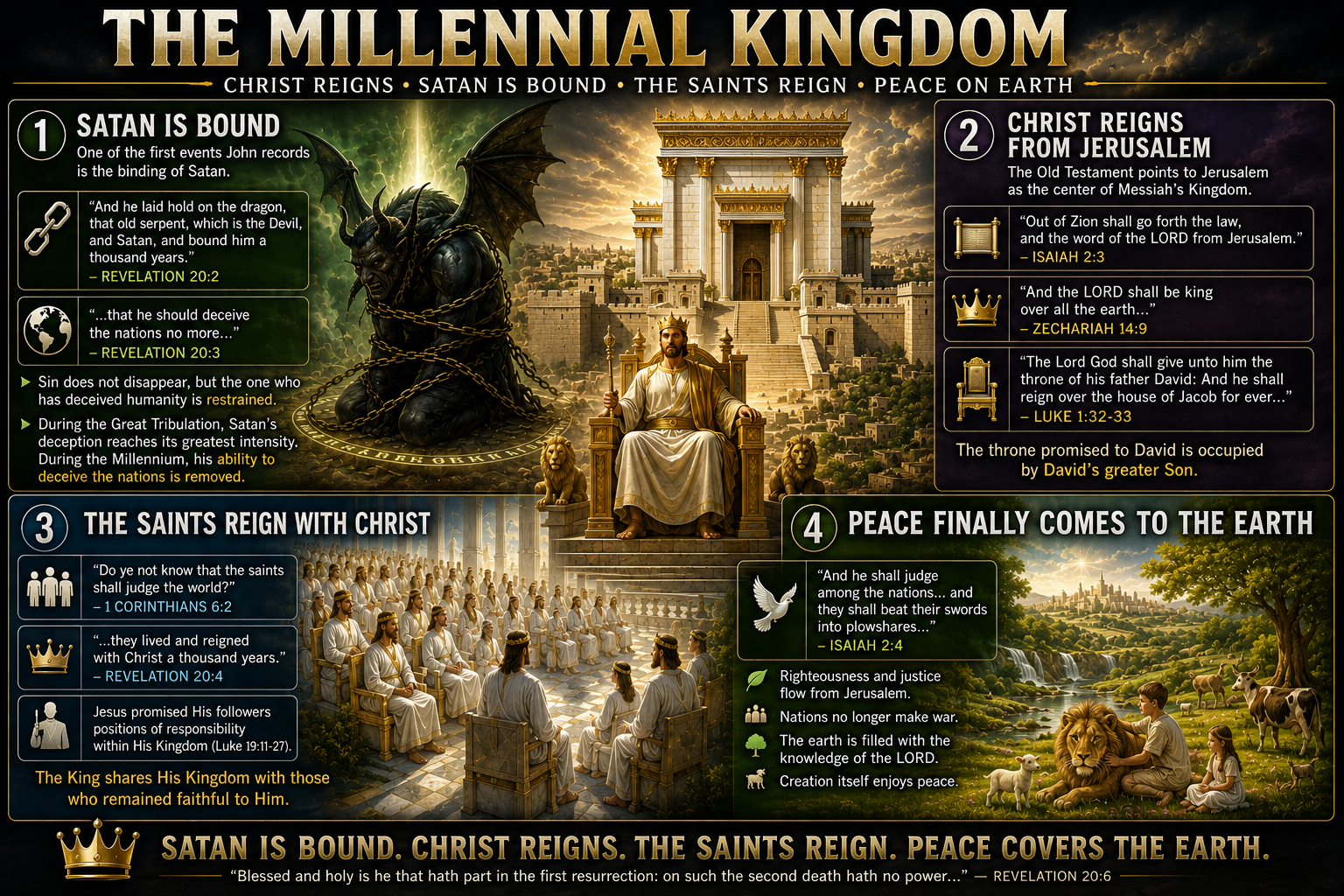
Israel’s Restoration
Throughout this article we have emphasized that Daniel’s prophecy concerns Israel and Jerusalem.
The Millennium reveals why.
God’s promises to Israel are not forgotten.
The prophets repeatedly foretold a future national restoration.
Jeremiah spoke of a day when Israel would dwell safely in the land (Jeremiah 31).
Ezekiel described the reunification of the nation under one Shepherd (Ezekiel 37).
Zechariah foretold the day when Israel would look upon the One whom they pierced and mourn in repentance (Zechariah 12:10).
Paul summarizes God’s future work by declaring:
“And so all Israel shall be saved…” (Romans 11:26)
This does not mean every Jewish person throughout history is automatically saved.
Rather, it points to a future national turning to the Messiah during God’s redemptive program.
The covenant promises made to Abraham, Isaac, Jacob, and David find their glorious fulfillment under the reign of Jesus Christ.
Every Prophecy Finds Its Fulfillment
One of the beautiful features of the Millennial Kingdom is how many prophetic themes converge there.
The Stone cut without hands fills the whole earth (Daniel 2).
The Son of Man receives everlasting dominion (Daniel 7).
The throne of David is occupied forever (Luke 1).
Israel is restored (Romans 11).
The nations come to Jerusalem (Zechariah 14).
Peace covers the earth (Isaiah 2).
The Messiah reigns.
Far from being an isolated doctrine found only in Revelation, the Millennium represents the culmination of God’s covenant purposes throughout both the Old and New Testaments.
The Final Test of Humanity
Near the close of the thousand years, Revelation records one final sobering event.
Satan is released for a short time (Revelation 20:7-10).
People have asked me how long Satan will be released for, to tempt the people of earth at the end of the Millennial Reign.
While the Bible does not offer that information, three and one half years would be my best guess.
It’s the exact length of time of Jesus’ ministry, the ministry of the Two Witnesses, and the length both the Antichrist and False Prophet were given.
Call it a hunch.
Despite living under the perfect government of Jesus Christ, many still choose rebellion when given the opportunity.
This reveals an important truth.
Humanity’s greatest problem has never been merely its environment.
It is the sinful condition of the human heart.
Even perfect government cannot transform an unredeemed heart.
Only the saving grace of God through Jesus Christ can accomplish that.
Satan’s final rebellion is swiftly crushed, demonstrating once and for all that evil will never again threaten God’s Kingdom.
The Kingdom Without End
From there, Scripture moves toward the Great White Throne Judgment (Revelation 20:11-15), the creation of the New Heaven and New Earth (Revelation 21-22), and the eternal dwelling of God with His people.
While those glorious events extend beyond the scope of Daniel’s Final Seven Years, they remind us that God’s plan reaches far beyond history itself.
The Final Seven Years are not the end of God’s story.
They are the final chapter of this present age.
Beyond them lies an eternal Kingdom where righteousness dwells, where death is defeated forever, and where God’s people enjoy His presence without end.
The Final Seven Years therefore should never be viewed merely as a prophecy of coming judgment.
They are the doorway through which God brings human history to its glorious conclusion under the reign of Jesus Christ (God in the flesh / 1 Timothy 3:16).
Common Misunderstandings About the Final 7-Year Covenant
Few prophetic subjects have generated more discussion than Daniel’s Seventieth Week. Because of its importance, several misunderstandings have become common over the years. Before concluding, it is helpful to address some of the questions readers frequently ask.
Is the Final 7-Year Covenant the New Covenant?
No. While some sincere interpreters believe the covenant of Daniel 9:27 refers to Christ confirming the New Covenant, Daniel is describing a future covenant confirmed by the coming prince of verse 26. The immediate context, the stopping of sacrifices, the Abomination of Desolation, Jesus’ future application of Daniel’s prophecy, and Paul’s description of the man of sin all point toward a future fulfillment rather than Christ’s first coming.
Does the Bible Actually Call It a “Peace Treaty”?
No.
Interestingly, Scripture never uses the phrase peace treaty.
Daniel simply says the coming ruler will confirm the covenant with many (Daniel 9:27).
The reason many Bible teachers refer to it as a peace agreement is because the covenant appears to produce a temporary period of stability involving Israel before being broken at the midpoint, and a pathway to build the Third Jewish Temple in Jerusalem.
Using the expression “peace treaty” can be a helpful shorthand, but it should never replace Daniel’s actual wording.
Has the Seventieth Week Already Been Fulfilled?
No.
As of the time of this writing (July 2026), Daniel’s 70th Week (i.e., the final 7 years until the return of Christ at Armageddon which is triggered by the confirmation of the covenant) has not been initiated.
Jesus referred to the Abomination of Desolation as future (Matthew 24:15).
Paul described the revelation of the man of sin as future (2 Thessalonians 2:3-4).
John later described the Beast’s forty-two-month futuristic reign in Revelation 13.
Revelation also indicates that individual’s martyred during the Great Tribulation were among those who made the rapture (i.e., the First Resurrection). Those who make the First Resurrection (i.e., Rapture), hell (the second death) has no power over them (Revelation 20:4-6).
Together these passages indicate that Daniel’s final week remains ahead of us.
Is the Antichrist Revealed Before the Covenant?
Probably not.
He is clearly revealed at the abomination of desolation (2 Thes. 2:1-4), when he stops the daily sacrifices of the new Third Jewish Temple, and declares himself God. This happens 3 and 1/2 years after the confirmation of the covenant.
However, his name will appear on the list of leaders who signed the confirmation of the covenant (Dan. 9:27), and prophecy watchers may begin to suspect who he is at that time.
Must There Be a Third Temple?
Yes.
Based on Daniel 9, Daniel 11, Matthew 24, 2 Thessalonians 2, and Revelation 11, a functioning Temple must exist during the Final Seven Years.
Without a Temple, the stopping of sacrifices and the Abomination of Desolation become exceedingly difficult to explain in their plain, grammatical sense.
Does This Mean Christians Should Fear the Future?
Absolutely not.
Bible prophecy was never given to produce fear.
It was given to produce faith.
Jesus repeatedly told His followers to watch, remain faithful, and trust Him.
The focus of prophecy is never the Antichrist.
It is Jesus Christ.
The confidence of believers rests not in understanding every prophetic detail perfectly but in knowing the One who holds the future.
Why Understanding the Final 7-Year Covenant Matters Today
After studying Daniel’s prophecy, a natural question arises.
Why does any of this matter?
For some people, Bible prophecy is merely an intellectual exercise. It becomes a fascinating puzzle to solve or a timeline to debate.
That was never God’s intention.
Biblical prophecy was not given simply to satisfy our curiosity about the future.
It was given to strengthen our faith in the present.
Understanding the Final Seven Years should shape how we live today.
Prophecy Demonstrates That God Controls History
One of the greatest themes running throughout Daniel is the sovereignty of God.
Daniel lived during one of Israel’s darkest periods.
Jerusalem had fallen.
The Temple lay in ruins.
The Jewish people had been carried into captivity.
To many, it appeared as though pagan empires controlled the future.
Yet Daniel repeatedly reminds us otherwise.
God raises up kings.
God removes kings.
God establishes kingdoms.
God brings kingdoms to an end.
Daniel declared to Nebuchadnezzar:
“He changeth the times and the seasons: he removeth kings, and setteth up kings…” (Daniel 2:21)
That truth remains just as relevant today.
Governments change.
International alliances shift.
Wars erupt.
Economic systems rise and fall.
Yet none of these developments catch God by surprise.
He has already revealed the broad outline of human history.
The Final Seven Years remind us that history is not random.
It is moving according to God’s sovereign plan.
Prophecy Strengthens Our Confidence in Scripture
One reason fulfilled prophecy is so compelling is that it demonstrates the reliability of God’s Word.
Daniel accurately foretold:
- the succession of world empires,
- the coming of the Messiah,
- the Messiah’s death,
- the destruction of Jerusalem,
- and the continuing conflict surrounding Israel.
If God fulfilled those prophecies exactly as He promised, believers can have complete confidence that the remaining prophecies will also come to pass.
Jesus said:
“Heaven and earth shall pass away, but my words shall not pass away.” (Matthew 24:35)
Every fulfilled prophecy becomes another testimony to the trustworthiness of Scripture.
Far from weakening faith, prophecy strengthens it.
Prophecy Keeps Our Eyes on Jesus
One danger in studying Bible prophecy is becoming so fascinated with future events that we lose sight of the One to whom all prophecy points.
The purpose of prophecy is not to make us experts on the Antichrist.
It is to deepen our love for Jesus Christ.
The Antichrist appears briefly.
Christ reigns forever.
The Beast’s kingdom lasts only a short time.
Christ’s Kingdom has no end.
The Mark of the Beast affects earthly commerce.
The Gospel transforms eternal destinies.
Whenever prophecy becomes centered on fear, speculation, or endless debates, it has lost its proper focus.
Jesus remains the center of God’s prophetic story.
In fact, the testimony of Jesus is the spirit of prophecy (Revelation 19:10).
Prophecy Calls Believers to Faithfulness
Throughout His Olivet Discourse (Matt. 24), Jesus repeatedly encouraged His disciples to:
- Watch.
- Be ready.
- Remain faithful.
After describing future events, He concluded:
“Watch therefore: for ye know not what hour your Lord doth come.” (Matthew 24:42)
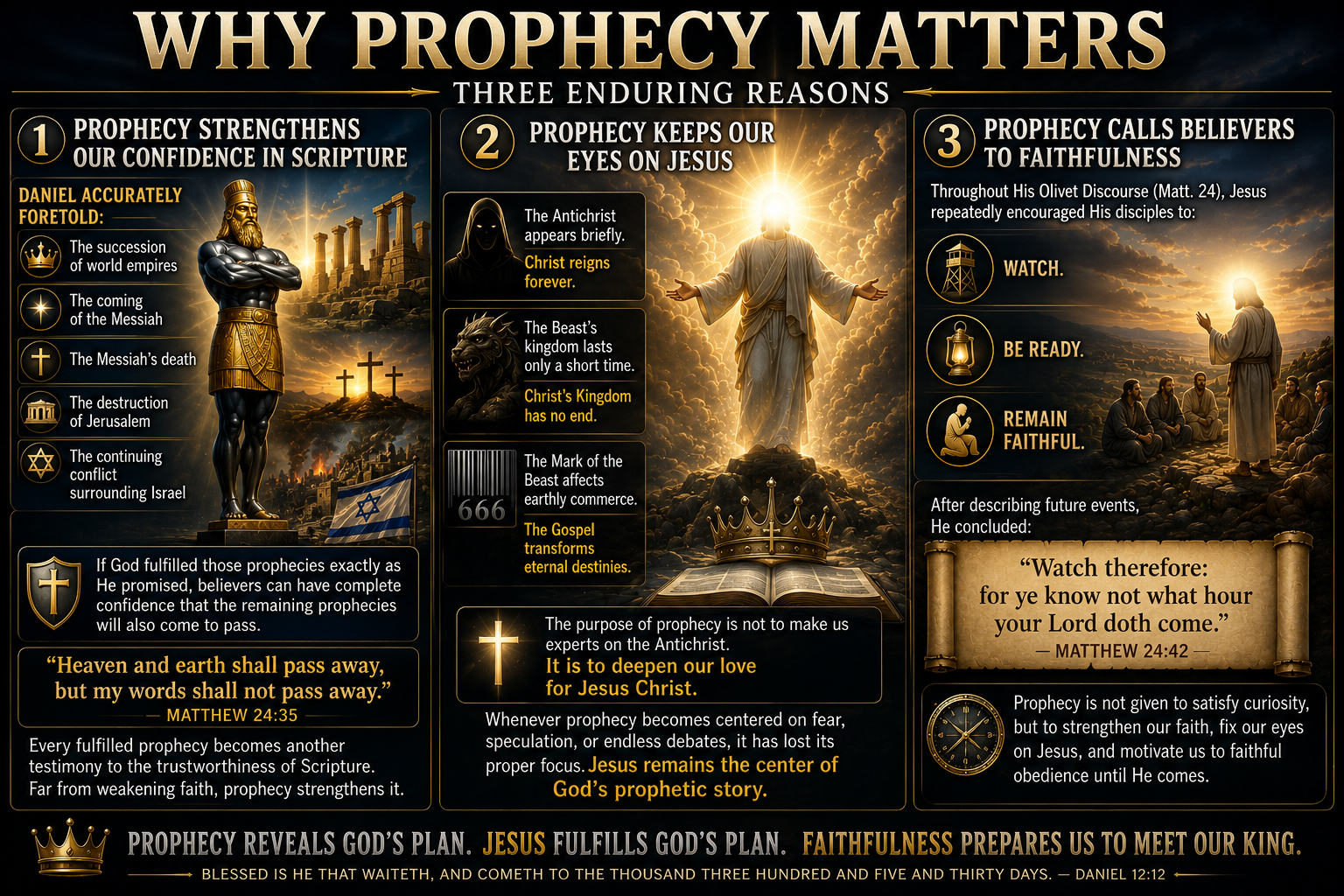
Watching does not mean living in fear.
Neither does it mean attempting to predict dates.
It means living each day in faithful obedience.
The believer who understands prophecy should become more committed to prayer.
More committed to holiness.
More committed to sharing the Gospel.
More committed to serving Christ faithfully until He returns.
Prophecy should never produce passivity.
It should produce perseverance, and ignite the church toward evangelism.
The Urgency of the Gospel
Perhaps the greatest practical lesson of the Final Seven Years is the urgency of the Gospel.
Daniel’s prophecy reminds us that history is moving toward a definite conclusion.
Jesus Christ will return
Every person will stand before Him.
The opportunity to respond to God’s grace will not continue indefinitely.
That reality should fill believers with compassion rather than fear.
The purpose is not to win prophetic arguments.
It is to point people to Jesus Christ while there is still time.
Jesus commissioned His followers:
“Go ye therefore, and teach all nations…” (Matthew 28:19)
That mission remains unchanged.
It is not time to sit the end-time harvest out, and allow the cares of this life and entertainment to steal our passion for the lost.
Whether Christ returns in our lifetime or generations from now, our calling is the same.
Proclaim the Gospel.
Make disciples.
Teach God’s Word.
Help people know the Savior.
Living With Hope Instead of Fear
Some people avoid studying Bible prophecy because they assume it is filled with frightening images of judgment and suffering.
Certainly, Scripture does not hide the seriousness of what lies ahead.
Yet the dominant message for believers is hope.
Paul concluded his teaching about the resurrection and Christ’s return by saying:
“Wherefore comfort one another with these words.” (1 Thessalonians 4:18)
Notice the word.
Comfort.
Not panic.
Not despair.
Comfort.
Our hope does not rest in political stability.
It does not rest in military strength.
It does not rest in economic prosperity.
It rests in the promise that Jesus Christ is coming again.
No matter how dark the world becomes, the story does not end with the Beast.
It ends with the King.
Frequently Asked Questions About the Final 7-Year Covenant
1. What begins the Final Seven Years?
According to Daniel 9:27, the Final Seven Years begin when the coming global ruler confirms a covenant with many for one prophetic week, or seven years.
He may not be revealed at the signing of this agreement, be he will be one of the participating signers.
Key Scriptures: Daniel 9:27
2. Is the Final 7-Year Covenant the same as a peace treaty?
The Bible never uses the expression peace treaty.
Daniel simply says the coming ruler confirms the covenant with many (Daniel 9:27). Many Bible teachers use the phrase “peace treaty” because the agreement appears to bring temporary stability involving Israel before it is broken. In modern vernacular, “peace treaties” are essentially like ancient “covenants.”
Key Scriptures: Daniel 9:27
3. Who confirms the covenant?
The coming prince of Daniel 9:26, identified elsewhere as the Antichrist, confirms the covenant. This understanding is based upon the immediate context of Daniel 9, Jesus’ future application of the Abomination of Desolation (Matthew 24:15), Paul’s description of the man of sin (2 Thessalonians 2), and Revelation’s portrayal of the Beast.
Key Scriptures: Daniel 9:26-27; Matthew 24:15; 2 Thessalonians 2:3-4; Revelation 13
4. Does the Bible say the covenant lasts exactly seven years?
Yes.
Daniel says the covenant is confirmed for one week, and throughout the prophecy a week represents seven years.
Key Scriptures: Daniel 9:24-27; Genesis 29:15-30 (key verse = Genesis 29:27)
5. When does the Great Tribulation begin?
Jesus places the Great Tribulation immediately after the Abomination of Desolation, which occurs at the midpoint of the seven-year covenant.
Key Scriptures: Matthew 24:15-21; Daniel 9:27
6. Is the Great Tribulation God’s wrath?
No. The Bible clearly distinguishes the Great Tribulation from God’s wrath.
The Great Tribulation is primarily the period of Satan’s wrath against God’s people (Revelation 12:12), while God’s wrath is poured out later in preparation for Christ’s return at the very end of the timing of the Great Tribulation.
The church is not subject to the wrath of God. The church has always be subjected to persecution and Satan’s wrath.
Key Scriptures: Revelation 12:12-17; Revelation 15-16; 1 Thessalonians 5:9
7. Must there be a Third Temple?
Based upon Daniel 9, Daniel 11, Matthew 24, 2 Thessalonians 2, and Revelation 11, a functioning Temple indeed must exist during the Final Seven Years.
Key Scriptures: Daniel 9:27; Matthew 24:15; 2 Thessalonians 2:4; Revelation 11:1-2
8. When does the Rapture occur?
The first resurrection (i.e., the Rapture) and gathering of believers to meet the Lord in the air (at Christ’s visible Second Coming), immediately follows the Great Tribulation, harmonizing Matthew 24:29-31, 1 Corinthians 15:51-52, 1 Thessalonians 4:16-17, 2 Thessalonians 2:1-4, and Revelation 20:4-6, 1 Corinthians 15:20-24 (key phrase “at His coming” = Second Coming, that is).
Key Scriptures: Matthew 24:29-31; 1 Thessalonians 4:16-17; Revelation 20:4-6
9. Why did God reveal these prophecies?
God gave prophecy to strengthen the faith of His people, reveal His sovereignty over history, encourage holy living, and point us toward Jesus Christ. It was impossible to understand all of these prophecies until recently in these latter times (Daniel 12:4, 9; Ezekiel 38:8).
Key Scriptures: John 14:29; Matthew 24:42; Revelation 19:10
10. What should Christians do while waiting for these events?
Believers should obey the Gospel (click here to learn more), remain faithful to Christ, study God’s Word, share the Gospel, encourage one another, and live with hopeful expectation of Christ’s return.
Key Scriptures: Matthew 28:19-20; Titus 2:11-14; Hebrews 10:23-25
Conclusion
Daniel’s prophecy of the Final Seven Years is far more than an isolated prediction about the end of the age. It is the closing chapter of God’s prophetic plan for Israel, the nations, and the world. Beginning with the confirmation of the covenant and culminating in the visible return of Jesus Christ, this remarkable prophecy provides the framework that unites many of the Bible’s most significant prophetic passages.
As we have seen, Daniel’s prophecy is confirmed and expanded by Jesus in the Olivet Discourse, explained further by the Apostle Paul, and brought to completion in the book of Revelation.
Together they reveal a consistent Prophetic Timeline:
A seven-year covenant, a rebuilt Temple, the Abomination of Desolation, the Great Tribulation, the rise of the Beast’s global and economic system (666), the gathering of the nations against Jerusalem at the battle of Armageddon, the rapture of the saints as the glorious return of Jesus Christ, and His subsequent thousand-year reign upon the earth.
Yet the greatest lesson of this prophecy is not the rise of the Antichrist, it is the triumph of Jesus Christ.
The Kingdom of God will never be destroyed.
The Final Seven Years remind us that history is not spinning out of control. It is moving exactly where God declared it would thousands of years ago. Every fulfilled prophecy strengthens our confidence that every remaining promise will also come to pass.
For believers, this should not produce fear.
It should produce confidence.
It should deepen our love for Scripture.
It should increase our urgency to share the Gospel.
And above all, it should strengthen our hope in the soon return of our LORD and Savior, Jesus Christ.
Whether these events unfold in our generation or in one yet to come, Jesus’ command remains the same:
“Watch therefore… be ye also ready.” (Matthew 24:42, 44)
The Cosmic King is coming.
May we be found faithfully proclaiming His Gospel, faithfully studying His Word, and faithfully looking for His glorious appearing.
How the Final 7-Year Covenant Fits into the Entire Biblical Story
One of the greatest mistakes people make when studying Bible prophecy is treating the Final Seven Years as though they stand alone.
They do not.
Daniel’s prophecy is one chapter in a much larger story that stretches from the opening pages of Genesis to the final chapters of Revelation.
The Bible is not a collection of disconnected prophecies.
It is one unified story of God’s redemptive plan.
When viewed through that lens, the Final Seven Years become much easier to understand.
They are not an interruption in God’s purposes.
They are the culmination of them.
It Begins with a Promise to Abraham
The prophetic story begins long before Daniel.
It begins with one man.
Abraham.
When God called Abram from Ur, He made a covenant that would shape the rest of biblical history.
He promised:
- A people.
- A land.
- A blessing that would ultimately extend to every nation (through Christ Jesus).
God declared:
“And I will make of thee a great nation… and in thee shall all families of the earth be blessed.” (Genesis 12:2-3)
Later He expanded that promise.
“Unto thy seed have I given this land…” (Genesis 15:18)
Nearly every major prophetic event in Scripture grows out of that covenant.
Israel exists because of it.
Jerusalem matters because of it.
The Messiah comes through it.
The future Kingdom fulfills it.
The Final Seven Years cannot be understood apart from God’s covenant with Abraham.
The Kingdom Promise to David
Centuries later, God made another covenant.
This time with King David.
God promised that one of David’s descendants would reign forever.
“And thine house and thy kingdom shall be established for ever before thee…” (2 Samuel 7:16)
At first glance, that promise seemed impossible.
Israel eventually lost her kingdom.
Jerusalem fell.
The monarchy ended.
Yet God had not forgotten.
The angel Gabriel later announced that Jesus would inherit David’s throne.
“The Lord God shall give unto him the throne of his father David.” (Luke 1:32)
Jesus’ first coming fulfilled the promise of the Messiah.
His Second Coming fulfills the promise of the Kingdom and His enthronement.
The Millennial Reign becomes the realization of God’s covenant with David.
Daniel Reveals God’s Prophetic Calendar
When Daniel received the prophecy of the Seventy Weeks, God was not creating a new plan.
He was revealing the timetable for completing the existing one.
Daniel learned that God’s covenant purposes would unfold through a carefully ordered sequence.
The Messiah would come.
The Messiah would be cut off (i.e., killed), but not for himself (as Jesus died for sinners).
Jerusalem would again be destroyed.
Then one final period of seven years would complete God’s prophetic program concerning Israel.
Daniel’s prophecy serves as the bridge between the Old Testament promises and their ultimate fulfillment.
Without Daniel 9, many later prophetic passages become much more difficult to understand.
With it, the prophetic timeline begins to take shape.
The First Coming Changed Everything
When Jesus entered history, He fulfilled hundreds of Old Testament prophecies.
He was born in Bethlehem.
He ministered in Galilee.
He entered Jerusalem.
He died for our sins.
He rose from the dead (on the third day).
He established the New Covenant through His blood.
The Cross stands at the center of human history.
Everything before it pointed forward.
Everything after it looks back (including the dating and calendar).
Yet Christ’s first coming did not complete every prophecy.
The prophets also foretold His future reign.
His judgment of the nations.
His restoration of Israel.
His everlasting Kingdom.
Even as the first 4 feasts trumpeted the foreshadowing of Christ’s first coming, even so the final 3 feasts foreshadow His Second Coming.
Those promises still await fulfillment.
The Church Age
Following Christ’s resurrection and ascension, the Gospel began spreading throughout the world.
People from every nation, tribe, language, and background have been invited into God’s family through faith in Jesus Christ, and obedience to His saving Gospel.
This present age demonstrates God’s extraordinary grace.
The Gospel is proclaimed freely.
Paul explained that during this period, God’s saving work extends to both Jew and Gentile alike through Christ (Ephesians 2:11-22).
This does not mean God has abandoned His promises to Israel.
Rather, as Paul explains in Romans 11, Israel’s present hardening is partial and temporary while God gathers a people for His name from among the nations.
The Church Age is therefore not an interruption of God’s purposes.
It is part of His purposes. And God has not forsaken Israel today, so we would do well to support Israel until Christ’s return.
In fact, the very reason God returns to earth at Armageddon, is to stand up for and fight on behalf of the nation of Israel. At Armageddon, God is angered by the nations seeking to annihilate Israel; thus God returns to save the nation of Israel and perform His promise of protection (Ezekiel 38:18).
The Final Seven Years Complete God’s Prophetic Program
Daniel’s seventieth week marks the resumption of God’s prophetic focus upon Israel and Jerusalem.
The covenant is confirmed.
The Temple is rebuilt.
The sacrifices resume.
The Abomination of Desolation occurs.
The Great Tribulation begins.
The Beast establishes his global system.
The nations gather against Jerusalem.
Everything moves toward one unavoidable conclusion.
The Return of Jesus Christ
Rather than standing apart from the biblical story, these events complete the prophetic framework Daniel first received from Gabriel.
The King Returns
Every covenant now begins reaching its fulfillment.
The promised Seed of Abraham returns.
David’s greater Son ascends His throne.
The Stone cut without hands destroys every human kingdom.
The Son of Man receives everlasting dominion.
The Messiah whom Israel rejected returns as the Conquering King whom every nation will acknowledge.
The prophets spoke of this day repeatedly.
Isaiah saw it.
Zechariah anticipated it.
Daniel described it.
Jesus promised it.
John witnessed it.
History has always been moving toward this moment. We get to see the culmination of it all.
The Kingdom Restores What Sin Destroyed
The Millennial Reign demonstrates what humanity has never been able to accomplish on its own.
Perfect government.
Perfect justice.
Perfect righteousness.
Peace flows from Jerusalem.
The nations learn God’s ways.
Israel is restored.
The saints reign with Christ.
Satan is bound.
The curse begins to recede.
Everything points toward God’s original purpose for creation.
The Kingdom is not God’s “Plan B.”
It has always been His destination.
We are on the pathway to Eternal Life.
The Story Ends Where It Began
The Bible opens in a garden.
Humanity walks with God.
Sin enters.
Death follows.
The remainder of Scripture tells the story of God’s work to redeem what was lost.
The Bible closes with a new heaven and a new earth.
Once again:
God dwells with His people.
Sin is gone.
Death is defeated.
The curse is removed.
The Tree of Life appears once more.
The story comes full circle. The culmination of the biblical meta-narrative arrives.
The Final Seven Years are therefore not the end of God’s story.
They are the final chapter before eternity begins.
If you haven’t already, it is time for you to “be ready.”
Timeline of the Final 7-Year Covenant
| Timeline Event | Primary Scripture | What Happens |
|---|---|---|
| The Covenant is Confirmed | Daniel 9:27 | A coming world leader confirms a covenant with many, beginning Daniel’s final seven-year period. |
| The First Three and One-Half Years | Daniel 9:27 | A period of relative peace follows. Israel remains in the land, Temple worship resumes, and the Antichrist rises in global influence. |
| The Third Temple Functions | Daniel 9:27; Revelation 11:1-2 | Daily sacrifices are offered once again in Jerusalem. |
| The Midpoint | Daniel 9:27 | The Antichrist breaks the covenant, stops the sacrifices, and commits the Abomination of Desolation. |
| The Great Tribulation Begins | Matthew 24:15-21; Revelation 12 | Satan’s wrath intensifies against Israel and believers. Israel flees to a place prepared by God. |
| The Beast’s Global System Expands | Revelation 13 | The Antichrist and False Prophet establish worldwide political, religious, and economic control. |
| The Mark of the Beast is Enforced | Revelation 13:16-18 | Economic participation becomes dependent upon allegiance to the Beast’s system. |
| The Two Witnesses Prophesy | Revelation 11 | God raises two prophetic witnesses who boldly proclaim His truth during this period. |
| The Nations Gather Against Jerusalem | Zechariah 14; Revelation 16 | Military forces converge for the final conflict known as Armageddon. |
| Jesus Christ Returns | Matthew 24:29-31 | Christ returns visibly in the sky with power and great glory |
| The First Resurrection | 1 Corinthians 15:20-23; 1 Thessalonians 4:16-17 | When He returns, the dead in Christ are raised and transformed first and living believers are transformed moments later; both are gathered to meet the Lord in the air on that day, then head towards the marriage supper and Armageddon. |
| The Millennial Kingdom Begins | Revelation 19
Revelation 20 |
Antichrist and False Prophet are destroyed at Armageddon, Satan is bound, Christ reigns from Jerusalem, and the saints reign with Him for one thousand years. |
This timeline demonstrates the remarkable harmony between Daniel, the Gospels, Paul’s letters, and the book of Revelation. Rather than presenting competing prophetic systems, these passages provide complementary perspectives on the same climactic period in God’s redemptive plan.
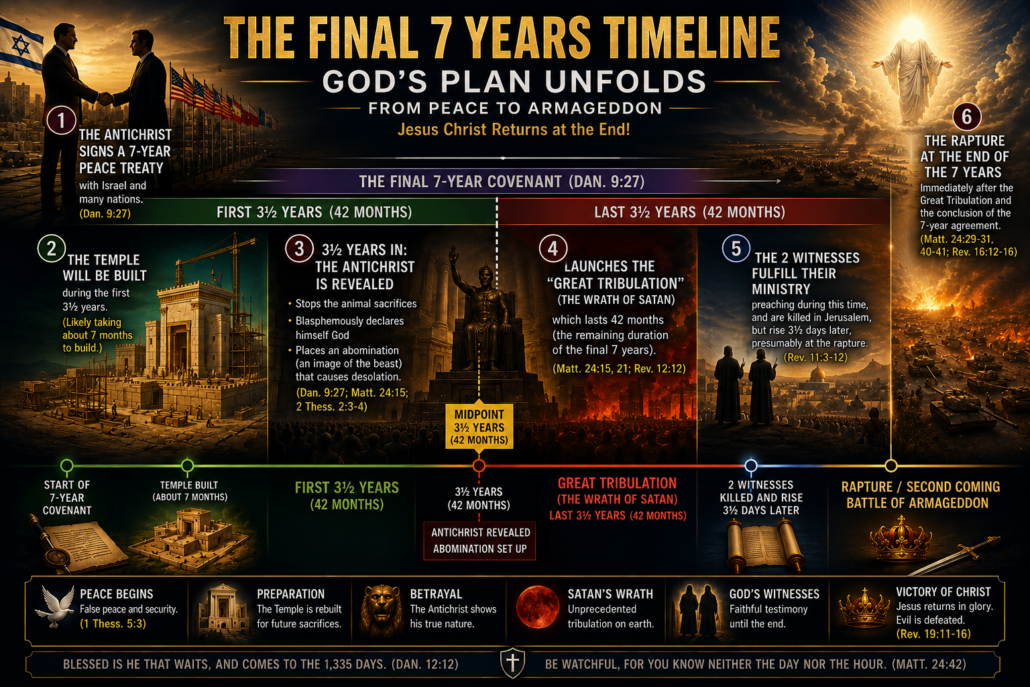
Bibliography
Primary Source
- The Holy Bible, King James Version. Public Domain.
- Unless otherwise noted, all Scripture quotations are taken from the King James Version (KJV). Historical and contextual comparisons have been made with the English Standard Version (ESV), New American Standard Bible (NASB 1995), and New International Version (NIV) where helpful for clarity.
Bible Dictionaries and Reference Works
- Bromiley, Geoffrey W., ed. The International Standard Bible Encyclopedia. Revised Edition. Grand Rapids, MI: William B. Eerdmans Publishing.
- Douglas, J. D., and others, eds. New Bible Dictionary. 3rd ed. Downers Grove, IL: InterVarsity Press.
- Elwell, Walter A., ed. Baker Encyclopedia of the Bible. Grand Rapids, MI: Baker Book House.
- Barry, John D., et al., eds. Lexham Bible Dictionary. Bellingham, WA: Lexham Press.
- BibleGateway. “Encyclopedia of the Bible: Seventy Weeks.” https://www.biblegateway.com/resources/encyclopedia-of-the-bible/Seventy-Weeks
Historical Sources
- Josephus. The Jewish War. Translated by G. A. Williamson. Revised Edition. London: Penguin Classics.
- Josephus. Antiquities of the Jews. Translated by William Whiston.
Biblical History and Archaeology
- The Temple Institute. “Temple Research and Preparation.” https://templeinstitute.org
- Israel Antiquities Authority. https://www.antiquities.org.il
About the Author
 Bryan Smith serves as Content & Teaching Pastor at Endtime Ministries and has been part of the Endtime family for more than 25 years. He has been engaged in pastoral ministry for two decades, served as Academic Dean, Registrar, and Professor for Valor University, and is a frequent teacher of the Understanding the End Time class. Bryan holds a Bachelor of Arts (B.A.) in Theology, a Master of Arts (M.A.) in Leadership, has completed advanced studies in the history of prophecy through HarvardX’s certificate program with Harvard University, and is pursuing a Doctor of Ministry (D.Min.) in Biblical Studies. In addition to hosting The Bible Prophecy Show podcast, Bryan is a regular contributor to Endtime magazine and writes on the intersection of Bible prophecy, theology, and global current events.