
More Nations Join Middle East Conflict
By Bryan Smith
As additional nations signal their willingness to help secure the Persian Gulf, the conflict surrounding Iran is taking on an increasingly international character, raising concerns about regional stability and the possibility of wider war.
The growing crisis in the Middle East is drawing new international participants.
Several European allies, along with Japan, have indicated they are prepared to help protect commercial shipping through the Strait of Hormuz following continued attacks on merchant vessels and heightened tensions involving Iran. Their willingness to contribute to maritime security reflects growing concern that instability in one of the world’s most vital waterways could have consequences far beyond the region.
The announcement comes as fighting between the United States and Iran continues to evolve. Although leaders have periodically expressed interest in de-escalation, military operations and retaliatory threats have kept the region on edge. The latest developments suggest that what began as a regional confrontation is increasingly becoming an international security concern.
What Happened?
The Strait of Hormuz is one of the world’s most strategically significant maritime chokepoints. Nearly one-fifth of the world’s seaborne oil supply passes through the narrow waterway connecting the Persian Gulf with the Gulf of Oman. Any disruption to commercial traffic can quickly affect global energy prices, inflation, supply chains, and financial markets.
Recent attacks on commercial vessels and continued threats from Iran prompted renewed efforts to safeguard international shipping. In response, the United Kingdom, France, Germany, Italy, the Netherlands, and Japan have signaled their readiness to support operations aimed at preserving freedom of navigation through the strait.
While details regarding each nation’s level of involvement have not been finalized, the announcement demonstrates a growing consensus among America’s allies that the security of the Strait of Hormuz is an international concern rather than simply a regional dispute.
The coalition’s willingness to participate follows weeks of escalating military activity. American forces have conducted strikes against Iranian military infrastructure after repeated threats to international shipping, while Iranian officials have warned they will continue responding to what they view as foreign aggression.
Although diplomatic channels remain open, military planners throughout the region continue preparing for the possibility of additional escalation.
Why This Matters
This development is significant because it broadens the scope of the conflict.
As more nations become directly involved in protecting trade routes or supporting military operations, the possibility increases that future incidents could involve multiple countries rather than only Iran and the United States.
From an economic standpoint, the stakes are enormous.
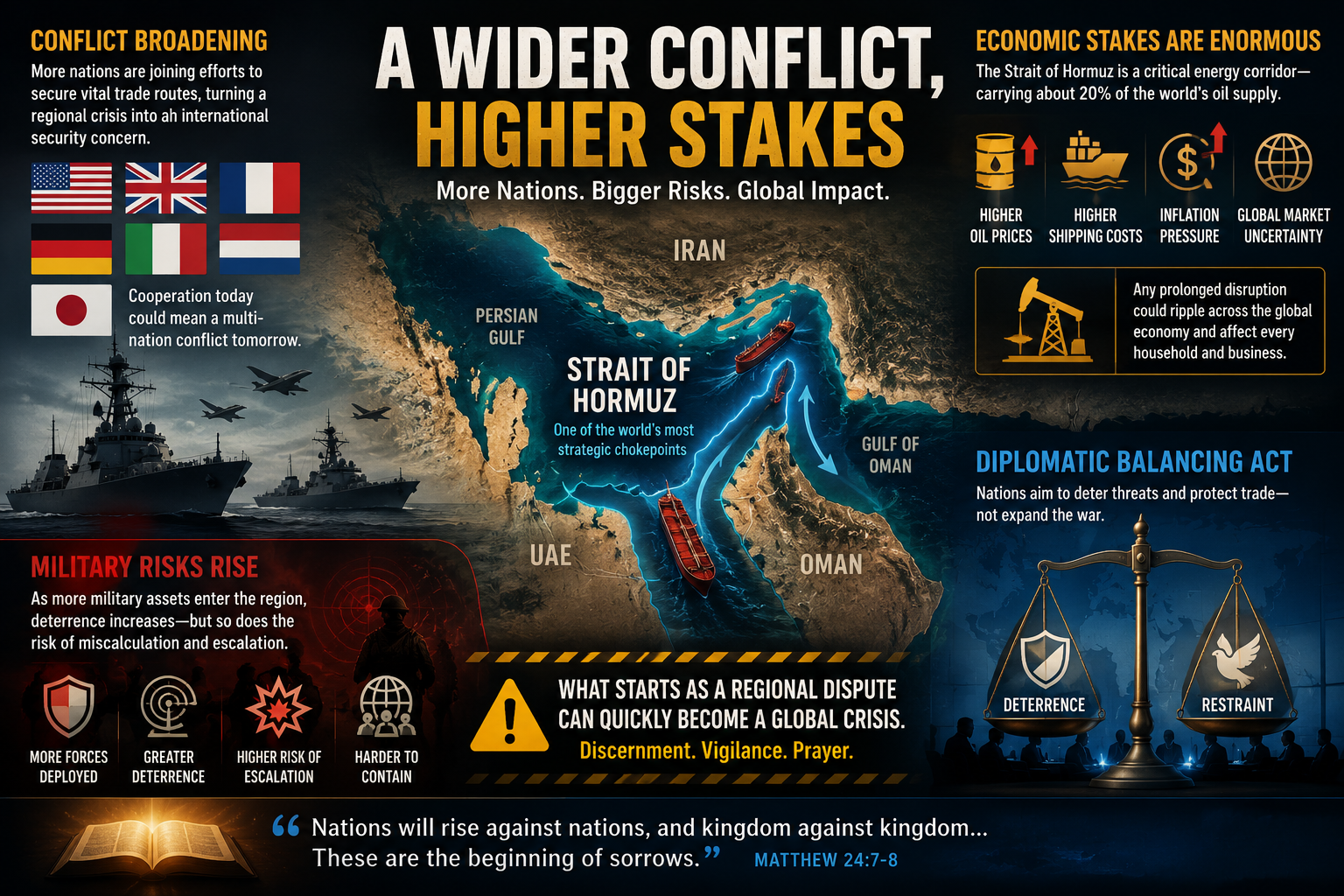
The Strait of Hormuz serves as one of the world’s most important energy corridors. Any prolonged disruption could drive oil prices higher, increase transportation costs, fuel inflation, and create uncertainty across international markets.
Militarily, multinational participation also changes the strategic landscape. A conflict involving several allied nations becomes far more difficult to contain than one limited to two opposing countries. Every additional military asset deployed into the region increases both deterrence and the possibility of unintended escalation.
Diplomatically, governments are attempting to balance deterrence with restraint. Most participating nations emphasize that their objective is protecting international commerce rather than expanding the conflict. Nevertheless, history demonstrates how quickly regional confrontations can widen once multiple nations become engaged.
Prophetic Perspective
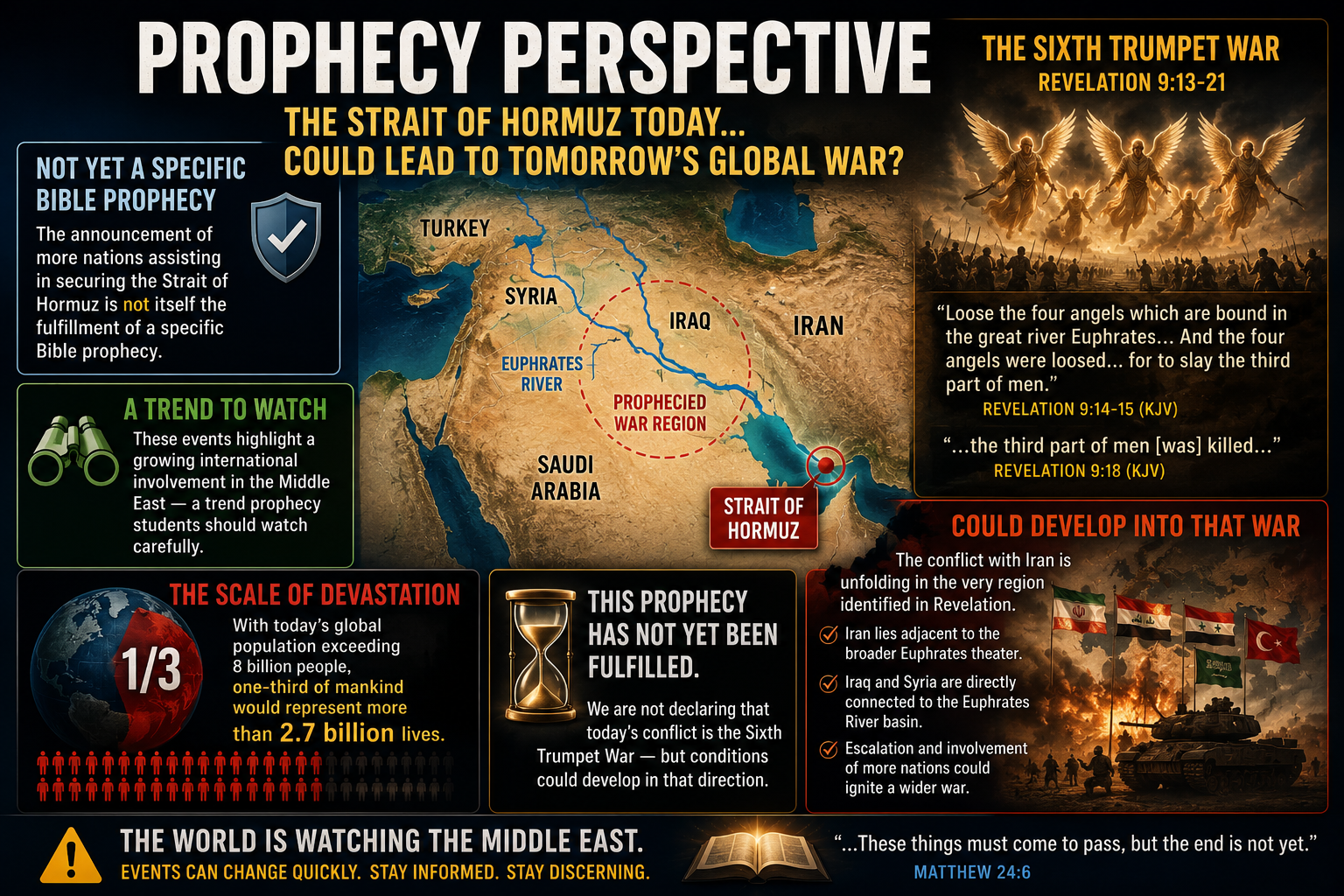
The announcement that additional nations are preparing to assist in securing the Strait of Hormuz is not itself the fulfillment of a specific Bible prophecy.
However, it does highlight a trend that students of Bible prophecy should watch carefully.
One of the clearest end time prophecies concerning global warfare is found in Revelation 9:13-21. During the sounding of the sixth trumpet, John describes a catastrophic war centered in the region of the Euphrates River.
“Loose the four angels which are bound in the great river Euphrates… And the four angels were loosed… for to slay the third part of men.” (Revelation 9:14-15, KJV)
The prophecy continues by describing an army of extraordinary size and the devastating loss of human life.
“…the third part of men [was] killed…” (Revelation 9:18, KJV)
With today’s global population exceeding eight billion people, one-third of mankind would represent more than 2.7 billion lives.
This prophecy has not yet been fulfilled.
From a prophetic perspective, this conflict with Iran does not yet appear as being the Sixth Trumpet War. However, it is unfolding in the very region identified in Revelation, and could develop into that war. Iran lies adjacent to the broader Euphrates theater, and neighboring nations such as Iraq and Syria are directly connected to the Euphrates River basin.
As additional countries become involved, the possibility of a much larger regional war naturally increases. What is presently a conflict involving Iran, the United States, and a growing coalition of allies could, if left unchecked, expand into a multinational confrontation involving many of the very nations that operate throughout the Middle East today.
Scripture does not identify the precise political event that ignites the Sixth Trumpet War. Therefore, it would be irresponsible to claim that the current conflict is that war.
Yet it is entirely reasonable to observe that the present trajectory mirrors the kind of escalation that could eventually lead to the fulfillment of Revelation 9. A localized conflict becoming an international war is precisely the type of development Bible students have long recognized as a possible precursor to this prophecy.
For that reason, believers should neither ignore these headlines nor conclude that every military exchange fulfills prophecy. Instead, they should watch with discernment, recognizing that today’s events may be helping set the stage for tomorrow’s prophetic fulfillment.
What Bible Prophecy Students Should Watch
Watch whether additional nations become directly involved in military operations instead of limiting their role to protecting commercial shipping.
Monitor activity surrounding Iraq and Syria, particularly the Euphrates River region described in Revelation 9.
Observe whether regional powers such as Turkey, Russia, China, or additional Middle Eastern nations become active participants in the conflict.
Continue watching efforts toward Middle East diplomacy. While today’s conflict does not begin Daniel’s Seventieth Week, major regional wars often reshape political alliances and create new diplomatic opportunities.
Above all, remember that prophecy is given to build faith, not fear. God’s Word provides confidence that history is moving according to His sovereign plan.
Final Thought
The Middle East has long stood at the crossroads of biblical prophecy, and today’s headlines remind us why the region continues to command the world’s attention.
Whether the present conflict subsides or expands, Christians should remain spiritually alert and biblically grounded. Revelation foretells a future war of unprecedented magnitude centered near the Euphrates River. While today’s events are not yet that prophesied conflict, they underscore how quickly the conditions for such a war can develop when more nations are drawn into the struggle.
Rather than reacting with anxiety, believers can respond with confidence, knowing that God declared the end from the beginning. As world events continue to unfold, Scripture remains the surest guide for understanding both the present and the future.
Sources
https://www.msn.com/en-us/news/other/us-iran-strikes-latest-developments/ar-AA28wmW7
About the Author
 Bryan Smith serves as Content & Teaching Pastor at Endtime Ministries and has been part of the Endtime family for more than 25 years. He has been engaged in pastoral ministry for two decades, served as Academic Dean, Registrar, and Professor for Valor University, and is a frequent teacher of the Understanding the End Time class. Bryan holds a Bachelor of Arts (B.A.) in Theology, a Master of Arts (M.A.) in Leadership, has completed advanced studies in the history of prophecy through HarvardX’s certificate program with Harvard University, and is pursuing a Doctor of Ministry (D.Min.) in Biblical Studies. In addition to hosting The Bible Prophecy Show podcast, Bryan is a regular contributor to Endtime magazine and writes on the intersection of Bible prophecy, theology, and global current events.