
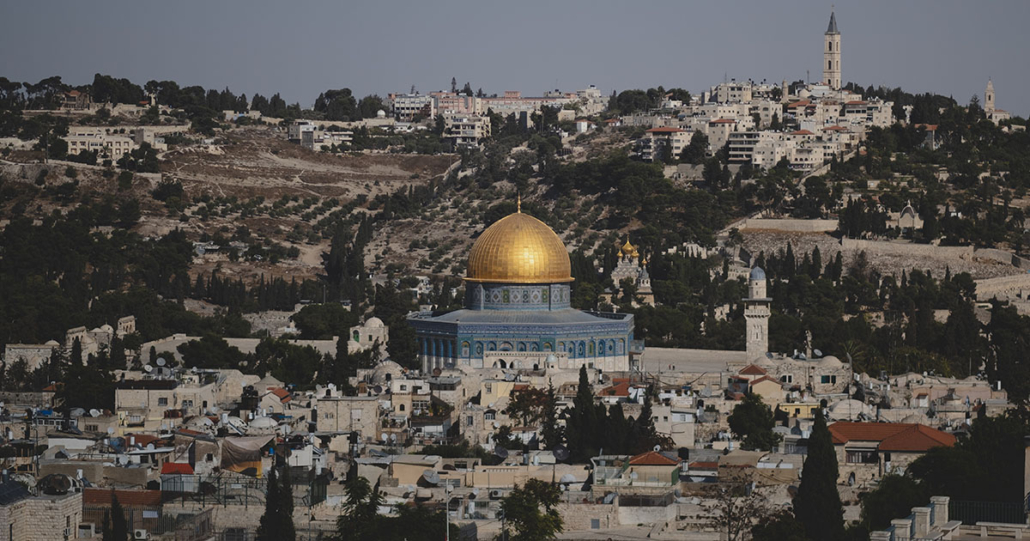
Temple Mount Worship Practices Continue to Shift
Changes at Jerusalem’s most contested holy site are fueling debate over religious freedom, regional stability, and the future of Bible prophecy.
By Bryan Smith
Jerusalem’s Temple Mount, the most sacred site in Judaism and one of Islam’s holiest locations, has once again become the focus of international attention as longstanding restrictions on Jewish prayer continue to loosen.
Recent reports indicate that Jewish worshippers are increasingly being permitted to pray openly on the Temple Mount under Israeli police supervision, marking a significant departure from policies that have largely governed the site since Israel captured Jerusalem’s Old City during the Six-Day War in 1967. While Israeli officials maintain that the official “status quo” remains unchanged, developments on the ground have led many observers to question whether a historic shift is already underway.
For Christians who study Bible prophecy, any change involving Jerusalem and the Temple Mount naturally raises important questions. Is this a fulfillment of prophecy? Does it signal movement toward a future Third Temple? And what should believers make of these developments?
What Happened?
For nearly six decades, the Temple Mount has operated under a delicate arrangement often referred to as the “status quo.”
Following Israel’s victory in the 1967 Six-Day War, then-Defense Minister Moshe Dayan allowed the Islamic Waqf, a Jordanian-administered religious authority, to retain day-to-day control over the site while Israel maintained overall security responsibility. Under that arrangement, Muslims were permitted to worship freely at the Al-Aqsa Mosque and Dome of the Rock, while Jews and other visitors could visit the site but were generally prohibited from praying there.
In recent months, however, numerous reports have documented what many observers describe as a practical change in enforcement.
Israeli police have reportedly allowed Jewish visitors to pray openly in certain areas of the compound. In January, authorities permitted Jewish visitors to bring prayer sheets onto the Temple Mount for the first time. Additional reports have described worshippers singing, bowing, and engaging in prayer without intervention from police officers.
Jewish visitation to the site has also increased dramatically. According to reports, more than 68,000 Jews visited the Temple Mount during the previous Hebrew year, representing substantial growth compared to prior years.
At the same time, these developments have generated concern among Muslim leaders, Jordanian officials, and Palestinians, many of whom view expanded Jewish prayer rights as a violation of longstanding agreements governing the holy site. Critics warn that alterations to the status quo have historically triggered unrest and could once again inflame regional tensions.
The debate intensified further this year as Israeli officials and activists openly discussed greater Jewish access to the site and future possibilities for expanded worship arrangements.
Why This Matters
The Temple Mount is far more than a religious landmark; it is the place where God said numerous times throughout the biblical corpus that He would put His name.
It sits at the center of some of the most sensitive political, diplomatic, and security issues in the Middle East.
For Israel, expanded Jewish access is viewed by many as a matter of religious liberty and national identity. For Palestinians and much of the Muslim world, any perceived change to the site’s governance raises fears about the future of Islamic control over one of Islam’s holiest locations (their 3rd holiest site).
Jordan, which maintains a special custodial role over Islamic holy sites in Jerusalem, has repeatedly objected to actions that appear to alter existing arrangements. Regional governments closely monitor developments on the Temple Mount because tensions there have often spilled beyond Jerusalem and affected broader Middle East stability.
Historically, disputes surrounding the Temple Mount have contributed to major outbreaks of violence and political unrest. As a result, even seemingly small changes are often viewed as significant geopolitical events.
The site remains one of the most sensitive flashpoints in the world, where religion, politics, history, and national aspirations intersect.
Prophetic Perspective
From a biblical and prophetic perspective, these developments deserve attention, but they should be viewed with discernment and caution.
Expanded Jewish prayer on the Temple Mount is not, by itself, a direct fulfillment of Bible prophecy.
Scripture does not predict a specific event in which Jewish prayer rights are restored to the Temple Mount. Therefore, believers should avoid declaring that current developments constitute a definitive prophetic fulfillment.
However, these developments may be contributing to conditions that align with future prophetic expectations. Several biblical passages indicate that a Jewish temple will play a role in end-time events.
Daniel 9:27 references sacrifices and offerings being stopped.
Jesus referred to the “abomination of desolation” spoken of by Daniel in Matthew 24:15. That specific event occurs on the Temple Mount, where the Antichrist walks into a newly rebuilt 3rd Jewish Temple, stops the animals sacrifices (that will have been resumed) and lies to the world as he falsely claims to be God.
The Apostle Paul described this same event labeling the Antichrist as the “man of sin” sitting in the temple of God in 2 Thessalonians 2:3-4. Well, you cannot sit in a temple that does not exist. Therefore, conditions atop the Temple Mount (which today would not allow for a 3rd Jewish Temple to be built) must change. Changes like those noted in this article reveal prophetic movement toward ultimate fulfillment.
Revelation 11:1-2 also references a temple in Jerusalem during the final prophetic period.
Because these passages appear to involve a functioning temple, many prophecy scholars believe some form of Jewish worship and temple must eventually be restored before those prophecies can be completely fulfilled.
What we are witnessing today may be another example of Jerusalem moving closer to the center of global attention.
While the Bible does not provide a detailed timetable connecting today’s Temple Mount developments to future prophetic milestones, it certainly appears to be pointing us in the direction of prophetic fulfillment. While expanded Jewish prayer could contribute to an environment in which future prophetic events become possible, it should not be confused with the fulfillment of those events themselves.
The proper response is neither excitement-driven speculation nor dismissive skepticism. Instead, believers should watch carefully while remaining anchored in Scripture.
What Bible Prophecy Students Should Watch
Several developments deserve ongoing attention:
- Whether Jewish prayer continues to become normalized on the Temple Mount.
- Any formal changes to the administration or governance of the site.
- Responses from Jordan, Palestinian leaders, and neighboring Arab nations.
- Increased discussion regarding Jewish worship facilities or temple-related preparations.
- International diplomatic efforts involving Jerusalem and its holy sites.
- Growing global attention focused on Jerusalem as a source of geopolitical tension.
None of these developments would automatically constitute prophetic fulfillment themselves.
However, together they could help shape conditions that influence future prophetic events described in Scripture.
Final Thought
The Temple Mount has been a focal point of faith, conflict, and prophecy for thousands of years. As developments continue to unfold, believers should resist the temptation to react emotionally or jump to prophetic conclusions.
Instead, Jesus instructed His followers to watch, pray, and remain spiritually prepared.
Current events may remind us that Jerusalem remains central to God’s prophetic plan, but our confidence is not in political developments or headlines. Our confidence is in the sovereignty of God and the certainty of His Word.
Regardless of how events unfold, Scripture assures us that God’s purposes will prevail.
About the Author
 Bryan Smith serves as Content & Teaching Pastor at Endtime Ministries and has been part of the Endtime family for more than 25 years. He has been engaged in pastoral ministry for two decades, served as Academic Dean, Registrar, and Professor for Valor University, and is a frequent teacher of the Understanding the End Time class. Bryan holds a Bachelor of Arts (B.A.) in Theology, a Master of Arts (M.A.) in Leadership, has completed advanced studies in the history of prophecy through HarvardX’s certificate program with Harvard University, and is pursuing a Doctor of Ministry (D.Min.) in Biblical Studies. In addition to hosting The Bible Prophecy Show podcast, Bryan is a regular contributor to Endtime magazine and writes on the intersection of Bible prophecy, theology, and global current events.