
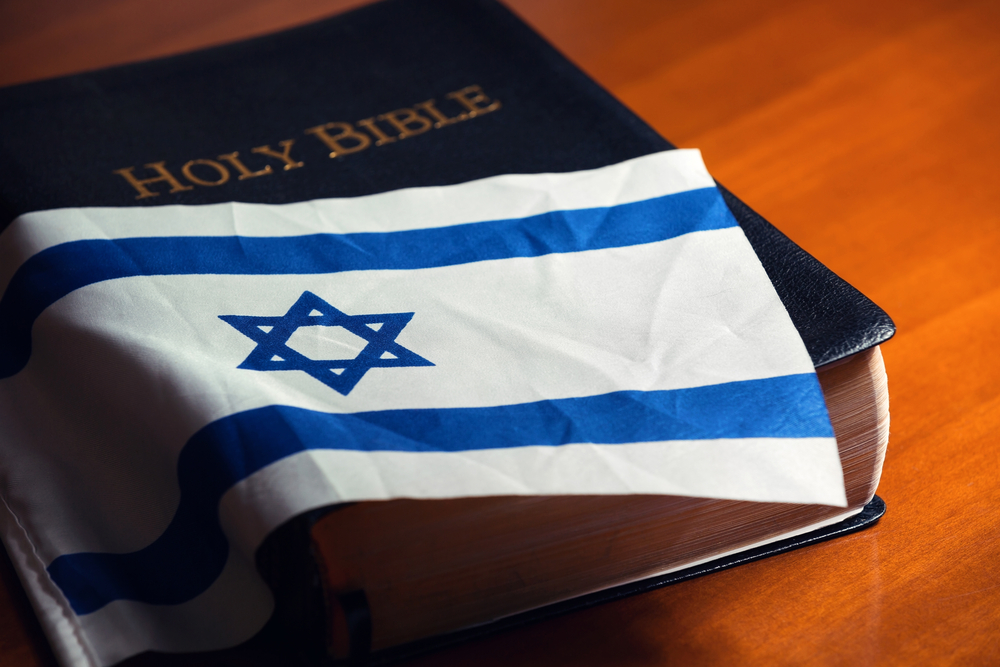
They Opened Their Bible: Why Christians Stand With Israel
“They Opened Their Bible”: Why Christians Stand With Israel
 A question is making the rounds again — in studios, on social feeds and across kitchen tables in America: Why should Christians support Israel?
On a recent episode of The Endtime Show, host Dave Robbins put it plainly to Israeli communicator Hananya Naftali, a member of Prime Minister Benjamin Netanyahu’s social media team. If a skeptical interviewer asked why Christians — or anyone — should back Israel, what would you say?
Naftali’s answer didn’t start with polling data, partisan talking points or a public relations pitch.
It started with a sentence that landed like a headline:
“They opened their Bible.”
That’s the dividing line in this debate. Many voices frame Israel as a political cause. Endtime Ministries has never hidden its position: our support for Israel is rooted first in Scripture — not slogans.
A biblical position — not a blind endorsement
Robbins made an important distinction that many critics overlook. Supporting Israel does not mean approving every policy decision of the Israeli government.
“I don’t give Israel a green light to do whatever,” Robbins said. “I don’t agree with every decision they make. However, I support Israel.”
Why? Because God tied a promise to Abraham that still echoes through history:
“I will bless them that bless you, and I will curse them that curse you.”
That isn’t a modern political invention. It’s an ancient covenant — and for Bible-believing Christians, it’s a landmark in how we understand God’s plan in the earth.
Cutting through the fog of war — and the fog of propaganda
The conversation turned quickly to the Gaza war and the claims that have flooded headlines and timelines. One accusation rises to the top again and again: that Israel is committing genocide and deliberately targeting civilians.
Naftali, who said he served in the Israeli military, rejected that characterization and argued that the Israel Defense Forces’ objectives are aimed at Hamas — not civilians. He described warfare as tragic and ugly but insisted the intent matters, especially when the enemy “cynically uses its own people.”
He also challenged the credibility of casualty reporting he said is commonly sourced from authorities in Gaza run by Hamas, arguing those numbers are used as a weapon in the information war.
Whether people recognize it or not, this conflict is fought on two fronts: on the ground — and in the narrative.
And narratives can move faster than facts.
As Naftali put it: lies spread fast. But truth has roots.
“Trucks as far as your eyes can see”
Another claim Robbins raised is familiar: that Israel has blocked humanitarian aid into Gaza.
Naftali recounted visiting a border crossing to observe aid deliveries firsthand. He said a pool of journalists from major outlets received the same briefing and viewed the same scene — a long line of trucks waiting to enter.
But, he said, coverage from some reporters framed the scene as insufficient or minimized what was visible on the ground.
That contrast is exactly why Endtime Ministries exists: to challenge convenient talking points with inconvenient facts — and to evaluate events through a biblical lens rather than a political agenda.
Not taking a side — taking a stand
The most quoted moment of the interview may be the simplest:
“When Christians speak up for Israel, they’re not taking a side — they’re taking a stand.”
A stand for what?
-
A stand for the Bible.
-
A stand for God’s faithfulness.
-
A stand against modern anti-Semitism, even when it’s repackaged as “acceptable” cultural commentary.
Naftali argued that hatred toward Israel often reveals something deeper — a persistent hostility toward the Jewish people that did not die in the 20th century, but merely changed its clothes.
Robbins added the Endtime perspective: there is a spiritual dimension to this conflict. Jerusalem is not just a piece of contested real estate. The Bible records God placing His name there repeatedly — and Scripture makes clear that what happens in Jerusalem will matter in the final chapter of human history.
The UN, history and the fight over legitimacy
The interview also touched on international pressure — including U.N. Resolution 2334 (2016), which declares Israel’s presence in East Jerusalem and the West Bank a violation of international law.
Naftali dismissed attempts to erase Jewish history in the land and argued that “facts on the ground” and ancient roots cannot be voted out of existence.
Robbins emphasized that Endtime’s perspective ultimately comes back to Scripture: arguments may shift, but the Bible’s framework does not.
The U.S.-Israel alliance and a prophecy lens
Robbins also discussed America’s unique relationship with Israel, pointing to passages he believes foreshadow that alliance. He described the relationship not merely as diplomatic, but as something with prophetic implications.
Naftali expressed gratitude for American support, arguing that alliances matter in a world where adversaries are actively building their own networks of influence. He warned against movements that want to isolate America and weaken support for Israel, while encouraging believers to stay rooted in Scripture — especially as the Bible foretells growing global pressure against Israel in the last days.
And then came a direct rebuttal to a popular modern teaching making its way through churches: replacement theology — the idea that God is finished with Israel.
Naftali’s response was blunt and pastoral:
If you believe God changed His mind about Israel, how can you trust His promises to you?
Romans 11 answers clearly: God has not rejected His people.
Peace — and the Prince of Peace
Near the end, the discussion turned to diplomacy, Saudi Arabia and the Abraham Accords — and whether a pathway toward a Palestinian state might be demanded as the price of normalization.
Naftali said he believes Israelis broadly oppose a Palestinian state and that any arrangement must protect Israel’s security, insisting peace cannot come at the cost of survival. Robbins agreed — and added Endtime’s conviction that true peace will not arrive through human negotiation alone.
Ultimately, peace in the Middle East will come when the Prince of Peace returns.
Until then, believers must think clearly, pray consistently and refuse to be discipled by propaganda.
What Endtime is asking you to do
Naftali’s closing message to the Endtime audience was simple and urgent:
Keep praying for Israel.
Friends reveal themselves in crisis, not comfort. And if you’re wondering where to begin amid the noise, start where he started:
Open your Bible.
Because when Christians stand with Israel, we’re not joining a trend.
We’re taking a stand — for truth, for Scripture, and for a God who keeps His promises all the way to the end.